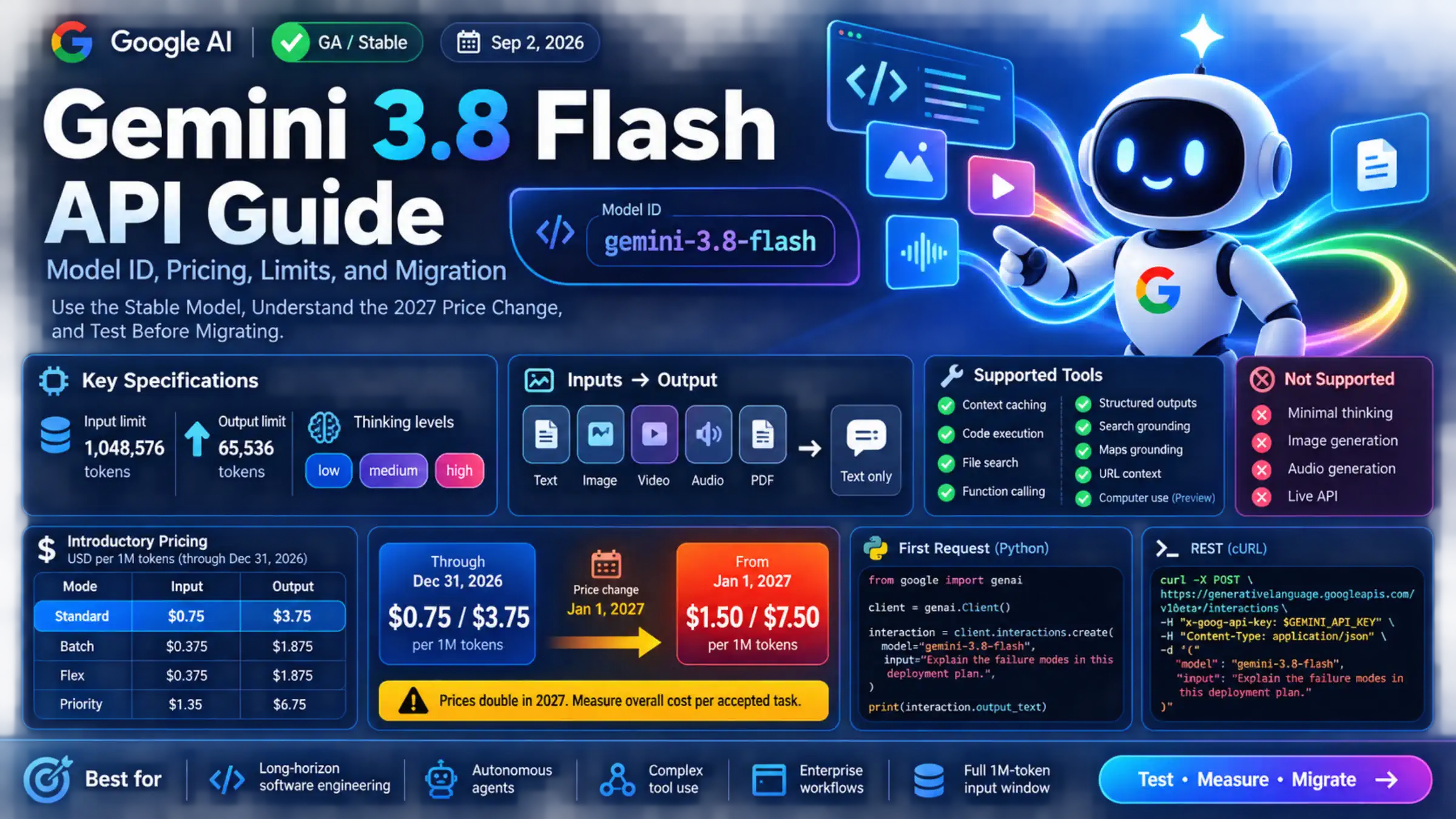
Google released Gemini 3.8 Flash to general availability on September 2, 2026. The exact Gemini Developer API model ID is gemini-3.8-flash. Google positions it as its most intelligent Flash model for long-horizon software engineering, autonomous agents, and complex enterprise workflows.
That makes 3.8 worth evaluating for these workloads; it does not establish that every existing integration will benefit. Its standard introductory price matches 3.6 Flash through the end of 2026, then doubles on January 1, 2027. Evaluate both quality and cost per accepted task before moving a working integration.
Since October 8, 2026, Google also routes every request sent to the deprecated gemini-3.7-flash to gemini-3.8-flash (release notes). If your code still names 3.7 Flash, it is already running on 3.8 Flash.
Gemini 3.8 Flash specifications
The official model page lists these specifications:
| Property | Gemini 3.8 Flash |
|---|---|
| Model ID | gemini-3.8-flash |
| Lifecycle | Stable / GA |
| Inputs | Text, image, video, audio, PDF |
| Output | Text |
| Input limit | 1,048,576 tokens |
| Output limit | 65,536 tokens |
| Thinking levels | low, medium, high |
| Service modes | Standard, Batch, Flex, Priority |
The output type is important: Gemini 3.8 Flash can understand media, but it does not generate images or audio. It is also not a Live API model. Use a dedicated image, speech, or Live model when the result must be media or a real-time audio stream.
Supported tools and important exclusions
Gemini 3.8 Flash supports context caching, code execution, file search, function calling, structured outputs, Search grounding, Maps grounding, URL context, and computer use in Preview. These capabilities make it a plausible candidate for tool-heavy coding and agent workflows.
Three exclusions prevent common integration mistakes:
minimalthinking is not supported and returns an error; uselow,medium, orhigh.- Image generation and audio generation are not supported.
- Live API is not supported.
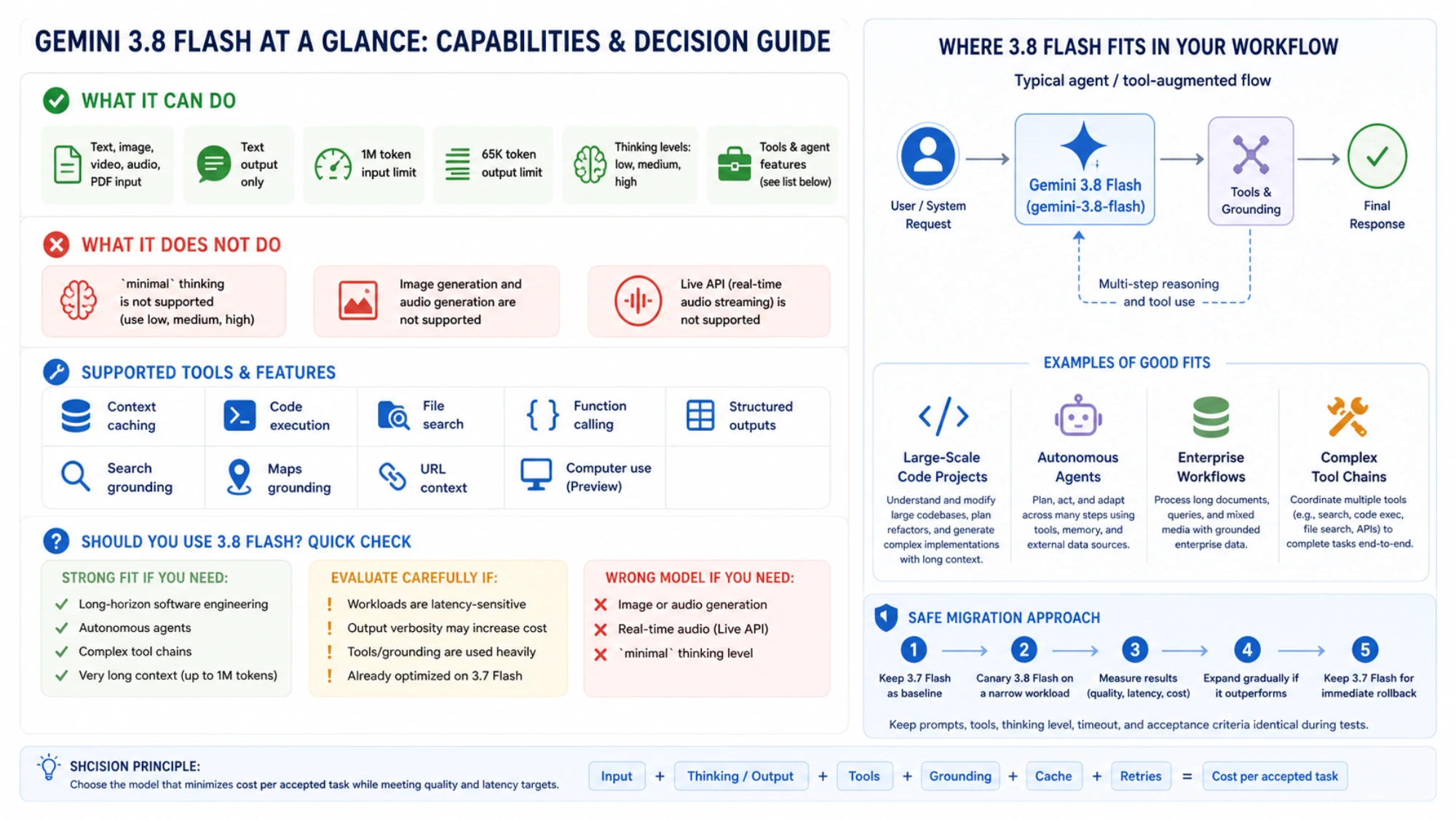
Do not infer that every feature uses the same billing unit or availability. Grounding, cache storage, computer use, and service modes each have their own terms.
Gemini 3.8 Flash pricing
Google's current pricing page lists USD per 1 million tokens. Output prices include thinking tokens.
| Mode | Input through Dec. 31, 2026 | Output through Dec. 31, 2026 | Input from Jan. 1, 2027 | Output from Jan. 1, 2027 |
|---|---|---|---|---|
| Standard | $0.75 | $3.75 | $1.50 | $7.50 |
| Batch | $0.375 | $1.875 | $0.75 | $3.75 |
| Flex | $0.375 | $1.875 | $0.75 | $3.75 |
| Priority | $1.35 | $6.75 | $2.70 | $13.50 |
Standard and Priority currently show free-tier access, while Batch and Flex do not. Context-cache token charges and hourly storage also change in 2027. Search and Maps grounding have separate request-based pricing after their included monthly allowance.
The meaningful measure is not the input rate alone:
cost per accepted task = total charges across all attempts / number of accepted tasks
Include uncached input, output (which includes thinking), applicable caching, tools, and grounding charges in the total. Keep charged retries in that total; do not add them again as a separate charge category.
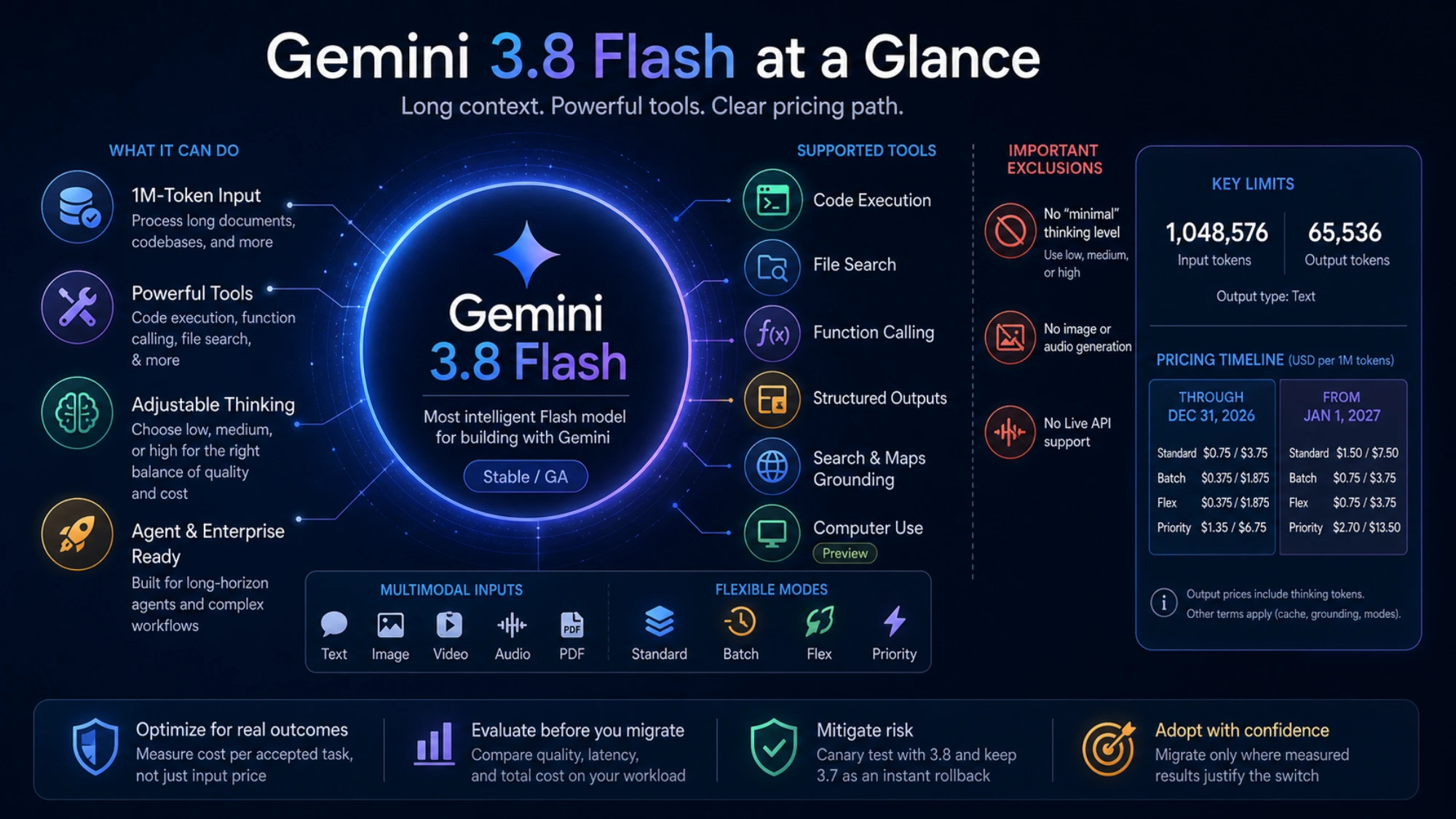
If 3.8 reduces retries or solves a tool chain in one pass, it can beat a cheaper model operationally. If output becomes more verbose or a task did not need its capabilities, the same model can cost more without improving the result.
Make your first request
Google's text-generation guide uses the Interactions API for its current 3.8 examples. Install the Google GenAI Python SDK with python -m pip install google-genai and set GEMINI_API_KEY in your environment. The following documentation-based example makes an API request when run; it has not been tested against a paid account for this guide:
from google import genai

client = genai.Client()

interaction = client.interactions.create(
    model="gemini-3.8-flash",
    input="Explain three common deployment failure modes and how to detect them.",
)

print(interaction.output_text)
The equivalent REST request is:
curl -X POST "https://generativelanguage.googleapis.com/v1beta/interactions" \
  -H "x-goog-api-key: $GEMINI_API_KEY" \
  -H "Content-Type: application/json" \
  -d '{
    "model": "gemini-3.8-flash",
    "input": "Explain three common deployment failure modes and how to detect them."
  }'
Start with the default thinking behavior, then set thinking_level explicitly when latency and cost must be comparable across models. Inspect the complete response rather than relying only on a convenience text field when your workflow includes thoughts, tools, or interleaved content.
Should you migrate from Gemini 3.7 Flash?
The move has already happened on Google's side. On October 8, 2026, Google deprecated gemini-3.7-flash and began routing all of its requests to gemini-3.8-flash; the deprecations page lists no shutdown date for the old ID, and the pricing page no longer has a row for it. Google asks you to update the model string to gemini-3.8-flash. The pricing page now describes 3.6 Flash, not 3.7, as the previous-generation Flash model.
Three consequences follow for an integration that still sends gemini-3.7-flash:
- Output already comes from 3.8 Flash. Requests since October 8 have been served by 3.8 Flash, so quality, latency, or verbosity changes after that date reflect 3.8 Flash. Old 3.7 measurements are a baseline, not a description of current behavior.
- 3.7 Flash is no longer a rollback target. Switching the string back to
gemini-3.7-flashsends the request to 3.8 Flash again. If you need a fallback with a different model, usegemini-3.6-flash, which is still GA at the same 2026 price. - List price does not change. 3.7 Flash was listed at the same $0.75 / $3.75 as 3.8 Flash. Google does not say which billing SKU routed requests use, so check the SKU in your Cloud Billing report.
To check what the switch did to your workload, compare 3.8 Flash with your pre-October 8 logs and with 3.6 Flash, keeping prompts, tools, thinking level, timeout, and acceptance criteria fixed. Include ordinary requests, long context, structured output, tool failures, refusals, and multi-turn state. Record first-attempt success, tool-call correctness, P50/P95 latency, input and output tokens, retries, safety failures, and total cost per accepted task. Then change the string to gemini-3.8-flash behind configuration, with 3.6 Flash as the fallback while the new path proves stable.
For a broader comparison with Flash-Lite and Pro options, use the separate Gemini text-model guide.