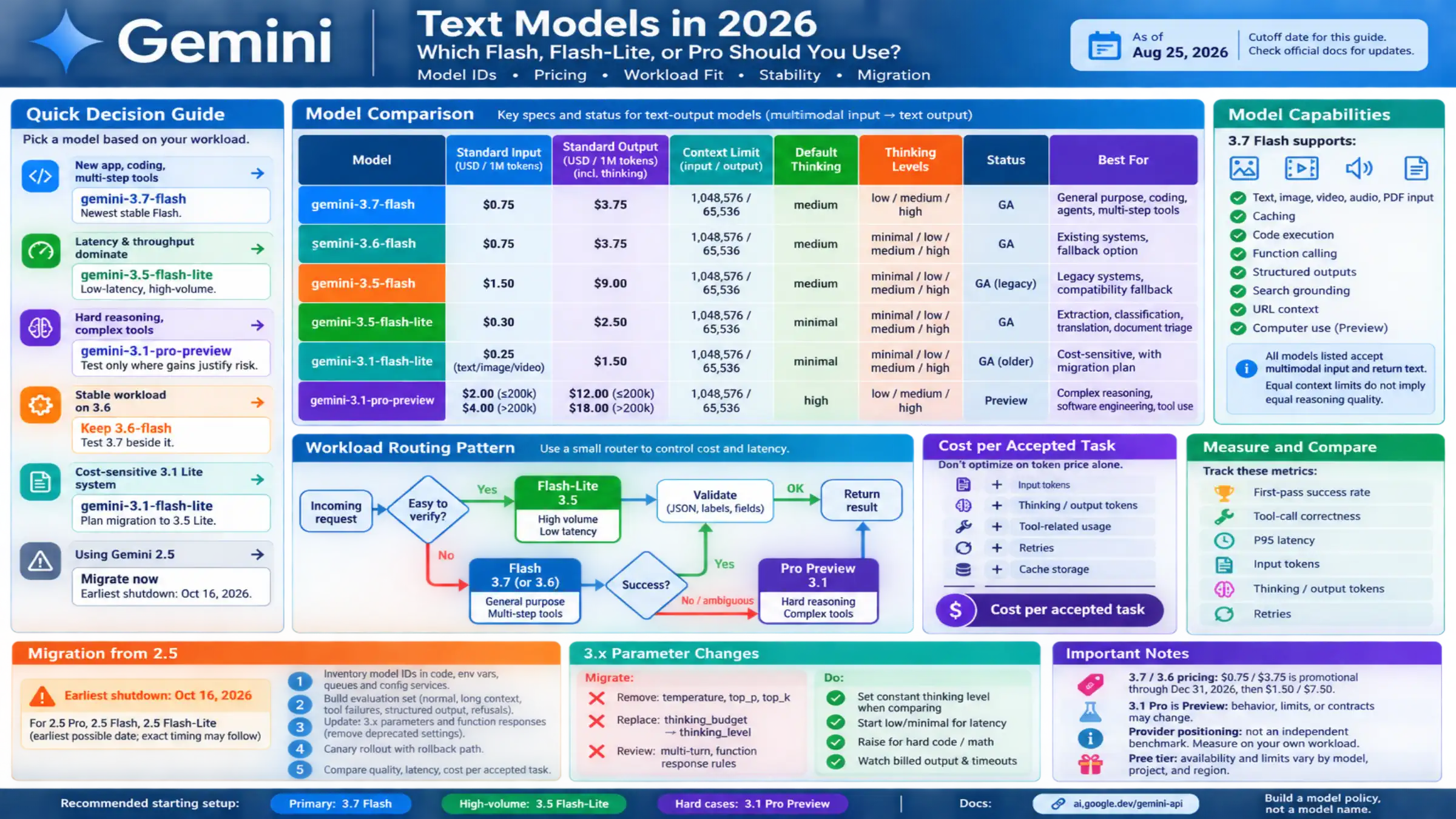
As of October 10, 2026, gemini-3.8-flash is the most defensible starting point for a new general-purpose Gemini Developer API integration. It has been the newest stable Flash model since September 2, 2026, and Google describes it as its most intelligent Flash model for long-horizon software engineering, autonomous agents, and complex enterprise workflows. Use gemini-3.5-flash-lite when latency and throughput dominate and the result is easy to validate. Treat gemini-3.1-pro-preview as an experiment for the hardest reasoning and tool-use cases, not as an automatic production default.
If your code still calls gemini-3.7-flash, the default when this guide was first written in August, it is already running on 3.8 Flash. Google deprecated gemini-3.7-flash and gemini-3.5-flash on October 8, 2026, and now routes every request to them to gemini-3.8-flash and gemini-3.6-flash (Gemini API release notes). Change the model string and re-run your evaluation set.
This guide compares general Gemini models that accept multimodal input and return text. Image generation, embeddings, Live audio, TTS, managed agents, and Gemini app subscriptions are different products or API surfaces.
A practical shortlist
| Situation | Start with | Decision logic |
|---|---|---|
| New app, coding assistant, multi-step tool workflow | gemini-3.8-flash | Newest stable Flash; balanced capability, speed, tools, and lifecycle |
Code still sends gemini-3.7-flash or gemini-3.5-flash | Change it to gemini-3.8-flash or gemini-3.6-flash | Both old IDs were deprecated on October 8, 2026 and already route to those models |
| Stable workload already on 3.6 | Keep gemini-3.6-flash, test 3.8 beside it | Both are GA and share the same 2026 promotional standard price |
| Classification, extraction, translation, document triage | gemini-3.5-flash-lite | Built for low-latency, high-volume bounded work |
| Existing cost-sensitive 3.1 Lite system | gemini-3.1-flash-lite, with a migration plan | Cheaper today, but older; Google lists May 7, 2027 as its earliest shutdown date, with 3.5 Lite as the successor |
| Difficult reasoning, complex code, custom tool orchestration | Compare gemini-3.1-pro-preview with 3.8 Flash | Pay for Pro only where it produces a measurable gain |
| Gemini 2.5 in production | Keep it running, plan the move without a deadline | Not deprecated; served until further notice to projects that already used it, with no shutdown date announced |
One model does not need to serve every request. A small router can send well-defined, machine-checkable work to Flash-Lite and escalate ambiguous, failed, or tool-heavy requests to 3.8 Flash. That often controls cost better than sending every prompt to the most expensive endpoint.
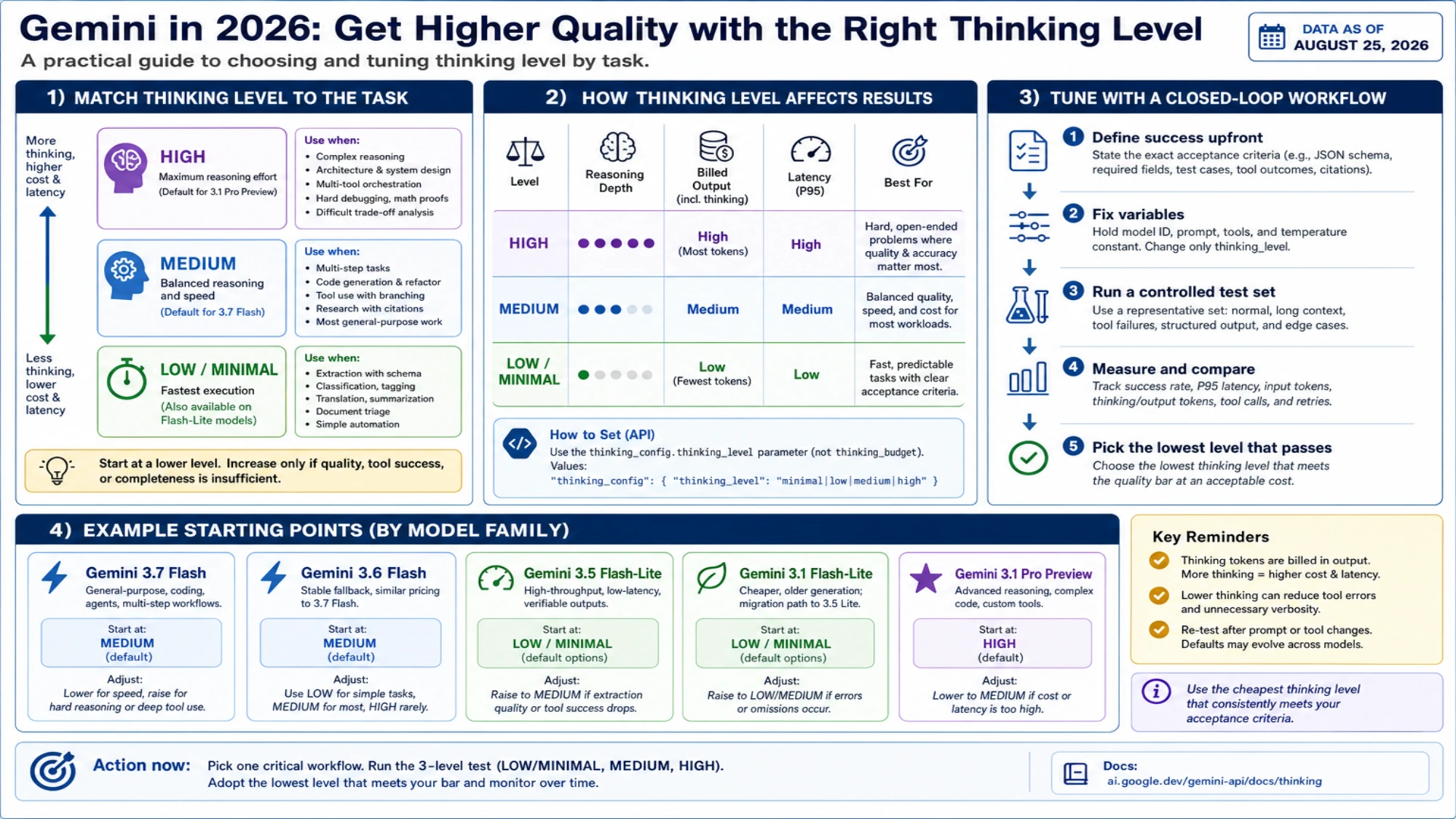
What the current names actually mean
As of October 10, 2026, Google's pricing page lists two stable Flash text models, 3.8 Flash and 3.6 Flash, plus 3.5 Flash-Lite and 3.1 Flash-Lite. Gemini 3.7 Flash and 3.5 Flash were also stable until October 8, 2026. They are now deprecated, with no shutdown date announced, and their IDs keep answering on 3.8 Flash and 3.6 Flash (deprecations page). Gemini 3.1 Pro and Gemini 3 Flash remain Preview. The status label matters more than the marketing tier: the exact model ID is your API contract.
Gemini 3.8 Flash (replaces 3.7 Flash): the default candidate
The 3.8 Flash model page specifies 1,048,576 input tokens and 65,536 output tokens. It accepts text, image, video, audio, and PDF input and returns text. Supported features include caching, code execution, file search, function calling, structured outputs, Search and Maps grounding, URL context, and computer use in Preview. It does not accept minimal thinking.
Requests that still name gemini-3.7-flash are served by 3.8 Flash, so their output, thinking behavior, and tool handling now follow 3.8 Flash. Treat old 3.7 test results as a baseline to re-run, not as a description of what you get today. 3.7 Flash was listed at the same $0.75 / $3.75 as 3.8 Flash, so the routing does not change the list rate. Google does not say which billing SKU the routed requests use, so check the SKU in your Cloud Billing report. The Gemini 3.8 Flash API guide covers the model ID, limits, and a first request.
Google positions 3.8 Flash for coding, agents, and long multi-step work. That is provider guidance, not proof that it wins on your private workload. A safe rollout still measures first-pass success, tool-call correctness, P95 latency, and total tokens per accepted result.
Gemini 3.6 Flash: a useful GA fallback
gemini-3.6-flash remains stable and uses the same temporary 2026 standard price as 3.8. Google's pricing page now calls it the previous-generation Flash model. Existing systems do not need an emergency migration simply because 3.8 exists. Keep 3.6 available as a fallback, then compare both on the same prompts.
If 3.8 reduces retries or verbose output, it may cost less per successful task even when the listed token price is identical. If it regresses on a particular tool chain, a configuration-driven 3.6 fallback is safer than a code change.
Gemini 3.5 Flash: deprecated, now routed to 3.6 Flash
gemini-3.5-flash was deprecated on October 8, 2026. Google routes its requests to gemini-3.6-flash and asks you to change the string to gemini-3.6-flash or gemini-3.8-flash (release notes). The pricing page no longer lists 3.5 Flash. Its last listed standard rate was $1.50 input and $9.00 output, against $0.75 / $3.75 for 3.6 Flash.
Google does not say which rate applies to calls that still use the old ID. Billing most likely follows the model that serves the request, but that is an inference; confirm the SKU in Cloud Billing before you budget on it. Either way, those calls now return 3.6 Flash output, so re-run your evaluation set and update the string.
Flash-Lite: work with a clear definition of done
The 3.5 Flash-Lite page targets low-latency, cost-effective, high-throughput execution: extraction, document parsing, simple automation, and subagent tasks. It also publishes 1,048,576 input and 65,536 output token limits. Equal context limits do not imply equal reasoning quality.
There is no Gemini 3.7 Flash-Lite or 3.8 Flash-Lite text model. As of October 10, 2026, the newest Flash-Lite text model is 3.5 Flash-Lite; the 3.8 Flash-Lite name belongs to a text-to-speech model, gemini-3.8-flash-lite-tts.
Flash-Lite works best when you can validate the output: a fixed label set, a JSON Schema, required extracted fields, or sampled translation review. For architecture, long-horizon debugging, or complex tool planning, one failed attempt can erase the savings from a lower token rate.
gemini-3.1-flash-lite is cheaper at current standard rates. It can remain sensible in an existing measured pipeline, but it is older. Google's deprecation table gives May 7, 2027 as its earliest shutdown date and identifies 3.5 Flash-Lite as its recommended replacement, so a new long-lived system should include migration cost.
Gemini 3.1 Pro Preview must earn its risk
Google's current model overview describes 3.1 Pro Preview as an advanced option for complex problem solving, software engineering, and precise tool use. It also offers gemini-3.1-pro-preview-customtools for workflows that mix bash and custom tools.
The final word is the constraint: Preview. Behavior, limits, or contracts can change before a stable release. Select tasks where Flash misses are expensive, run a blinded comparison against 3.8 Flash, and route to Pro only if the quality gain covers its higher price, latency, and change risk.
Standard prices on October 10, 2026
These figures come from the official pricing page. They are USD per 1 million tokens for standard paid inference. Output includes thinking tokens. Batch, Flex, and Priority have separate rates.
| Model | Standard input | Standard output, including thinking | Status |
|---|---|---|---|
| Gemini 3.8 Flash | $0.75 | $3.75 | GA; promotional through Dec. 31, 2026, then scheduled for $1.50 / $7.50 |
| Gemini 3.6 Flash | $0.75 | $3.75 | GA, previous generation; same promotional period |
| Gemini 3.7 Flash | Not listed | Not listed | Deprecated Oct. 8, 2026; requests route to 3.8 Flash |
| Gemini 3.5 Flash | Not listed (was $1.50) | Not listed (was $9.00) | Deprecated Oct. 8, 2026; requests route to 3.6 Flash |
| Gemini 3.5 Flash-Lite | $0.30 | $2.50 | GA |
| Gemini 3.1 Flash-Lite | $0.25 for text/image/video input | $1.50 | GA, older generation |
| Gemini 3.1 Pro Preview | $2.00 at ≤200k prompt; $4.00 above 200k | $12.00; $18.00 | Preview |
The useful unit is:
cost per accepted task = input + thinking/output + tool-related usage + retries + cache storage
Track success rate, P95 latency, input tokens, thinking/output tokens, and retries together. A $0.30 model that retries or calls the wrong tool can cost more than a $0.75 model that succeeds once.
Eligible free-tier models may provide free tokens, but availability and limits vary by model, project, and region; submitted free-tier content may be used to improve Google products. The paid tier says submitted content is not used for that purpose. AI Studio availability is not a promise of unlimited free production use.
Thinking level changes the comparison
Google's thinking documentation shows different defaults. Gemini 3.8 Flash defaults to medium and supports low, medium, and high. Gemini 3.6 Flash and 3.5 Flash-Lite also support minimal. Gemini 3.1 Pro Preview defaults to high. Requests sent to the deprecated gemini-3.7-flash and gemini-3.5-flash IDs run on 3.8 Flash and 3.6 Flash, so set levels for the model that actually serves them.
Fix the thinking level when comparing models. Start low or minimal for latency-critical extraction; raise it for hard code, math, and multi-tool work while watching billed output and timeout rate. Google's latest-model guide, which the 3.8 Flash release notes point to, listed these changes for the move to 3.7: remove deprecated temperature, top_p, and top_k, replace thinking_budget with thinking_level, and review multi-turn and function-response rules. Recheck it before you migrate, because it now targets 3.8 Flash.
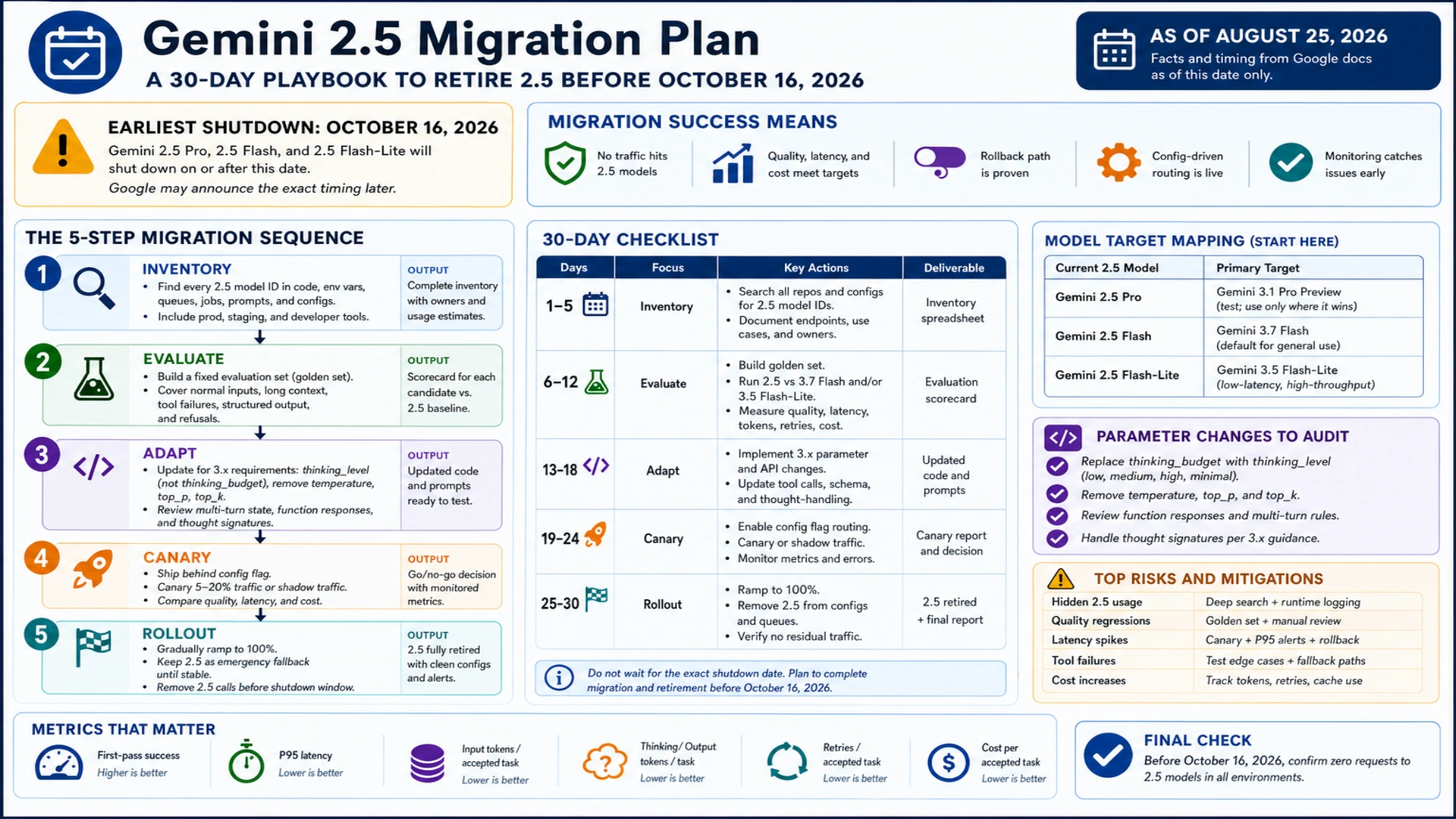
Migrate from Gemini 2.5 before it becomes an incident
Google's deprecation schedule says Gemini 2.0 Flash and Flash-Lite shut down on June 1, 2026. In August 2026 the same page listed October 16, 2026 as the earliest shutdown date for 2.5 Pro, 2.5 Flash, and 2.5 Flash-Lite. That date no longer applies. As of the page's October 9, 2026 version, the three 2.5 models are not deprecated, show "No shutdown date announced", and will be served through the API until further notice.
Access has narrowed instead: Google is limiting the 2.5 models to users who have actively used them before, and tells new projects to use 3.5 Flash-Lite or 3.8 Flash. An existing 2.5 integration can keep running, but a new service, or one you may need to redeploy under a new project, should not be built on 2.5. Google says it will give advance notice of exact shutdown dates, so the migration below no longer has a fixed deadline, but the work is the same.
A production migration should cover more than the model string:
- Inventory model IDs in code, environment variables, queues, and configuration services.
- Build a fixed evaluation set with normal inputs, long context, tool failures, structured output, and refusal cases.
- Update 3.x parameters, thought-signature handling, function responses, and conversation state.
- Put old and new models behind configuration, canary the change, and keep a rollback path.
- Compare quality, latency, and cost per accepted task after rollout.
For a new system, start with 3.8 Flash, the model that gemini-3.7-flash requests already reach. Add 3.5 Flash-Lite for repetitive, verifiable work. Test 3.1 Pro Preview only for the tasks where stable Flash is demonstrably insufficient. That creates a model policy you can operate, rather than a model name you hope will stay best.