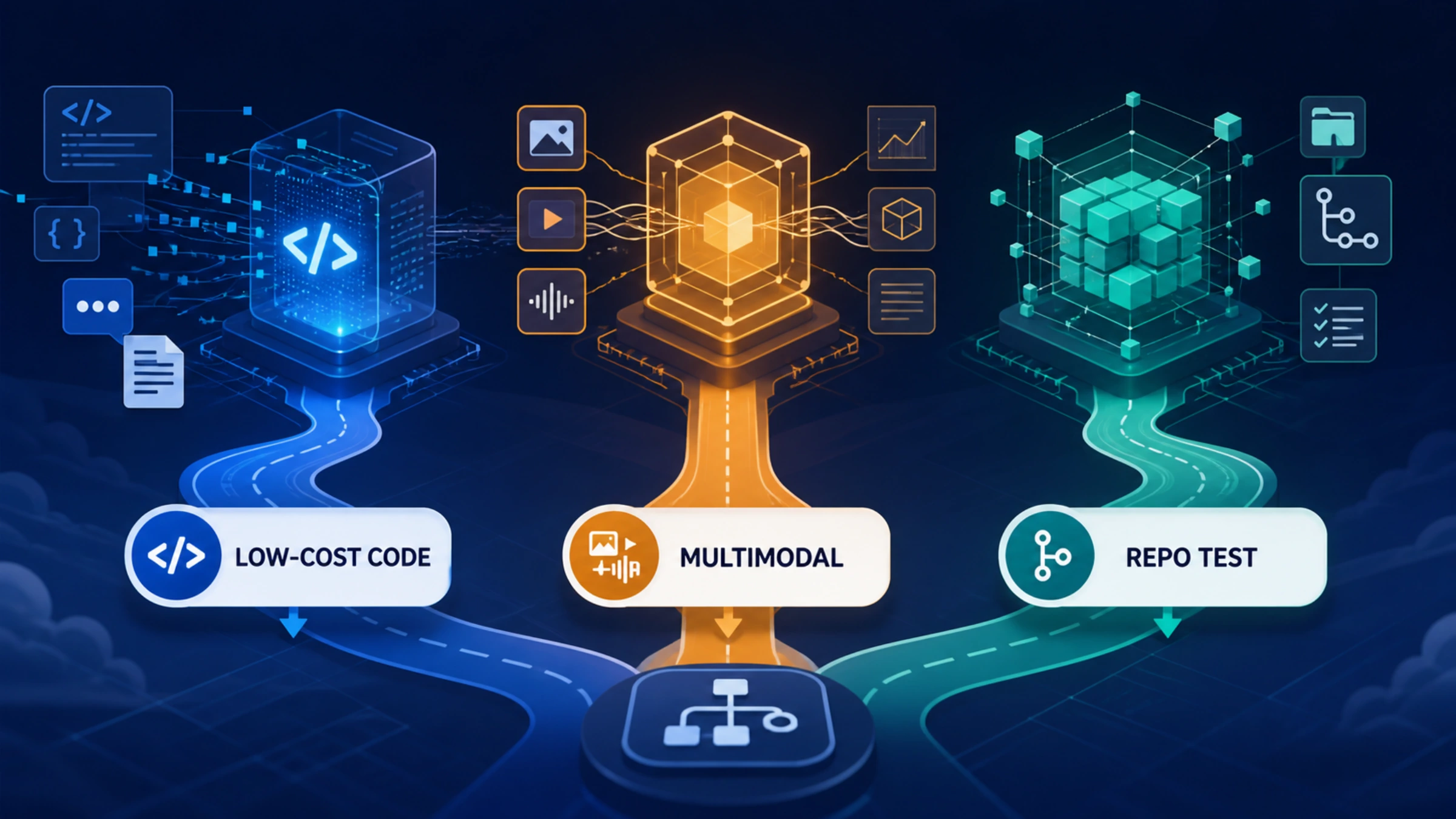
Short answer: start with DeepSeek V4 Flash for text-heavy coding agents when API cost and throughput matter most. Choose Kimi K3 when native image or video understanding is part of the job, or when its long-horizon behavior saves enough human intervention to justify a much higher token price. Put GLM-5.2 in the middle: it costs more than Flash but far less than K3 at official direct rates, and it deserves the job when a controlled test on your repository shows better accepted results.
That is a starting rule, not a permanent ranking. All three advertise a one-million-token context. The useful differences are modality, reasoning controls, direct API price, licensing, and what happens inside your actual agent harness.
Prices and product facts below were checked on August 6, 2026. Recheck them before buying.
The three-way decision in one table
| Decision factor | DeepSeek V4 Flash | Kimi K3 | GLM-5.2 |
|---|---|---|---|
| Best first test | Cost-sensitive text, code, and high-volume agents | Multimodal and ambitious long-horizon work | Coding agents where repository quality may justify a middle price |
| Official context | 1M tokens | 1,048,576 tokens | 1M tokens |
| Reasoning control | Thinking and non-thinking modes | Always reasons; low, high, or max effort | Multiple effort levels |
| Native modality in official model description | Text generation | Text plus native vision; model documentation also describes video understanding | Text flagship |
| Tool/API features | Tool calls, JSON output, OpenAI and Anthropic formats | Tool calls, structured output, dynamic tools, OpenAI-compatible API | Tool calls and long-horizon coding focus |
| Open-weight license | MIT | Kimi K3 License | MIT |
| Direct API price: uncached input / output per 1M tokens | $0.14 / $0.28 | $3.00 / $15.00 | $1.40 / $4.40 |
The model names matter. DeepSeek V4 Flash is not V4 Pro, and a benchmark for Pro cannot be pasted into the Flash column. Kimi K3 is not Kimi K2.5 or K2.6. If an article, router, or console does not show the exact model ID, stop before comparing its price or score.
DeepSeek's official API rate card lists deepseek-v4-flash, a 384K maximum output, and both thinking and non-thinking operation. Its official model card describes a 284B-total, 13B-active MoE with MIT-licensed weights.
Kimi's K3 price page describes an always-reasoning model with configurable effort. The Kimi K3 model card describes a much larger 2.8T-total, 104B-active native multimodal MoE. “Active parameters” is not the storage requirement for the full weights; neither number makes local deployment a casual single-GPU project.
Z.ai's GLM-5.2 model card positions it for long-horizon coding with flexible effort and local serving under MIT. These are provider descriptions, not independent proof that one model will finish your repository task.
Official API cost: the gap is large enough to change the default
Use a concrete workload rather than comparing one output-token row. Suppose a run consumes 1 million uncached input tokens and 100,000 output tokens:
- DeepSeek V4 Flash:
1 × $0.14 + 0.1 × $0.28 = $0.168 - Kimi K3:
1 × $3.00 + 0.1 × $15.00 = $4.50 - GLM-5.2:
1 × $1.40 + 0.1 × $4.40 = $1.84
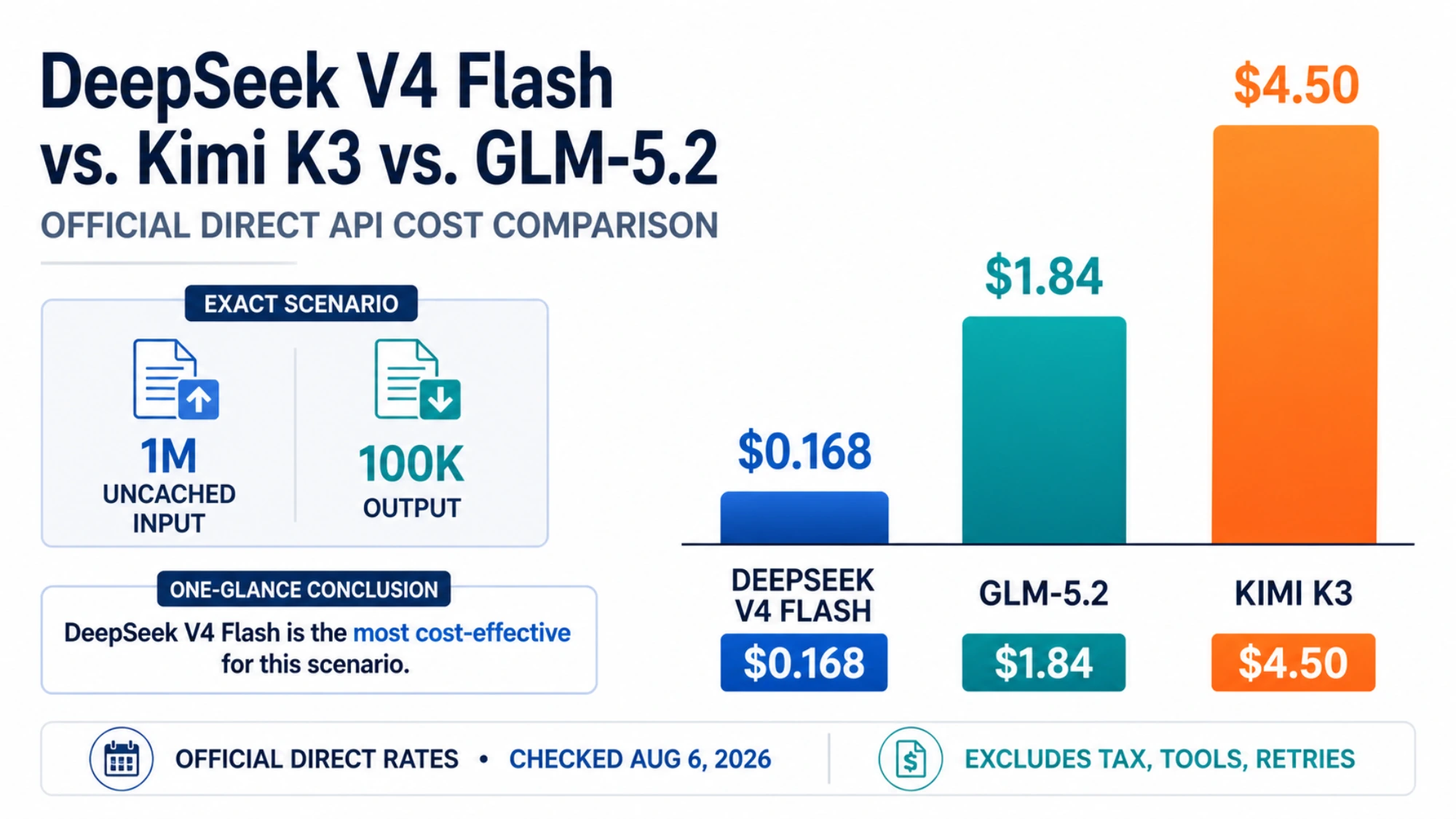
These are arithmetic results from the three direct-provider rate cards, not quotes for a subscription or third-party router. They exclude tax, tool fees, retries, cache writes, provider markup, and failed work.
The more honest formula is:
total cost = uncached input + cached input + output + tools + retries
Then calculate:
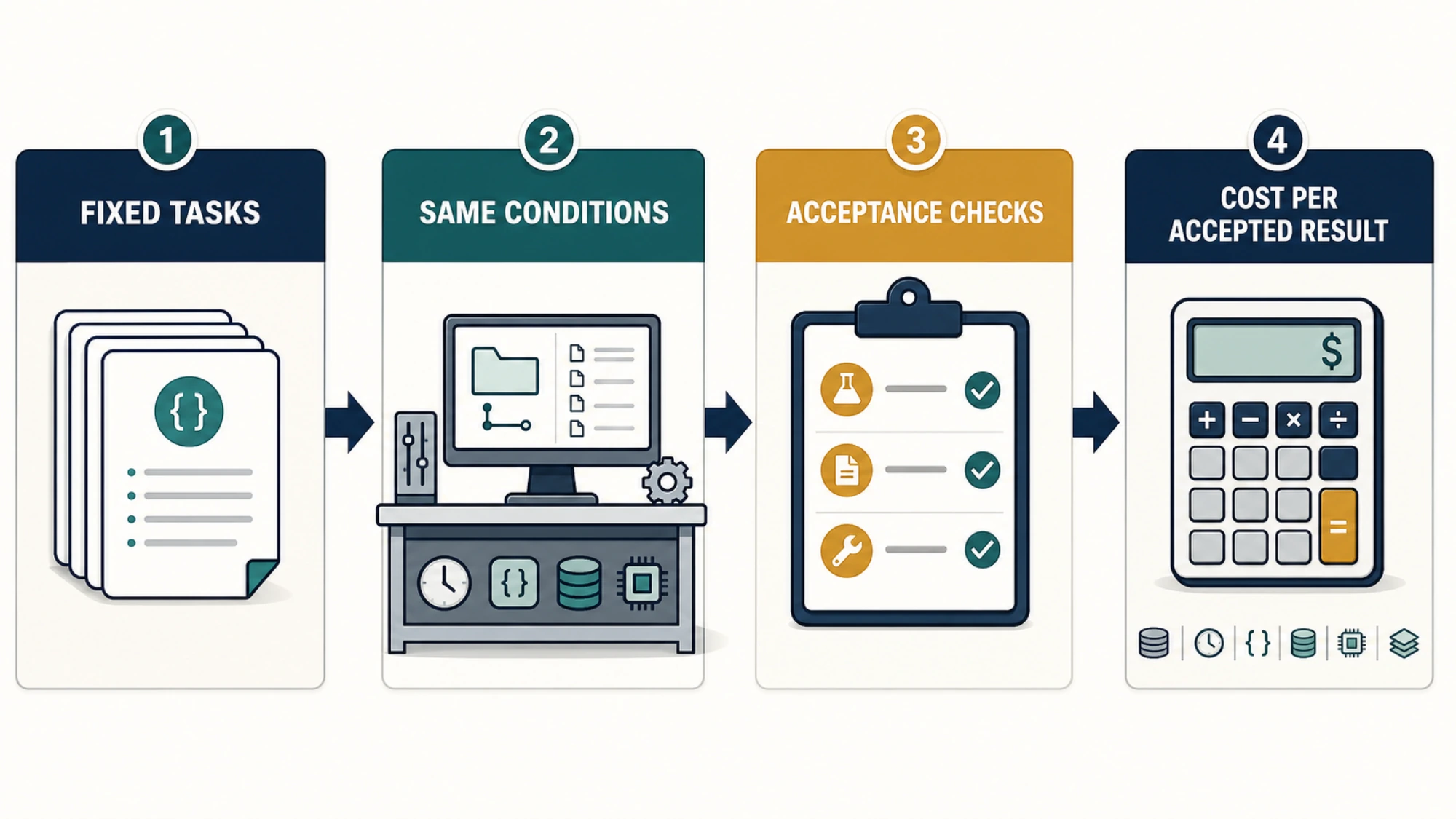
cost per accepted result = total cost of all attempts / number of results that passed acceptance
A cheap request that fails three times may cost more than one expensive request that passes. Conversely, Kimi K3 needs a very large reduction in rework to overcome its direct token-price gap for text-only jobs.
Cache hits help all three, but not equally
The checked cached-input rates are $0.0028/M for DeepSeek, $0.30/M for Kimi, and $0.26/M for GLM. A repeated agent prefix, stable repository map, or shared document set can therefore make cache design more important than another benchmark point.
Do not assume the full prompt is cached. Record the provider's reported cached tokens. Keep changing user instructions, tool results, and generated history separate from a stable prefix. If a gateway applies different cache rules or prices, use its rate card rather than the upstream numbers above.
Which model fits your workload?
Choose DeepSeek V4 Flash for inexpensive text and code loops
Flash earns the first experiment when tasks have clear checks, inputs are mostly text, and you expect many agent turns or parallel jobs. Its official direct rates leave room for retries, reviewers, and larger task samples without immediately turning evaluation into a budget problem.
Use non-thinking mode for straightforward transformations only after verifying quality; use thinking for planning, debugging, and multi-step tool work. Do not treat the 13B active-parameter figure as proof of latency. Provider hardware, queueing, output length, and harness behavior still determine wall time.
Choose Kimi K3 when multimodality is part of the requirement
K3 is the clearest choice when the agent must reason over screenshots, diagrams, rendered documents, or video alongside text. It also exposes reasoning-effort controls and features aimed at long-horizon knowledge work.
Its price means “K3 wrote the nicest answer” is not enough. Require an observable advantage: fewer interventions, a higher accepted-result rate, or a task DeepSeek and GLM cannot perform because they lack the required modality. Check the API's current modality contract before sending production media; the open-weight model card and hosted API are related but not identical deployment contracts.
Choose GLM-5.2 when the repository test supports the premium over Flash
GLM-5.2 offers one-million-token context, flexible effort, MIT-licensed weights, and a direct price between the other two. That makes it a sensible challenger for difficult coding-agent work, particularly if Flash loops, misses repository conventions, or needs more repair.
The model does not win by occupying the middle column. It wins only when its additional cost buys more accepted work. If it ties Flash on your suite, choose the cheaper or operationally simpler route.
Why public benchmark tables disagree
Official model cards contain useful hypotheses. They do not form a clean three-way laboratory test. A score can change with:
- the agent harness and its file-selection or context-compaction policy;
- thinking effort, maximum output, temperature, and retry rules;
- tool permissions, network access, and time limits;
- judge model, task version, and the definition of success;
- direct-provider versus hosted-provider latency and cache behavior.
Kimi's own table, for example, documents different harnesses for several model rows. GLM's card also lists benchmark-specific contexts, tools, and maximum outputs. Reading those footnotes is more useful than averaging the headline scores.
Use public benchmarks to choose what to test. Do not use them to skip the test.
Run a fair A/B/C test on your own tasks
Choose 10–30 private tasks that resemble paid work: a multi-file bug fix, a bounded feature with tests, a document-and-data synthesis task, or a tool-using support workflow. Avoid toy prompts and one enormous migration.
- Start every run from the same commit, files, instructions, and expected output.
- Use the same provider class where possible. Do not compare a premium hosted route with a congested free endpoint and label it a model test.
- Match tool permissions, context packet, timeout, retry budget, and an explicit reasoning-effort policy.
- Define acceptance before running: tests, factual checks, schema validation, visual review, or another business condition.
- Record pass/fail, human interventions, wall time, input/output/cached tokens, tool fees, and retries.
- Repeat borderline tasks and compare cost per accepted result, not the best screenshot or first-token speed.
| Measure | What to record |
|---|---|
| Accepted result | Passed checks and unresolved failures |
| Human intervention | Clarifications, manual repairs, approvals, restarts |
| Wall time | Start to accepted result |
| Meter | Uncached input, cached input, output, and tool charges |
| Reliability | Retries, malformed tool calls, lost context, refusals |
| Final economics | Total spend divided by accepted results |
Stop when one model clearly fails a required modality, exceeds the budget ceiling, or wins across a second representative sample. If the difference is within normal run-to-run variation, keep the cheaper default and retest after meaningful model or workflow changes.
Verdict and the safest next step
For most text-and-code teams, DeepSeek V4 Flash should get the first work sample because its official direct price is dramatically lower. Kimi K3 is the specialist choice for native multimodality and high-value long-horizon work. GLM-5.2 is the practical challenger when repository behavior matters more than the lowest token bill.
Use each provider's official API when you need its exact reasoning, caching, or multimodal contract. If you prefer one OpenAI-compatible integration surface, the LaoZhang API documentation describes a unified API and a Models endpoint; check the live model list before assuming any of these three routes is available. For a broader Western-versus-Chinese coding-agent decision, see the same-locale GPT-5.6 Sol vs Claude Fable 5 comparison.