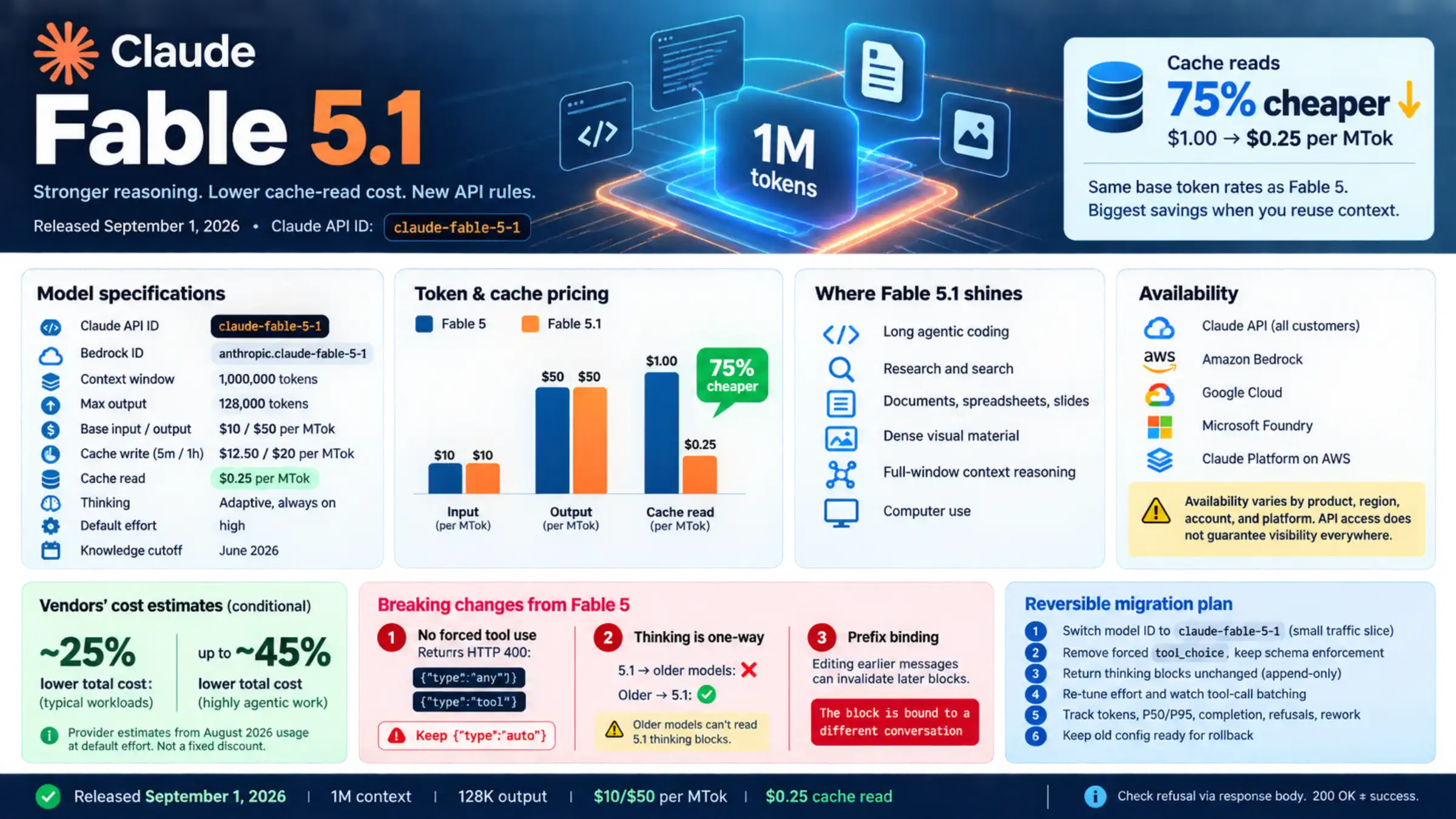
Claude Fable 5.1 launched on September 1, 2026, under the direct Claude API model ID claude-fable-5-1. It has a one-million-token context window, 128K maximum output, and always-on adaptive thinking. Anthropic positions it for demanding reasoning, long-running agents, multistep research, and complex document work.
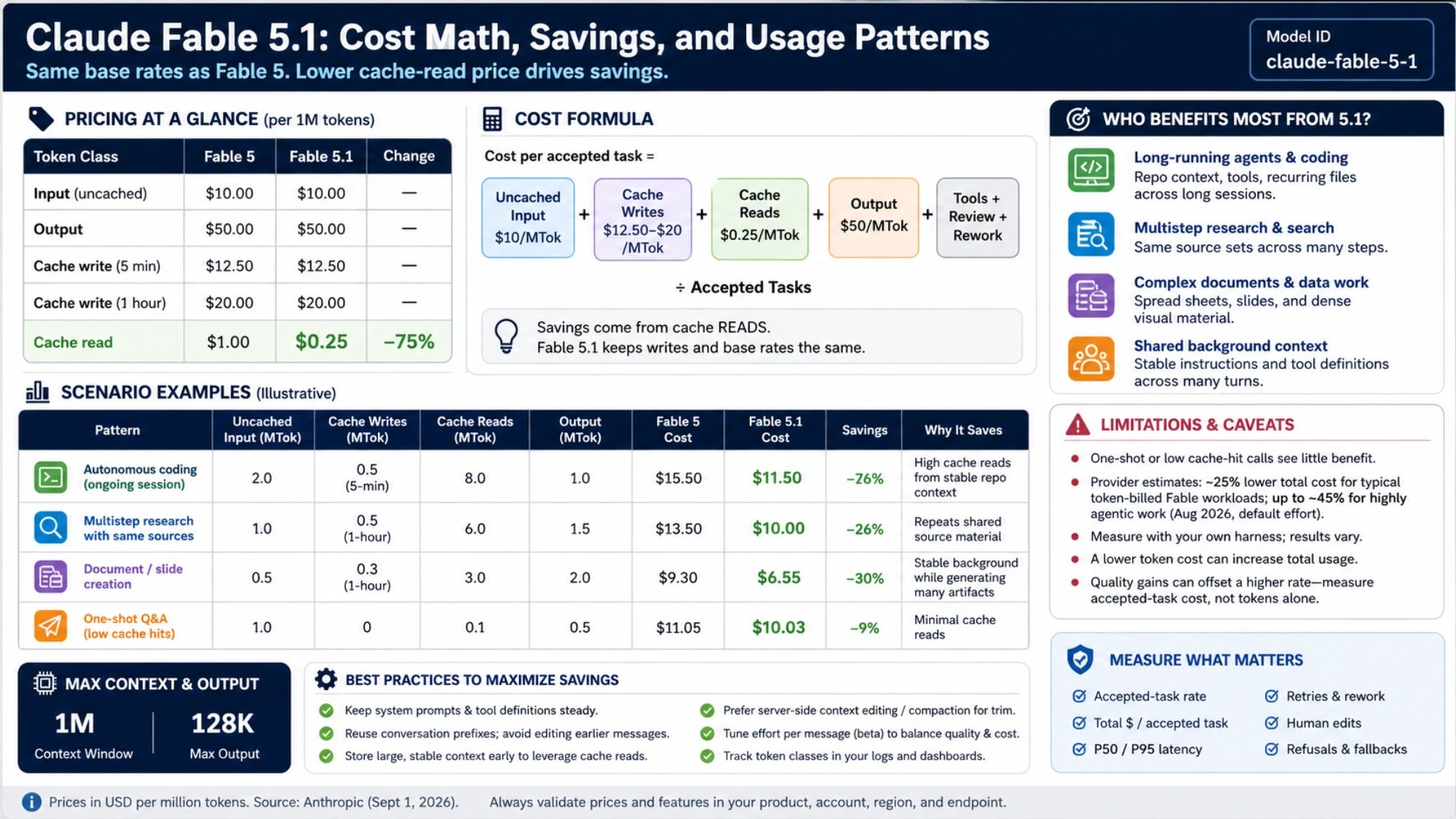
The version number hides two different changes. Fable 5.1 keeps Fable 5's $10-per-million input and $50-per-million output rates, while cache reads fall to $0.25 per million tokens. At the same time, forced tool calls and preserved thinking gain compatibility constraints that can turn a model-name swap into an HTTP 400.
Check your client’s compatibility and compare representative tasks before upgrading a production deployment.
Specifications and availability
The official Fable 5.1 model page marks the model active for all Claude API customers and lists Amazon Bedrock, Google Cloud, Microsoft Foundry, and Claude Platform on AWS.
| Item | Published specification |
|---|---|
| Claude API ID | claude-fable-5-1 |
| Amazon Bedrock ID | anthropic.claude-fable-5-1 |
| Context / maximum output | 1M / 128K tokens |
| Base input / output | $10 / $50 per MTok |
| Five-minute / one-hour cache write | $12.50 / $20 per MTok |
| Cache read | $0.25 per MTok |
| Thinking | Adaptive, always on |
| Default API effort | high |
| Reliable knowledge cutoff | June 2026 |
API availability is not the same as visibility in every product. Claude.ai, Claude Code plans, regional accounts, IDEs, and third-party gateways apply their own rollout, billing, and model-selection rules. If the ID is missing, check the product, account, region, and endpoint rather than assuming the direct API announcement applies everywhere.
A knowledge cutoff is not live knowledge. Current prices, policies, releases, and business facts still need fresh sources or retrieval tools.
The lower cost is concentrated in cache reads
Base input, output, and cache-write prices are unchanged from Fable 5. Cache reads now cost 0.025 times base input instead of 0.1 times, dropping from $1 to $0.25 per million tokens.
The saving matters most when an agent repeatedly reads a stable prefix:
- system instructions and tool definitions across a long session;
- repository context and recurring files during an autonomous coding run;
- the same source set across a multistep research task;
- shared background material while producing documents, spreadsheets, or slides.
A one-shot call with few cache hits will not receive the same reduction. In its launch announcement, Anthropic estimates roughly 25% lower total cost for typical token-billed Fable workloads and up to about 45% for highly agentic work. Those are provider estimates based on four weeks of August 2026 usage at default effort, not fixed discounts.
Calculate from actual usage:
API cost per accepted task = total API charges across all attempts / accepted tasks
Calculate the charges from each token category and its rate, including tools and charged retries. Record human review and rework time separately, or assign an explicit hourly rate if you want to compare total delivery cost.
The model can justify a higher rate if it removes hours of repair. It can also be wasteful when an existing model already passes on the first attempt.
What improved, and what needs observation
Anthropic says the largest capability gains appear in long agentic coding, research and search, document/spreadsheet/slide work, dense visual material, full-window context reasoning, and computer use.
The launch table reports gains over Fable 5 on Terminal-Bench-Science 0.1, Terminal-Bench 4.0, GDPval-AA v2, OSWorld 2.0, AutomationBench, and CursorBench 3.2.0. These are vendor-reported results with named benchmark versions, harnesses, effort levels, and production safeguards. They support putting Fable 5.1 into a trial; they do not prove it will win on a particular repository or document set.
Several behavioral differences can affect product quality or cost:
- independent tool operations may arrive one per turn rather than in a batch;
- long tool runs can expose fewer user-facing progress updates;
- at
loweffort, the model may answer from memory more often instead of searching; - a small file change is more likely to become a whole-file rewrite;
- prose can be denser and use fewer visual breaks.
These are not automatically defects. Measure whether they change latency, token consumption, review time, or task completion in the production harness.
Three breaking areas when moving from Fable 5
Anthropic's Fable 5.1 change reference identifies three client-breaking areas.
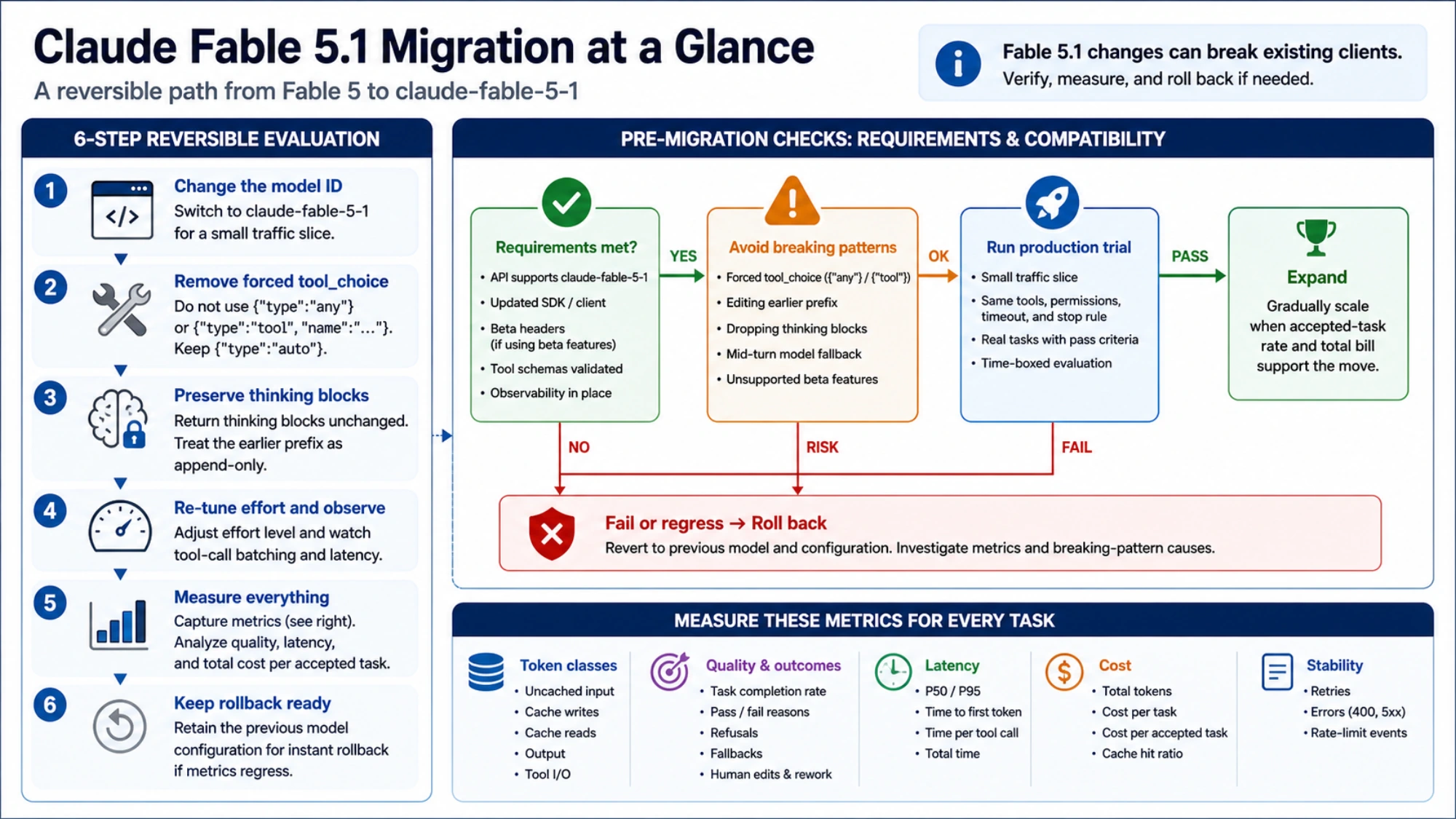
Forced tool use is unsupported
Either of these tool_choice values returns HTTP 400:
{"type": "any"}
{"type": "tool", "name": "lookup_customer"}
The message is:
tool_choice: type "tool" and "any" are not supported for this model.Use tool_choice: {"type":"auto"} and explain when the tool is needed. Strict schemas validate arguments or output structure; they do not force the model to call a tool. If a tool result is mandatory, have your application check that the required call completed before accepting the answer.
Preserved thinking is one-way
Fable 5.1 can read thinking blocks produced by earlier Claude models. Earlier models cannot read Fable 5.1 thinking blocks. If a live conversation falls back to Fable 5, Opus, or another older model, the API may drop those blocks before the target model sees them. Without the relevant beta controls, that transformation can be silent.
Editing the earlier prefix can invalidate later blocks
Changing an earlier message, rebuilding system or tools, deleting an injected reminder, or serving different document bytes can make later thinking blocks invalid. Strict enforcement can return:
The block is bound to a different conversationTreat the conversation prefix as append-only. Add new instructions later, use mid-conversation tool or system changes, and trim with server-side context editing or compaction.
New API features have explicit conditions
Fable 5.1 adds beta per-message effort, beta turn-scoped system messages, and beta readable progress updates between tool calls. Each feature needs its documented beta header and a supported API or platform. Do not place it in production merely because the model supports the concept.
Generated text carries Anthropic's statistical watermark. Supported image and video files retrieved through the Claude Files API can carry C2PA Content Credentials.
The model has 30-day data retention unless Anthropic expressly authorizes zero data retention. Enterprise Frontier Safeguards are rolling out in phases; they are not a universal current ZDR promise.
Refusals also require response-body checks. A declined request can return HTTP 200 with stop_reason: "refusal". Transport success is not task success.
A reversible Fable 5 migration
Build a small set of real tasks with observable pass conditions: tests pass, JSON validates, a report reconciles to source values, or a browser flow completes. Give the current model and Fable 5.1 the same input, tools, permissions, timeout, and stop rule.
Then:
- change the model ID to
claude-fable-5-1for a small traffic slice; - remove forced
tool_choiceand keep schema enforcement explicit; - return thinking blocks unchanged and stop editing the earlier prefix;
- re-tune
effortand observe tool-call batching; - record all token classes, task completion, P50/P95, retries, refusals, fallbacks, human edits, and rework;
- keep the old configuration ready for rollback.
If Fable 5.1 improves only a narrow group of hard tasks, use it there. Expand only when the accepted-task rate and total bill support the move.
For the separate question of where Fable belongs beside Opus, Sonnet, and Haiku, use the current Claude model-selection guide.