As of September 25, 2026, all three models are still sold through their official APIs, so the choice comes down to what your clip needs. Wan 2.7 is the cheapest way to get a clip with sound at 720p, costs about the same as Kling 3.0 Turbo at 1080p, and its editing endpoint is still the one Alibaba points to for copying an effect or camera move. Kling 3.0 is the cheaper route to 4K and the one built around multi-shot scenes with spoken dialogue in several languages. Seedance 2.0 accepts up to nine reference images and three videos in one request and places highest of the three on Arena's blind preference leaderboards, but a 1080p clip costs more than twice as much.
Since spring, all three lineups have moved. Wan 2.7 is now Alibaba's previous generation: Wan 3.0 arrived on August 6, 2026 with 30-second clips. Seedance 2.0 now sits next to Seedance 2.5, which also runs to 30 seconds but stops at 1080p. Kling 3.0 is still Kuaishou's current family, now with a cheaper Turbo sibling and 4K output. None of the three has official weights you can run on your own GPU.
Which one to test first for your video job
Start from the delivery condition that you cannot compromise on. The price figures below are official list prices per second of output.
| Your job | Test first | Why | What changes the answer |
|---|---|---|---|
| Clips up to 15 s with sound, 720p, lowest list price | Wan 2.7 | $0.086–$0.10 per second with audio included; Kling 3.0 with audio is $0.126, Seedance 2.0 about $0.15 | If you don't need sound, Kling 3.0 silent is $0.084 per second |
| Clips with sound at 1080p on a budget | Wan 2.7 or Kling 3.0 Turbo | $0.143–$0.15 vs $0.14 per second, both with audio | Turbo has no first/last-frame control and no 4K |
| 4K delivery | Kling 3.0 | $0.42 per second vs about $0.78 for Seedance 2.0; Wan 2.7 stops at 1080p | Seedance 2.0 4K runs one job at a time per account |
| Keep a product or character consistent from many references | Seedance 2.0 | Up to 9 reference images and 3 reference videos in one request, plus editing and extending | No uploads of real human faces as references |
| A real person's likeness from your own footage | Wan 2.7 (wan2.7-r2v) | Seedance 2.0 blocks direct uploads of real faces; Wan 2.7's reference docs carry no such ban | You still need consent and must pass moderation; confirm Kling's rules before relying on it |
| Edit an existing clip: restyle, replace, copy an effect or camera move | Wan 2.7 (wan2.7-videoedit) | Alibaba still recommends it for effect and camera-move replication after launching Wan 3.0 | Input and output seconds are both billed |
| Multi-shot scenes with dialogue in English, Spanish, Japanese, Korean or Chinese | Kling 3.0 | Native speech in those languages was part of the launch; multi-shot works on 3.0, Omni and Turbo | Audio adds 50% to Kling's per-second price |
| Anything longer than 15 seconds | None of the three | All three cap a single generation at 15 s | Wan 3.0 and Seedance 2.5 both go to 30 s |
| Running the model on your own hardware | None of the three | No official Wan 2.7 weights exist; Kling and Seedance are hosted services | The Wan 2.2 family is the newest official open-weight Wan |
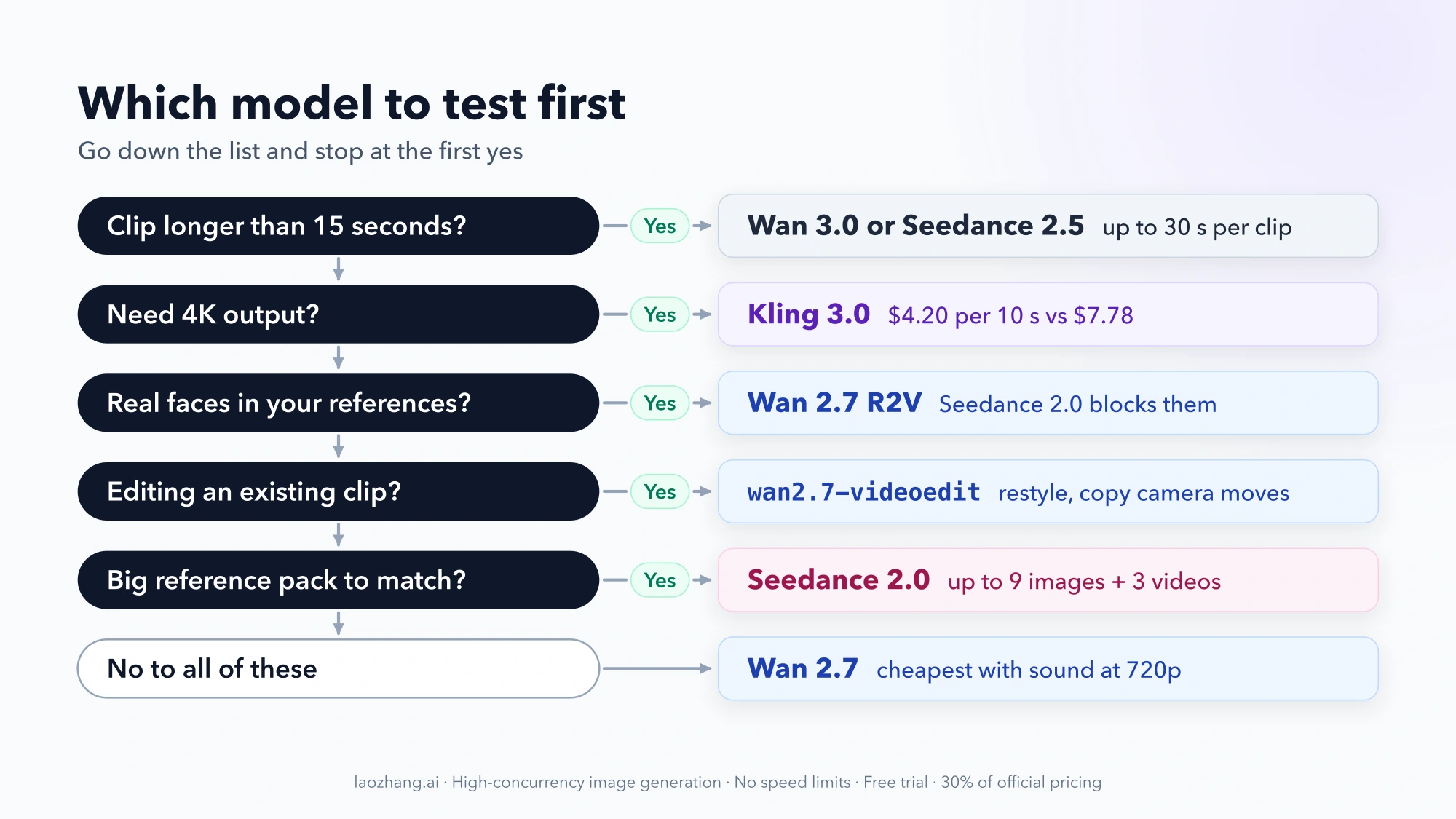
If two rows apply, test those two models on the same brief instead of all three. Each pair has its own section below.
Where each model stands in September 2026
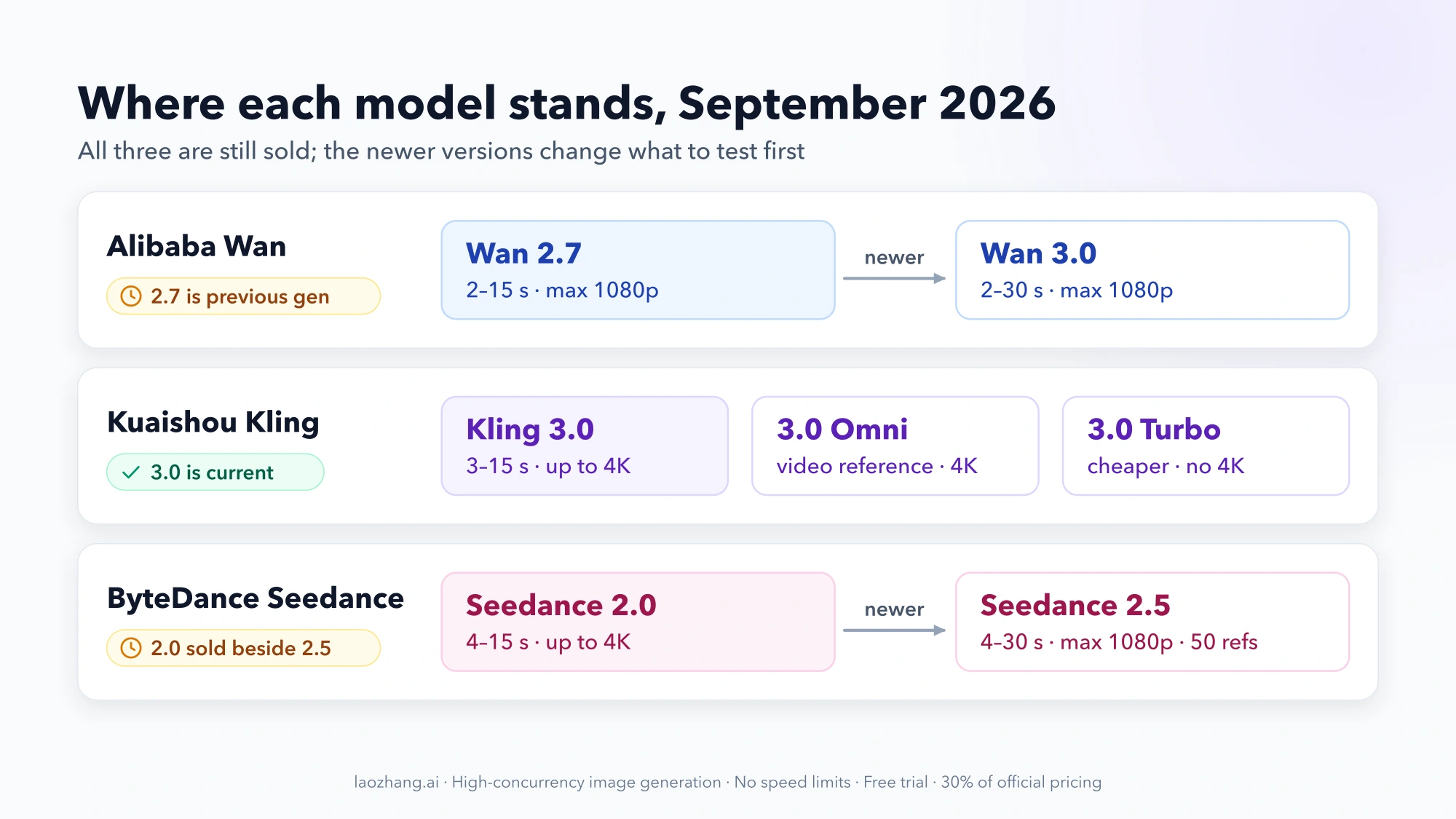
Wan 2.7 is still on sale, but it is no longer Alibaba's lead model. Alibaba released wan2.7-t2v, wan2.7-i2v, wan2.7-r2v and wan2.7-videoedit on April 3, 2026 and was still shipping new dated snapshots on July 1, 2026, according to the Model Studio release list. On the video generation model page (updated September 24, 2026), the recommended-models table now lists wan3.0-video, wan3.0-video-prime and Alibaba's separate HappyHorse 1.1 line. The only Wan 2.7 model left in that table is wan2.7-videoedit, for effect and camera-movement replication. The decommissioning page, updated September 11, 2026, lists no retirement date for the Wan 2.7 mainline models. Alibaba's policy is three months' notice for mainline model IDs and 30 days for dated snapshots, so pin a dated snapshot only if you watch those notices.
Kling 3.0 is the current Kling generation. Kuaishou launched Kling 3.0 on February 5, 2026 with 15-second clips, native audio and multi-shot generation, then added 4K output and the cheaper Kling 3.0 Turbo in the second quarter. The API capability map lists three siblings rather than a successor: kling-v3, kling-v3-omni (the only one that takes a video as reference) and kling-3.0-turbo (720p/1080p only, no first/last frame). All three run 3–15 seconds.
Seedance 2.0 is still sold alongside the newer 2.5. On BytePlus ModelArk, dreamina-seedance-2-0-260128 covers text-to-video, first frame, first and last frame, multi-reference input, editing and extension at 4–15 seconds. It is also the only Seedance API model with 4K. Seedance 2.5 (dreamina-seedance-2-5-260628) runs 4–30 seconds with up to 50 references but tops out at 1080p, per the Seedance 2.0 series tutorial and the Seedance 2.5 docs. If you are choosing between Seedance versions rather than vendors, Seedance Video Models in 2026: When to Use 2.5, 2.0, Fast, or Mini covers that decision.
| Wan 2.7 | Kling 3.0 | Seedance 2.0 | |
|---|---|---|---|
| Vendor and console | Alibaba Cloud Model Studio | Kling AI developer platform | BytePlus ModelArk |
| Clip length | 2–15 s (2–10 s for editing, and for R2V with a reference video) | 3–15 s | 4–15 s |
| Resolution | 720p, 1080p | 720p, 1080p, 4K (Turbo: no 4K) | 480p, 720p, 1080p, 4K |
| Sound | Always included in the price | Optional, +50% | Optional, same price |
| References | R2V: up to 5 images and videos combined | Omni: video reference; 3.0: element control | Up to 9 images and 3 videos |
| Editing an existing clip | wan2.7-videoedit | Omni with video input | Edit and extend |
| Status | Previous generation; Wan 3.0 is newer | Current family | Sold beside Seedance 2.5 |
What the same 10-second clip costs on each
The table uses each vendor's official list price for one 10-second, 16:9 clip. It covers the generation charge only.
| 10-second clip | Wan 2.7 | Kling 3.0 | Seedance 2.0 |
|---|---|---|---|
| 720p with audio | $1.00 (Singapore) / $0.86 (Tokyo, Beijing) | $1.26 (Turbo $1.12) | $1.51 |
| 720p silent | No silent tier | $0.84 | $1.51 (no silent discount) |
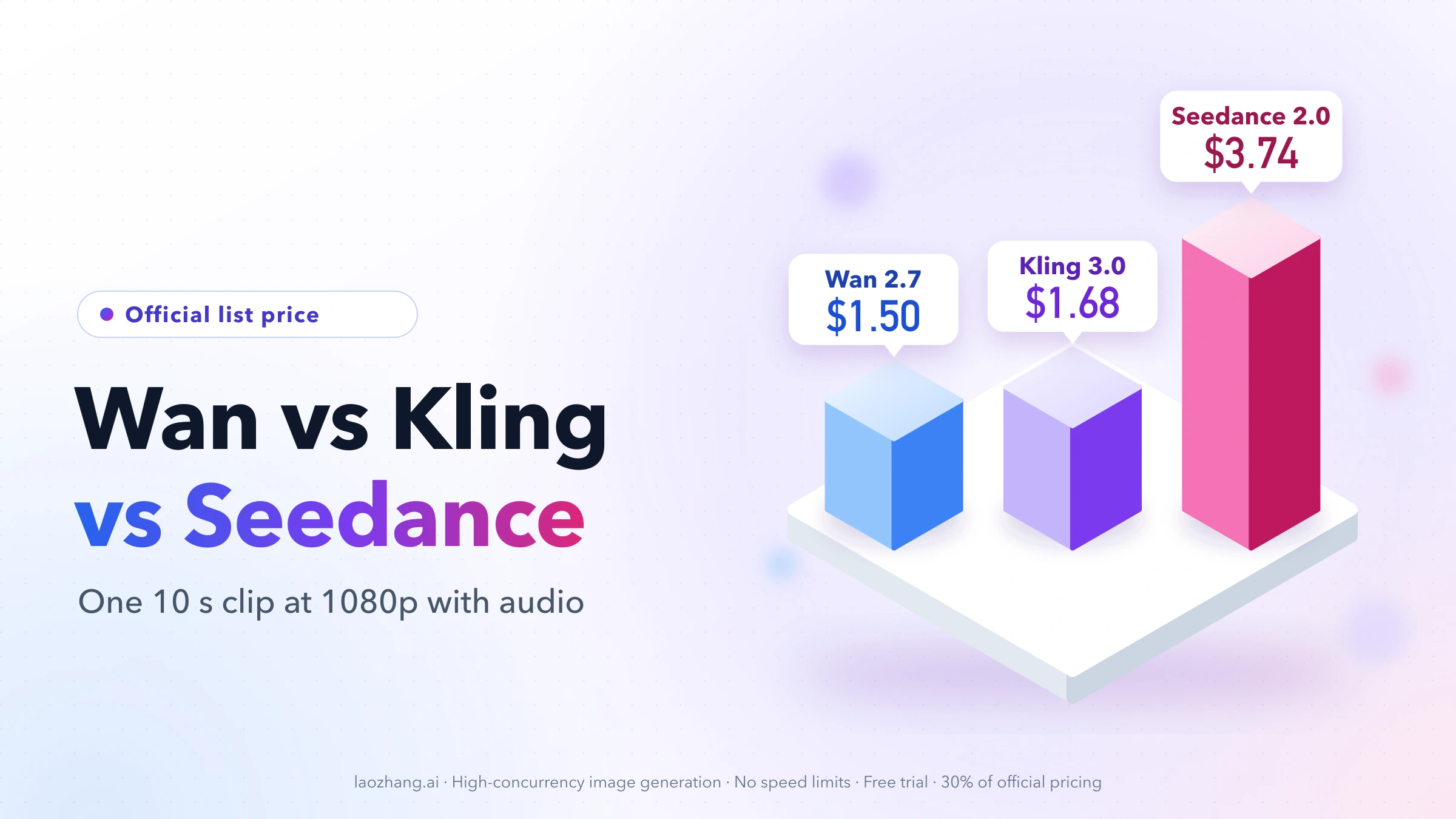
| 1080p with audio | $1.50 / $1.43 | $1.68 (Turbo $1.40) | $3.74 |
| 4K | Not available | $4.20 | $7.78 |
| 15 s at 1080p with audio | $2.25 / $2.15 | $2.52 | $5.61 |
Here is how each number is built, so you can redo it for your own length and resolution:
- Wan 2.7: seconds × per-second rate. Model Studio pricing lists $0.10 (720p) and $0.15 (1080p) in Singapore, and $0.086012 and $0.143353 in Beijing. The wan2.7-t2v model page lists Tokyo at the Beijing rate. The rate is the same for
t2v,i2v,r2vandvideoedit, and every clip is billed as a clip with sound. Singapore adds 50 free seconds per model for 90 days. - Kling 3.0: seconds × units × $0.14. On the Kling API pricing page, 1 unit costs $0.14. Kling 3.0 with native audio is 0.9 units per second at 720p and 1.2 at 1080p. Silent output is 0.6 and 0.8, 4K is 3.0 units, and Turbo is 0.8 and 1.0.
- Seedance 2.0: tokens × price per million tokens. Token use works out to seconds × width × height × frame rate ÷ 1,024, so a 1080p clip at 24 fps uses 48,600 tokens per second. Ten seconds is 486,000 tokens × $7.70 per million = $3.74, which matches ModelArk's own example of $1.87 for a 5-second 1080p clip. The ModelArk price list sets $7.00 per million for 480p/720p, $7.70 for 1080p and $4.00 for 4K. A 4K clip uses four times the tokens of 1080p, which is why the lower per-token rate still produces the highest bill.
Three things make the real bill differ from this table. Inputs cost money on some requests: Wan 2.7 R2V bills up to 5 seconds of your reference video, wan2.7-videoedit bills the input clip plus the output, and Seedance uses a separate per-token rate plus minimum usage when a video is part of the input. Editing a 10-second clip into a new 10-second 1080p clip on Wan 2.7 in Singapore therefore costs (10 + 10) × $0.15 = $3.00. Retakes add up too. All three vendors skip the charge for failed generations, but a clip you reject still counts. If you keep one take in three, your cost per usable clip is three times the table figure. Taxes, prepaid packs and promotions are excluded as well. Kling's resource packs expire, and Seedance's current discounts on the fast and mini variants apply only to enterprise accounts until October 7, 2026.
If you want to try Wan 2.7 and Seedance 2.0 under a single API key, laozhang.ai resells both at its own prices. Wan 2.7 is $0.09 per second at 720p and $0.15 at 1080p, and Seedance 2.0 is $8.28 per million tokens, which is above ModelArk's list. It does not offer Kling or Wan 3.0, so you still need Kling's own platform for the third model. Check its terms and payment options for your country the same way you would for any other provider.
Wan 2.7 vs Seedance 2.0
These two solve different problems.
Choose Wan 2.7 when the budget or the source material leads. At 1080p with sound, Wan 2.7 costs $1.43–$1.50 per 10-second clip against $3.74 for Seedance 2.0, and the gap widens with every extra second. It gives each job its own endpoint. wan2.7-i2v handles a first frame, first and last frames, continuing an existing clip, or audio-driven generation from a track you supply. wan2.7-r2v takes up to five reference images and videos, one character each, plus a voice sample. wan2.7-videoedit rewrites an existing 2–10 second clip from a text instruction. If your pipeline starts with a render, a storyboard frame or footage you already own, Wan 2.7 lets you iterate cheaply.
Choose Seedance 2.0 when the output has to match a lot of reference material. One request can carry up to nine images and three videos, and audio can join the reference set. The same model also edits and extends clips and goes up to 4K. On Arena's image-to-video leaderboard dated September 21, 2026, Seedance 2.0 at 720p scores 1475 (5th) against Wan 2.7's 1428 (11th). On the text-to-video board it scores 1479 (5th) against Wan 2.7's 1337 (20th). Those are blind preference votes on Arena's prompts. They do not score sound, shot structure, cost or whether a clip passes your client's review, but they are a reasonable signal that Seedance 2.0 deserves a slot when visual polish decides the job.
The blocker to check first is faces. ModelArk says Seedance 2.0 does "not support direct uploads of reference images or videos containing real human faces," and offers a digital-character library and your own earlier outputs as alternatives. If your ad is built around a real spokesperson, test Wan 2.7 R2V first.
Wan 2.7 vs Kling 3.0
Here the split is resolution and sound.
- 4K: only Kling 3.0 (and 3.0 Omni) offers it, at $0.42 per second. Wan 2.7 stops at 1080p.
- Sound: Wan 2.7 always includes audio in its price. Kling charges 50% more for native audio on 3.0 ($0.126 vs $0.084 per second at 720p). If you add music and voice in post, Kling 3.0 silent is the cheapest per-second option in this comparison. If you want the model to produce the soundtrack, Wan 2.7 is cheaper at 720p. At 1080p, Wan 2.7 ($0.143–$0.15) and Kling 3.0 Turbo ($0.14) cost almost the same.
- Spoken language: Kling 3.0 launched with native speech in English, Chinese, Japanese, Korean and Spanish, including scenes where characters speak different languages. Wan 2.7's API documents Chinese and English prompts. Alibaba doesn't document how well it voices other languages, so test that before you commit a Spanish or Japanese campaign to it.
- Control: both handle first and last frames (Kling Turbo does not) and multi-shot prompts. Kling 3.0 adds element control and motion control. Wan 2.7 splits reference-driven work and editing into dedicated endpoints, which is easier to wire into an automated pipeline when each job type is known in advance.
On Arena's image-to-video board, Wan 2.7 (1428) sits above the kling-v3-pro entry (1354). Arena doesn't state that entry's resolution, and neither Turbo nor Omni is listed, so treat the gap as a hint rather than a verdict.
Kling 3.0 vs Seedance 2.0
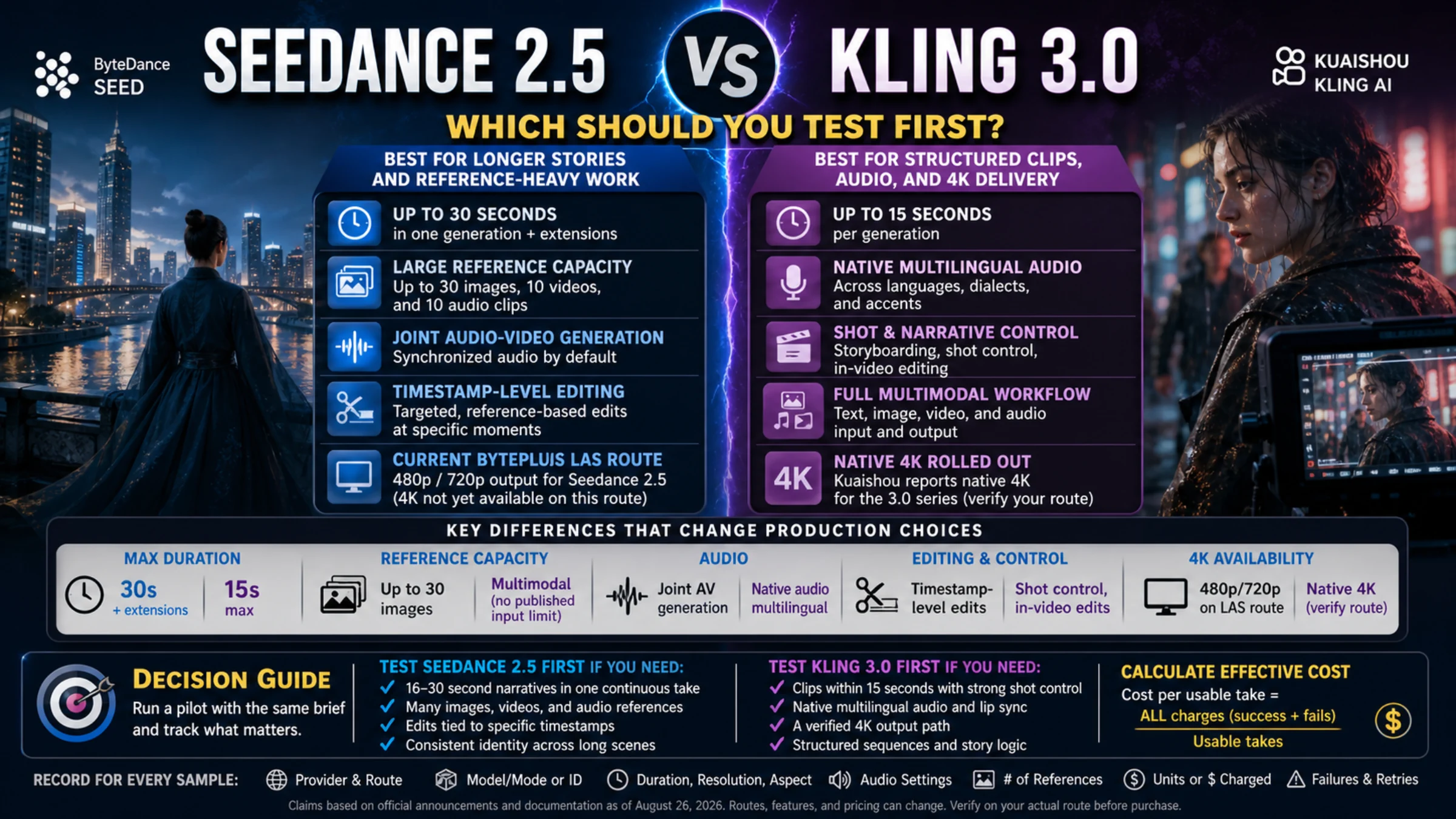
Both do 4K, native audio and multi-shot clips up to 15 seconds. Kling 3.0's 4K costs $4.20 per 10 seconds against Seedance 2.0's $7.78. Seedance 2.0's 4K mode also allows only one concurrent job and 15 requests per minute per account. Seedance 2.0 accepts up to nine images and three videos in one request and scores higher on Arena's image-to-video board. If your clip is built on a real person's face, Seedance's upload ban rules it out, and Kling's content terms are the thing to check before you plan around Kling. Most teams comparing these two are now also weighing Seedance 2.5, which Seedance 2.5 or Kling 3.0: Which Should You Test First? covers in depth.
Can you run Wan 2.7 locally?
No. As of September 25, 2026, Alibaba has not published Wan 2.7 weights, and Wan 3.0 has none either. The official Wan-AI organization on Hugging Face has nothing newer than the Wan 2.2 family, including Wan2.2-Animate-2-14B and Wan-Dancer-14B from July and August 2026. The Wan-Video GitHub organization hosts Wan2.1, Wan2.2, Wan-Animate-2 and Wan-Dancer under Apache 2.0, with no Wan 2.7 or Wan 3.0 repository.
Two things cause the confusion. ComfyUI does ship a Wan 2.7 workflow, but it runs through Partner Nodes that require a signed-in ComfyUI account and call the hosted API, so every generation is a paid cloud request. Sites with names like wan27.org or wan27ai.com are not run by Alibaba, and their download or "Apache 2.0" claims don't match Alibaba's own repositories.
If local inference is the real requirement, the choice is Wan 2.2. It is an earlier, different model, not a free version of Wan 2.7. Seedance 2.0 and Kling 3.0 are closed, hosted models, so there is no self-hosted edition of either.
Should a new project start on Wan 3.0 or Seedance 2.5 instead?
If you have no existing integration, look at the newer models before you commit, because they remove the 15-second ceiling.
- Wan 3.0 (
wan3.0-video) combines text-to-video, first/last frame, references and editing in one model, at 2–30 seconds and up to 1080p. At 720p it costs the same as Wan 2.7 in Singapore ($1.00 per 10 s) and slightly less elsewhere ($0.83). At 1080p it costs more: $2.00 in Singapore and $1.65 elsewhere, against $1.50 and $1.43 for Wan 2.7. It is also listed in Alibaba's US (Virginia) region, which Wan 2.7 is not. Its API reference still labels it a preview, but it is available without an application. - Seedance 2.5 runs to 30 seconds with up to 50 references, at $2.31 per 10 seconds at 720p and $5.69 at 1080p on the ModelArk list, with no 4K.
Wan 2.7 still makes sense when you already have working calls to its task-specific endpoints, when 1080p cost matters more than length, or when the job is wan2.7-videoedit. Seedance 2.0 still makes sense when you need 4K from Seedance. For the newer pair, Seedance 2.5 or Wan 3.0? Choose by the Production Bottleneck compares them directly. For a wider view, The AI Video Models That Matter in 2026—and How to Choose One covers eight models.
Region and account checks for US teams
- Wan 2.7 is not deployed in Alibaba's US (Virginia) or Frankfurt regions. You call it in Singapore or Tokyo, and the model, endpoint and API key must all belong to the same region, because cross-region calls fail. Model Studio's region also sets where your data is stored.
- ModelArk's availability list does not include the United States. BytePlus says availability "shall be determined at the point of purchase," so a US-based company should confirm eligibility with BytePlus before building a product on Seedance 2.0.
- Kling's developer platform prices in US dollars. Read its terms for your country when you sign up. Kling's consumer app bills in credits, which are a different currency from the API's units, so don't compare app credits with API dollars.
Run one fair test before you commit
A public demo tells you little about your own brief. Before you commit, run each finalist on the same job:
- Write one real brief: subject, action, camera, duration, aspect ratio, resolution and whether the model must produce the sound.
- Give each model the same inputs it will get in production. If Seedance gets your reference pack, Wan 2.7 R2V and Kling 3.0 Omni should get their closest equivalent.
- Record the exact model ID and region:
wan2.7-i2vor a dated snapshot, Singapore or Tokyo;kling-v3orkling-3.0-turbo;dreamina-seedance-2-0-260128. - Generate at least three takes per model and count how many you would ship. Divide the generation cost by that number to get your real cost per usable clip.
- Judge only what the job needs: identity or product consistency, motion, sound, readable text in frame, and how easily you can fix a near-miss with an edit.
The model that wins is the one that clears your acceptance bar at the lowest cost per usable clip, which may not be the one with the highest leaderboard score.
FAQ
Is Wan 2.7 open source?
No. Alibaba sells Wan 2.7 only as a hosted API on Model Studio. The newest official open weights from the Wan team belong to the Wan 2.2 family, released under Apache 2.0.
Is Wan 2.7 still available now that Wan 3.0 is out?
Yes. All four Wan 2.7 models and their dated snapshots are still listed and priced on Model Studio, and the decommissioning page lists no retirement date for the mainline models. Alibaba now recommends Wan 3.0 for new generation work and keeps wan2.7-videoedit as its pick for effect and camera-move replication.
Does Wan 2.7 support 4K?
No. Wan 2.7 outputs 720p or 1080p only. Among these three models, only Kling 3.0 and Seedance 2.0 offer 4K.
Can Seedance 2.0 make 60-second videos?
No. Seedance 2.0 generates 4–15 seconds per request on ModelArk. Seedance 2.5 extends that to 30 seconds. Longer videos mean stitching or extending clips.
Does Kling use Seedance?
No. Kling is Kuaishou's own model family, and Seedance comes from ByteDance and is sold through BytePlus ModelArk. They are separate models from competing companies.