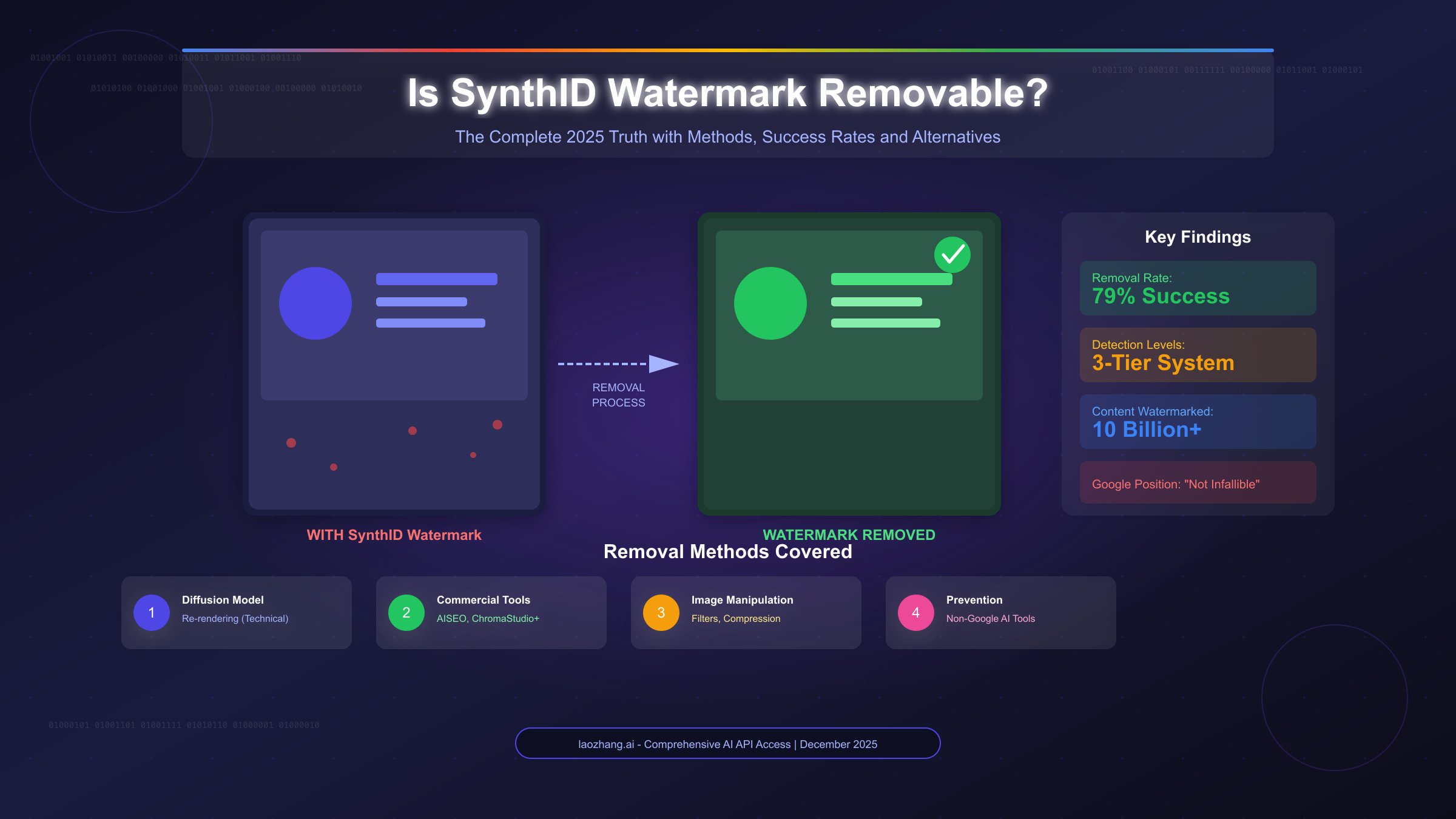
Yes, SynthID watermarks can be removed from AI-generated images, but with significant caveats. Research from IEEE Spectrum shows that specialized tools like UnMarker achieve a 79% success rate against SynthID watermarks, though Google disputes this figure. The reality is nuanced: most "removal" methods actually degrade detection confidence rather than completely eliminating the watermark. More importantly, Google themselves acknowledge that SynthID is "not infallible" and can be bypassed through various techniques. For those seeking clean AI images without watermark concerns, the most reliable approach is using non-Google AI models that don't embed SynthID in the first place.
TL;DR: Can You Remove SynthID Watermarks?
The short answer is yes, but the practical answer requires context. SynthID watermarks can be disrupted, degraded, or removed through several methods, but complete removal without any image quality loss remains challenging.
What the research shows:
| Method | Success Rate | Difficulty | Trade-off |
|---|---|---|---|
| Diffusion re-rendering | 79% | Expert | Some detail loss |
| Commercial tools | 60% | Beginner | Variable quality |
| Image manipulation | 40% | Moderate | Quality degradation |
| Prevention (non-Google AI) | 100% | Easy | None |
Key findings from December 2025:
The IEEE Spectrum published research showing the UnMarker tool defeats 79% of SynthID watermarks, though Google DeepMind contests this figure. University of Maryland researchers concluded that adversarial techniques can remove AI watermarks, but circumvention typically requires technical sophistication. Google's own documentation acknowledges that SynthID is designed to be robust but not tamper-proof.
The practical reality: If you need watermark-free AI images, prevention beats removal. Using non-Google AI models like FLUX, Stable Diffusion, or accessing models through aggregated APIs like laozhang.ai provides 100% "success rate" because these systems don't embed SynthID watermarks to begin with.
Understanding How SynthID Technology Works
Before discussing removal, understanding how SynthID embeds watermarks helps explain why removal is challenging but possible. SynthID represents a fundamentally different approach to content watermarking compared to traditional methods.
The embedding mechanism: Unlike visible watermarks that overlay images or metadata tags that attach to file headers, SynthID embeds identification signals directly into the pixel-level and frequency-domain patterns of AI-generated content. Google DeepMind developed this approach to create watermarks that are imperceptible to humans while remaining detectable by specialized verification systems. The watermark becomes part of the image's mathematical structure rather than a separate layer.
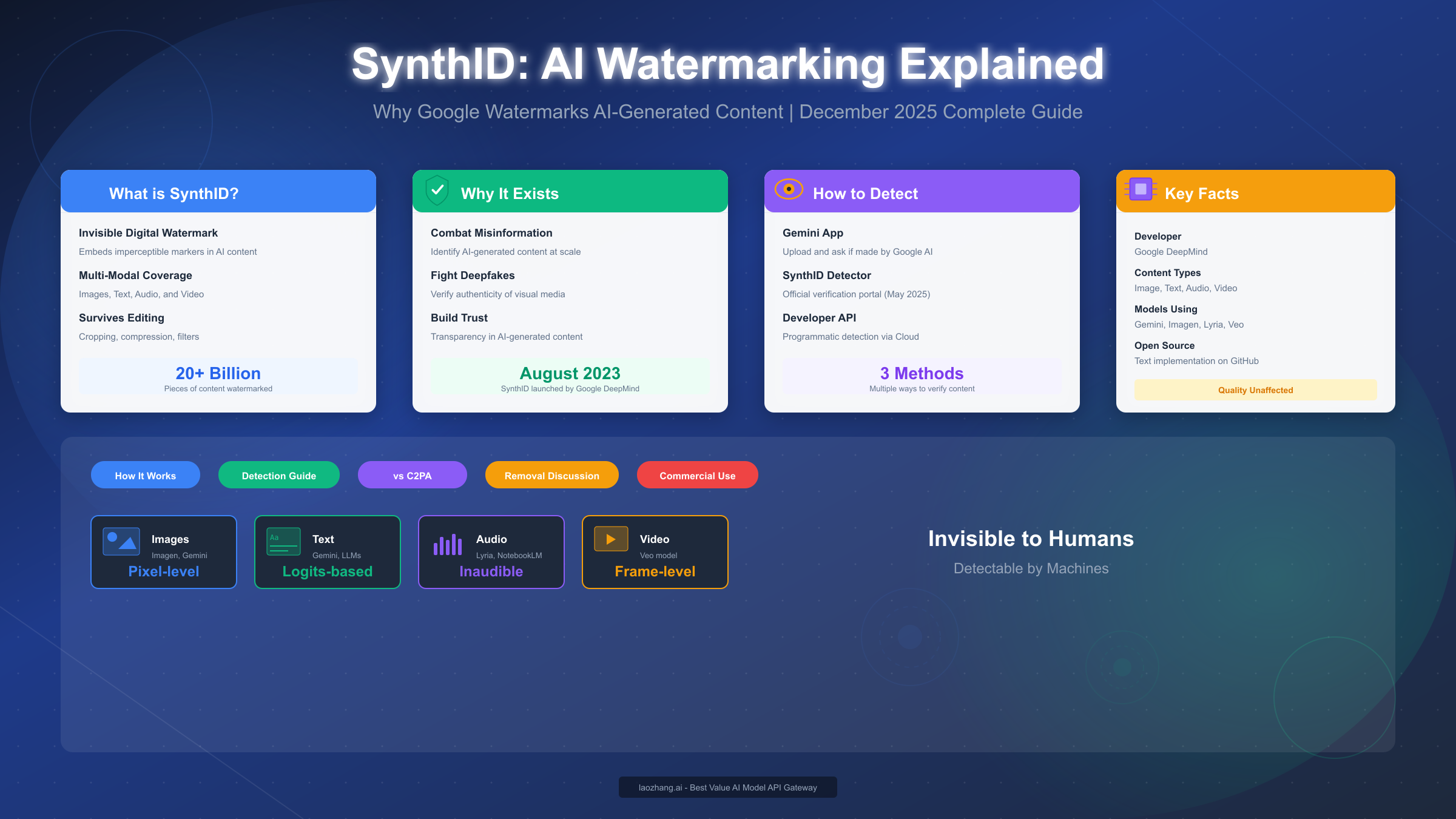
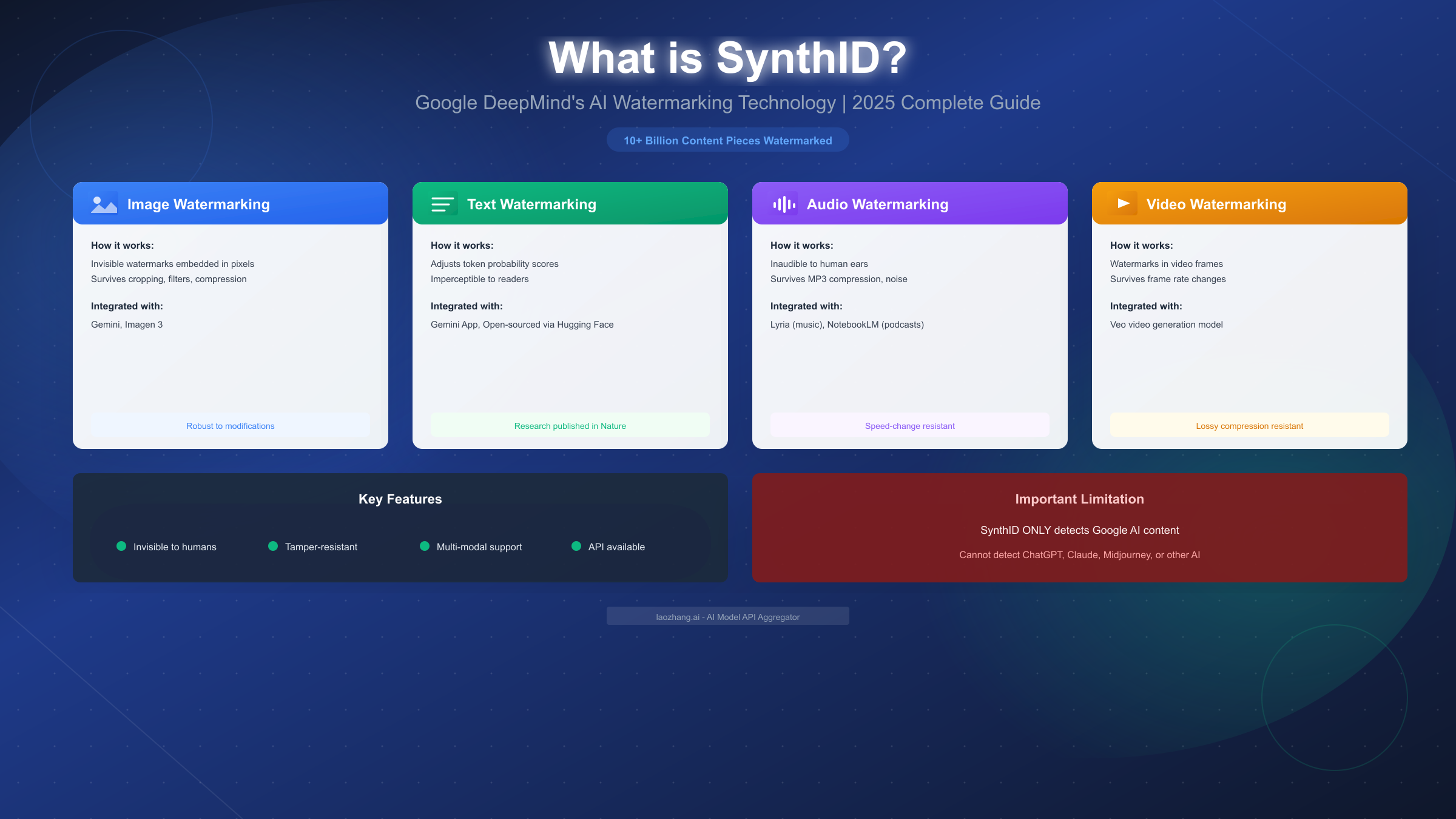
Scale of deployment: As of December 2025, Google reports that SynthID has watermarked over 10 billion pieces of content across four modalities: images (via Imagen), video (via Veo), audio (via Lyria), and text (via Gemini). This makes it the most widely deployed invisible AI watermarking system in existence.
The 3-tier detection system: SynthID doesn't provide simple yes/no detection. Instead, it uses a Bayesian detector that outputs three possible confidence levels. Understanding these levels is crucial for understanding what "removal" actually means.
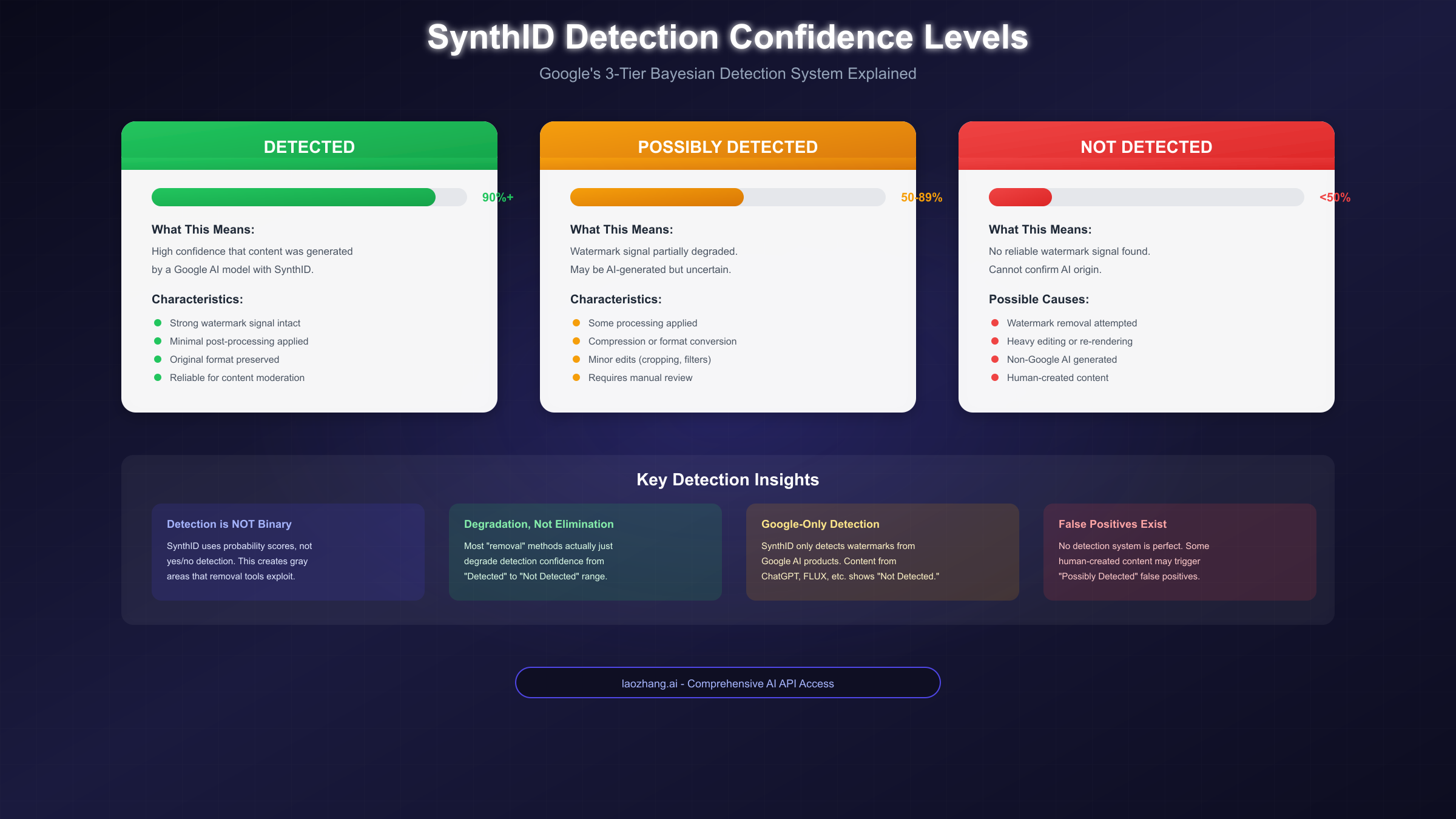
Detected (90%+ confidence): The watermark signal is strong and intact. This indicates high confidence that content originated from a Google AI model with SynthID. Detection at this level is reliable for content moderation and verification purposes.
Possibly Detected (50-89% confidence): The watermark signal has been partially degraded. This gray zone occurs when images have been processed, compressed, or edited. Most "removal" attempts actually move content from "Detected" to this zone rather than fully eliminating the watermark.
Not Detected (below 50% confidence): No reliable watermark signal found. This could mean the watermark was successfully removed, the content wasn't created by Google AI, or the content was human-created. This is the target zone for removal attempts.
What SynthID survives: The technology is designed to persist through common image transformations including cropping, resizing, compression (JPEG artifacts), minor color adjustments, and standard social media processing. Google claims these survivability characteristics are what makes SynthID useful for tracking AI content across the internet.
What SynthID doesn't survive: Heavy editing, aggressive filters, re-rendering through other AI models, translation to different formats, and targeted removal techniques can all degrade or eliminate the watermark signal.
Complete Removal Methods: From Technical to Simple
Multiple approaches exist for removing or degrading SynthID watermarks, ranging from sophisticated technical methods to simple image manipulation. Each comes with different success rates, difficulty levels, and trade-offs.
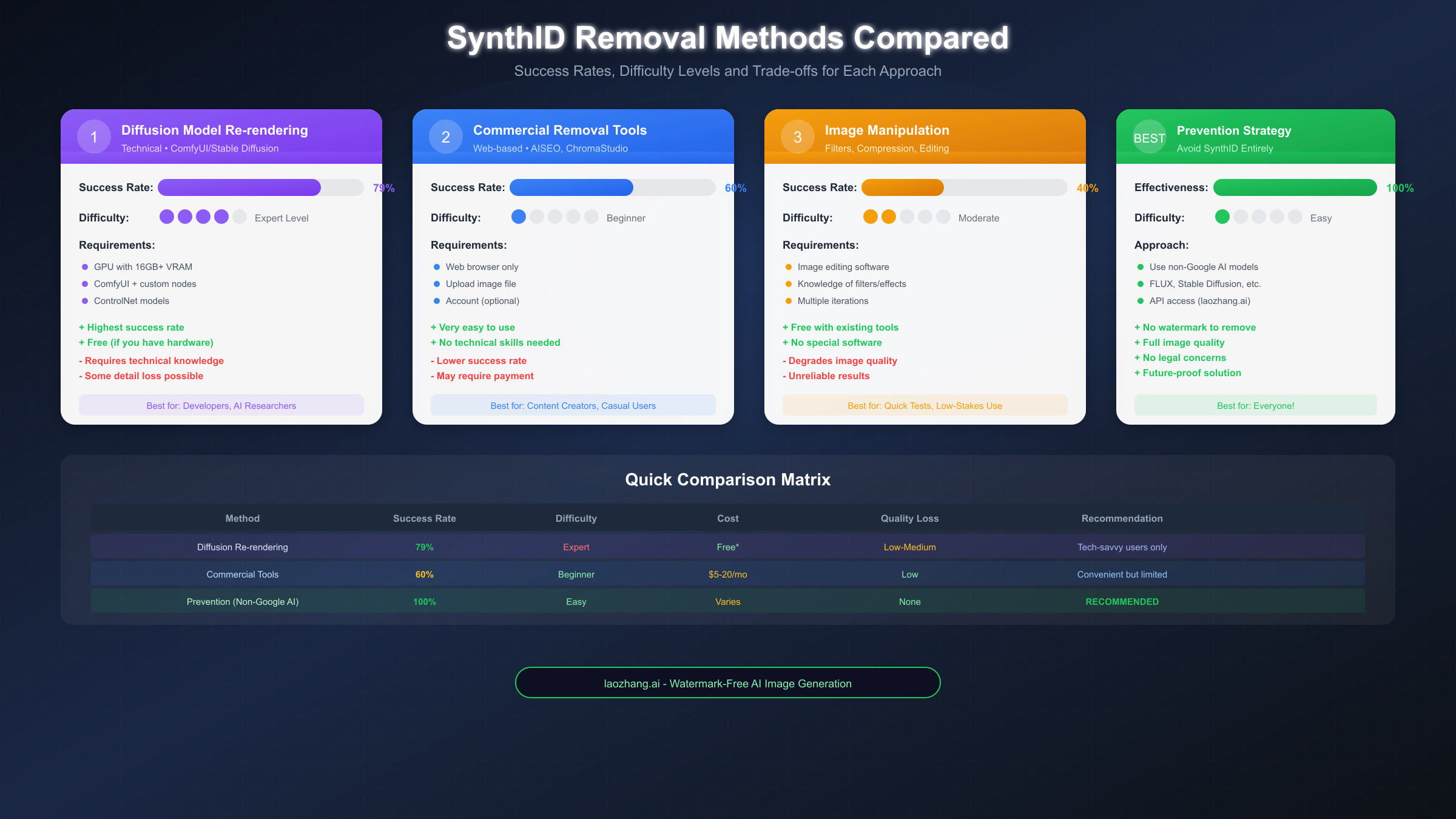
Method 1: Diffusion Model Re-rendering (79% Success Rate)
The most effective removal method involves re-processing watermarked images through a carefully configured diffusion model pipeline. This technique, documented in the GitHub repository Synthid-Bypass, uses the original image as a structural guide while a diffusion model effectively "re-renders" the content.
The core process works as follows: First, the original image is loaded into a ComfyUI workflow. ControlNets extract structural information like edges and composition. The image then passes through multiple sampling nodes with low denoising values (around 0.2), which preserve visual content while discarding the subtle watermark patterns. Face detection and dedicated sampling nodes handle portrait preservation.
This method requires significant technical resources: a GPU with 16GB+ VRAM, ComfyUI with multiple custom nodes (Impact Pack, Masquerade Nodes, Inpaint-CropAndStitch), specific models (Z-Image-Turbo, ControlNets), and familiarity with diffusion model workflows. The 79% success rate comes from IEEE Spectrum research using the related UnMarker tool, though Google disputes this figure.
Method 2: Commercial Removal Tools (60% Success Rate)
Several commercial tools now claim to remove SynthID watermarks with varying degrees of success. AISEO SynthID Remover approaches watermark removal at the pixel and frequency level, applying "fine-grained adjustments that remain invisible to viewers while being effective against watermark detection." The tool processes files locally in the browser, meaning your images never leave your device.
ChromaStudio offers similar functionality, claiming to clear invisible SynthID watermarks from AI-generated images without harming quality. RemoveMySynthID.com provides free client-side processing for images, videos, and text.
These tools share important caveats: results may vary depending on specific watermark implementation and image characteristics. No removal method can guarantee identical outcomes across every possible scenario, and these tools don't claim to bypass all detection mechanisms permanently. The estimated 60% success rate reflects the reality that commercial tools offer convenience but not guaranteed results.
Method 3: Image Manipulation (40% Success Rate)
Basic image editing techniques can sometimes degrade watermark detection, though results are unreliable. Applying aggressive filters such as color distortion or extreme contrast changes can disrupt watermark patterns. Re-encoding with major adjustments to compression, frame rate, or color profile may degrade the watermark. Heavy noise addition, blur effects, and artistic stylization can also reduce detection confidence.
The problem with this approach is quality degradation. The modifications required to meaningfully impact watermark detection typically cause visible damage to the image. You might successfully move detection from "Detected" to "Not Detected," but at the cost of having a noticeably degraded image.
Method 4: Translation and Reprocessing (Variable Success)
Watermarks embedded in AI-generated text can be removed through translation to another language and back, or through significant paraphrasing. For images, screenshotting and re-uploading can strip some metadata-based signals, though SynthID's pixel-level embedding makes this less effective than it would be for simpler watermarking systems.
Reprocessing through non-watermarking AI systems (using the image as input to a model that doesn't apply SynthID) effectively creates a new image without the watermark. This is essentially a form of the diffusion re-rendering method but can be done through various img2img tools.
Tool-by-Tool Analysis and Comparison
For those who want to attempt removal, here's a detailed breakdown of available tools, their approaches, and realistic expectations.
UnMarker (Research Tool)
UnMarker emerged from academic research into watermarking vulnerabilities. According to IEEE Spectrum, the tool entirely defeated HiDDeN and Yu2 watermarks, achieved 79% success against SynthID (disputed by Google), and showed that even newer watermarks like StegaStamp and Tree-Ring were defeatable at around 60%. The tool works by analyzing spectral frequencies and applying targeted modifications.
UnMarker is primarily a research tool demonstrating watermarking limitations rather than a user-friendly product. Access requires academic context and technical implementation skills.
AISEO SynthID Remover
This commercial tool offers browser-based processing for images and videos. It targets the pixel/frequency level where SynthID operates, supports JPEG, PNG, WebP, MP4, WebM, and MOV formats, and processes everything locally for privacy. Pricing requires checking their website, though some functionality may be available through free trials.
ChromaStudio
Focuses specifically on image watermark removal with claims of quality preservation. The tool is marketed toward content creators who need clean AI images for commercial use.
RemoveMySynthID.com
A free, browser-based option with client-side processing. The site emphasizes that files are "instantly wiped from memory" after download and never leave your device. However, free tools typically have more limited capabilities than paid alternatives.
ComfyUI Workflows
For technical users, open-source ComfyUI workflows provide the most control and highest success rates. The Synthid-Bypass repository on GitHub provides a complete implementation. Requirements include specific model downloads, node installations, and GPU resources, but the cost is free beyond hardware investment.
| Tool | Type | Success Rate | Cost | Difficulty |
|---|---|---|---|---|
| UnMarker | Research | 79% | Academic | Expert |
| AISEO | Commercial | ~60% | Subscription | Beginner |
| ChromaStudio | Commercial | ~60% | Subscription | Beginner |
| RemoveMySynthID | Free web | Variable | Free | Beginner |
| ComfyUI workflows | Open source | 79% | Free* | Expert |
*Requires GPU hardware investment
For developers and businesses needing consistent API access to AI models without watermarking concerns, platforms like laozhang.ai provide aggregated access to various AI models at competitive rates, with full documentation available at https://docs.laozhang.ai/.
What Happens When Removal Fails
Understanding failure modes helps set realistic expectations. Not all removal attempts succeed, and partial success can be worse than no attempt at all.
Partial watermark persistence: The most common outcome of removal attempts isn't complete success or complete failure—it's partial degradation. The watermark signal may drop from "Detected" to "Possibly Detected," which is enough to evade some automated filters but not enough to pass rigorous verification. This partial state can be problematic because it suggests tampering.
Image quality degradation: Aggressive removal techniques often damage visible image quality. Diffusion re-rendering can cause subtle detail loss, especially in complex textures, faces, and fine patterns. Commercial tools may introduce artifacts, color shifts, or resolution reduction. The trade-off between watermark removal and image quality is fundamental.
Detection confidence variation: Removal success can vary by image. The same technique might achieve complete removal on one image and barely affect another. Factors include original image complexity, watermark implementation version, and specific modifications applied. Claims of consistent success rates should be treated skeptically.
The "100% removal" myth: No current method guarantees complete watermark removal across all images without any quality loss. Tools claiming 100% success rates are overstating their capabilities. Even the most effective methods have failure cases.
Residual detection risk: Even when detection shows "Not Detected," there's no guarantee the watermark is completely gone. Detection systems may improve over time, and archived images could be re-analyzed with more sensitive methods in the future. Removal is not necessarily permanent protection.
Legal and Ethical Considerations
Watermark removal exists in a complex legal and ethical landscape that varies by jurisdiction and use case. Understanding these implications is essential before attempting removal.
US Legal Framework (COPIED Act 2024)
The US Congress passed the COPIED Act in 2024, which criminalizes the removal of AI content watermarks under certain circumstances. The law specifically targets removal intended to deceive or defraud, particularly in contexts involving electoral manipulation, fraud, or impersonation. However, the law includes exceptions for research purposes and personal use not intended to deceive.
Enforcement remains largely untested as of December 2025. The act primarily targets commercial operations and organized disinformation campaigns rather than individual users experimenting with their own AI-generated content.
EU AI Act Implications
The EU AI Act includes transparency requirements for AI-generated content. While not specifically criminalizing watermark removal, the act emphasizes that high-risk AI applications must maintain content authenticity. Commercial use of watermark-removed AI content in the EU may face regulatory scrutiny, particularly in advertising, news media, and political communications.
Platform Terms of Service
Major platforms including Meta, Google, and X (Twitter) have terms prohibiting removal of AI content identifiers when uploading content. Violation can result in account suspension or content removal. These platform-level restrictions may have more immediate practical impact than government regulations.
Ethical Framework: When Removal May Be Justified
Some use cases for watermark removal are ethically defensible. Security researchers studying watermarking vulnerabilities contribute to improving detection systems. Artists seeking to maintain creative control over their own AI-assisted work have legitimate interests. Privacy advocates concerned about tracking may have reasonable objections to permanent watermarks.
Ethically Problematic Use Cases
Removing watermarks to create deceptive content, pass off AI work as human-created, evade content moderation systems, or commit fraud is ethically indefensible regardless of legal status. The existence of removal tools doesn't make these uses acceptable.
| Jurisdiction | Primary Law | Removal Status | Enforcement |
|---|---|---|---|
| United States | COPIED Act 2024 | Criminalized (with exceptions) | Limited |
| European Union | AI Act | Regulated | Developing |
| United Kingdom | Online Safety Act | Indirect regulation | Active |
| China | AI Regulations | Restricted | Active |
| Platform-level | Terms of Service | Prohibited | Automated |
Better Alternatives: Avoiding SynthID Entirely
The most reliable way to have AI images without SynthID watermarks is to not use Google AI products for generation. This prevention approach has a 100% "success rate" because there's no watermark to remove.
Non-Google AI Image Generators
Several high-quality AI image generators don't use SynthID or any similar invisible watermarking. FLUX, developed by Black Forest Labs, produces excellent results without embedded watermarks. Stable Diffusion models, whether SDXL, SD 3, or community fine-tunes, don't include invisible watermarks. Midjourney uses its own approaches to content identification but not SynthID. DALL-E from OpenAI has its own watermarking approach distinct from SynthID.
Local Deployment Options
Running AI models locally provides complete control over output. ComfyUI supports FLUX and Stable Diffusion models without any watermarking. Automatic1111 and Forge offer similar capabilities. The trade-off is hardware requirements and setup complexity, but the result is clean images with no tracking.
API Access Alternatives
For developers and businesses needing programmatic access to AI image generation, several options exist. Replicate offers access to various models with transparent policies. Together AI provides model access at scale. For those seeking cost-effective unified access to multiple AI models, platforms like laozhang.ai offer aggregated API access to FLUX, Stable Diffusion, and other watermark-free models at competitive rates (approximately 84% of official pricing with volume bonuses).
When Prevention Beats Removal
For most practical purposes, prevention is superior to removal for several reasons. There's no quality degradation from removal processing. No legal concerns arise about watermark removal. Future detection improvements can't retroactively identify your content. You maintain full control over your creative output. The workflow is simpler with no post-processing required.
If your use case allows choosing your AI model, choose one that doesn't apply SynthID rather than trying to remove it afterward. For users related to the watermark topic, see our guide on Nano Banana Pro watermark commercial use for more context on AI image watermarking.
The Future of AI Watermarking
The cat-and-mouse dynamic between watermarking and removal will continue evolving. Understanding likely trajectories helps inform current decisions.
SynthID Improvement Trajectory
Google DeepMind continues developing SynthID with each iteration becoming more robust. Future versions will likely address known bypass methods, reduce vulnerability to diffusion re-rendering, and improve detection sensitivity. The watermark embedding may become more deeply integrated into the generation process, making removal increasingly difficult.
Industry Standardization Efforts
The Coalition for Content Provenance and Authenticity (C2PA) is developing industry-wide standards for content authentication. If standardization succeeds, multiple AI providers might adopt compatible watermarking systems, making the "use non-watermarked alternatives" strategy less viable over time.
Regulatory Pressure
Government requirements for AI content identification are expanding globally. Future regulations may mandate watermarking for AI content, narrow exceptions for watermark-free generation, and create penalties for platforms hosting unmarked AI content.
Technical Predictions
Near-term, removal methods will remain viable for technically sophisticated users. Medium-term, improved watermarking may make current removal techniques obsolete. Long-term, the equilibrium likely favors watermarking as detection systems become more capable and removal becomes harder.
Practical Implications
If you're building a workflow that depends on watermark-free AI content, consider building flexibility to adapt as the landscape changes. The current window of relatively easy removal may not remain open indefinitely.
Final Verdict and Recommendations
After comprehensive analysis of SynthID watermark removal methods, tools, legal implications, and alternatives, here's the bottom line for different user types.
For content creators needing clean AI images: Use non-Google AI models from the start. FLUX, Stable Diffusion, and similar tools provide high-quality output without SynthID. Prevention is simpler, more reliable, and carries no legal risk compared to removal.
For researchers studying watermarking: The documented bypass methods and tools provide legitimate research opportunities. Academic context and proper disclosure protect this use case under most legal frameworks.
For developers building AI applications: Avoid the complexity of watermark removal in your pipeline. Access watermark-free models through APIs like laozhang.ai for clean, scalable image generation without post-processing concerns.
For casual users with a specific image: Commercial tools like AISEO or ChromaStudio offer the simplest approach, understanding that results vary and success isn't guaranteed. For one-off needs, the 60% success rate may be acceptable.
For technical users seeking maximum control: ComfyUI workflows with diffusion re-rendering provide the highest success rates. The investment in setup pays off if you need consistent removal across many images.
The fundamental recommendation: Choose your AI model based on watermarking policy before generation, not after. The effort spent on removal is better spent on selecting the right tool for your needs from the start.
SynthID watermarks can be removed, but the question should be whether removal is the right approach for your situation. In most cases, it isn't.
This analysis reflects the state of SynthID technology and removal methods as of December 2025. Both watermarking systems and bypass techniques evolve rapidly; verify current capabilities before making decisions based on this information.