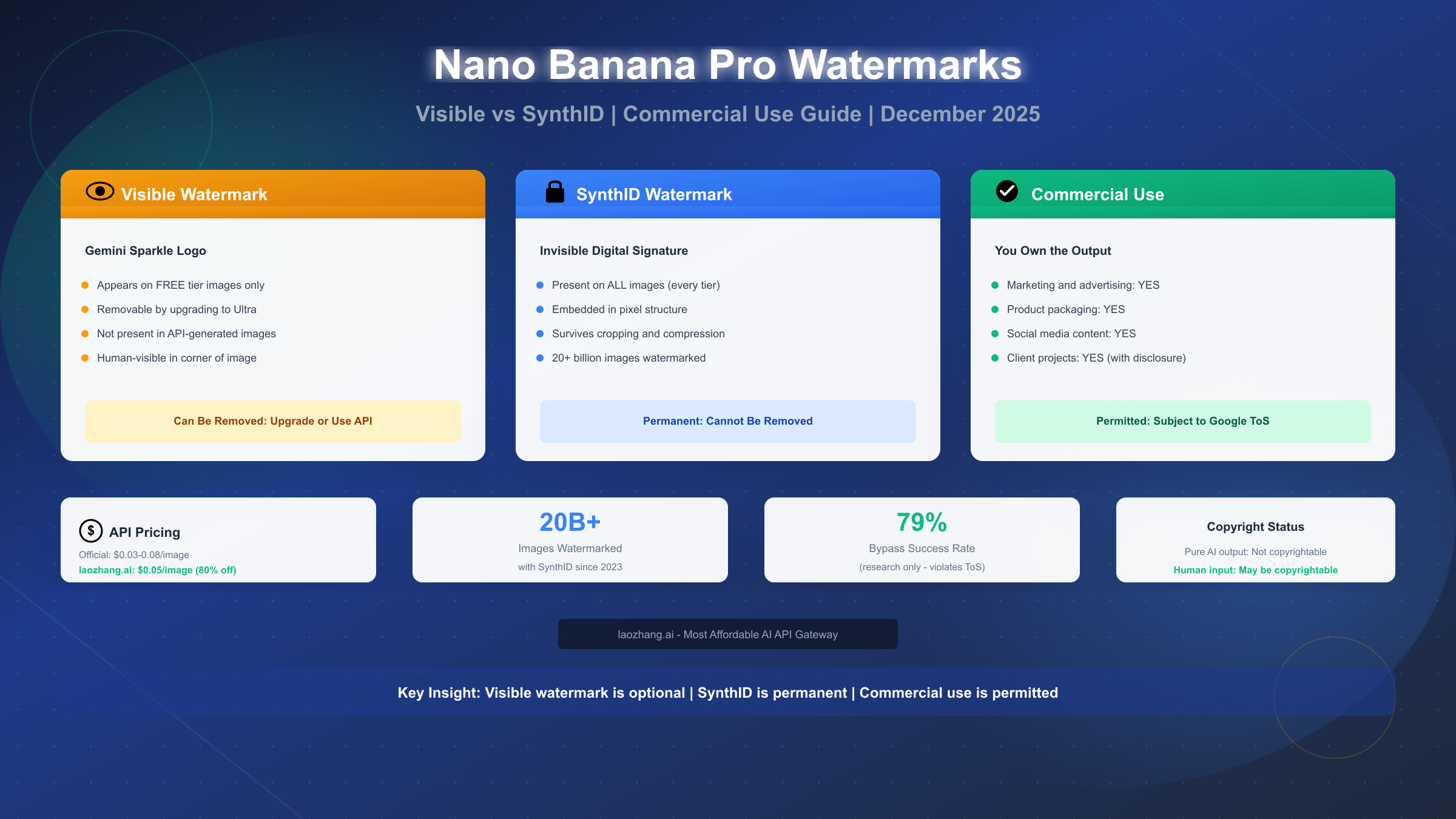
Nano Banana Pro applies two distinct watermarks to every image it generates, and understanding the difference between them is essential for anyone using AI images commercially. The visible watermark (the Gemini sparkle logo) only appears on free tier images and can be removed by upgrading to Gemini Ultra or using the API directly. The invisible SynthID watermark, however, is embedded in all images regardless of your subscription tier and cannot be removed without degrading image quality. For commercial use, Google permits businesses to use generated images in marketing materials, products, and advertising—you own the output under their Terms of Service. This December 2025 guide explains everything you need to know about watermarks, commercial rights, and best practices for using Nano Banana Pro images in your business.
What is Nano Banana Pro and Why Watermarks Matter
Nano Banana Pro represents Google's most advanced image generation technology, built on the Gemini 3 Pro architecture and developed by Google DeepMind. Unlike its predecessor Nano Banana (based on Gemini 2.5 Flash), the Pro version delivers superior image quality, better text rendering with 94% accuracy, and support for resolutions up to 4K. If you want to understand the technical differences between Nano Banana and Nano Banana Pro, we have a detailed comparison available.
The watermarking system exists for a critical reason that extends beyond simple branding. Google implemented watermarks as part of their responsible AI initiative, responding to growing concerns about AI-generated content being used to spread misinformation, create deepfakes, or deceive consumers. The SynthID technology specifically was developed by Google DeepMind to create an invisible but detectable signature that identifies content as AI-generated without affecting image quality or usability.
Why this matters for businesses: The presence of SynthID doesn't restrict your commercial use rights, but it does mean that anyone with the right tools can verify whether your image was AI-generated. As regulations around AI content disclosure tighten globally—particularly with the EU AI Act and similar legislation—understanding these watermarks becomes increasingly important for compliance and transparency.
The watermarking approach also reflects Google's commitment to the C2PA (Coalition for Content Provenance and Authenticity) standards, which aim to create industry-wide transparency about content origins. Since late 2024, Nano Banana Pro images also embed C2PA metadata alongside SynthID, providing multiple layers of provenance information. This doesn't change your rights as a user, but it does mean your images carry verifiable information about their AI origins.
The Two Watermark Types Explained
Understanding the fundamental difference between visible and invisible watermarks is crucial for making informed decisions about your Nano Banana Pro usage. These two systems serve different purposes and have completely different implications for your workflow.
Visible Watermark (Gemini Sparkle)
The visible watermark appears as a small Gemini sparkle logo, typically positioned in a corner of generated images. This watermark is purely cosmetic and serves as a branding element rather than a security feature. Google applies this visible mark only to images generated through their free consumer-facing products, specifically the Gemini web application at gemini.google.com.
The visible watermark is designed to be obvious to human viewers, clearly indicating that an image was created using Google's AI tools. However, it's important to understand that this mark is essentially optional—it's removed at higher subscription tiers and never applied to API-generated images in the first place. The visible watermark has no connection to SynthID and removing it (through an upgrade) does not affect the invisible watermark in any way.
When visible watermarks appear: Free tier Gemini web app usage only. Images generated through Google AI Studio, the official API, Vertex AI enterprise platform, or third-party API providers never receive visible watermarks.
Invisible SynthID Watermark
SynthID operates on an entirely different principle. Developed by Google DeepMind, this technology embeds an imperceptible digital signature directly into the pixel structure of every generated image. Unlike the visible watermark, SynthID cannot be seen by human eyes—it exists as subtle statistical patterns woven throughout the image data.
The technical implementation uses a form of steganography, where information is hidden within other data. During image generation, the AI model makes millions of small adjustments to pixel values that are invisible to viewers but create a detectable pattern for specialized software. According to Google DeepMind, over 20 billion pieces of content have been watermarked with SynthID since its 2023 launch.
Key characteristics of SynthID:
- Embedded during generation, not added afterward
- Survives common modifications including cropping, resizing, compression, and color adjustments
- Cannot be completely removed without significantly degrading image quality
- Detection requires specialized tools—the Gemini app can verify SynthID presence when you upload an image and ask "Was this created by Google AI?"
- Applied to ALL Nano Banana Pro images regardless of access method or subscription tier
Detection and Verification Methods
Google provides several ways to verify whether an image contains SynthID watermarks. The most accessible method is through the Gemini app itself—simply upload an image and ask whether it was created or edited with Google AI. The system will analyze the embedded signature and provide a confidence assessment.
For developers, the SynthID detector is available as a Bayesian classifier that outputs three possible states: watermarked, not watermarked, or uncertain. The uncertain state accounts for cases where an image may have been modified enough to partially degrade the watermark without completely removing it. Research implementations are available on GitHub and through Hugging Face Transformers.
It's worth noting that SynthID detection only works for Google-generated content. The system cannot identify images created by other AI generators like DALL-E, Midjourney, or Stable Diffusion—each company implements their own watermarking approaches with varying degrees of robustness.
Pricing Tiers and Watermark Differences
The relationship between pricing and watermarks creates important considerations for different use cases. Here's a comprehensive breakdown of what you get at each tier.
| Access Method | Visible Watermark | SynthID | Commercial Rights | Cost |
|---|---|---|---|---|
| Gemini Free | Yes (sparkle logo) | Yes | Limited (personal) | $0 |
| Gemini Advanced | Yes | Yes | Full | $20/month |
| Gemini Ultra | No | Yes | Full | Enterprise pricing |
| Google AI Studio | No | Yes | Full | Free (rate limited) |
| Official Gemini API | No | Yes | Full | $0.03-0.08/image |
| laozhang.ai | No | Yes | Full | $0.05/image |
Understanding the tiers: The progression from free to paid tiers primarily affects the visible watermark, not SynthID. Many users mistakenly believe that paying for Gemini Advanced removes "the watermark"—but this only removes the visible Gemini sparkle. The invisible SynthID signature remains embedded in all images regardless of what you pay.
For the detailed API pricing breakdown, the official rates vary by resolution: standard 1K images cost less than high-resolution 2K or 4K outputs. However, third-party API providers like laozhang.ai offer a flat $0.05 per image regardless of resolution, which represents significant savings for high-volume usage—approximately 80% less than official rates for 4K images.
Cost optimization strategy: If your primary concern is removing the visible watermark while maintaining full commercial rights, the most cost-effective approach is using the API rather than consumer subscriptions. Google AI Studio provides free API access with rate limits, while third-party providers offer unlimited access at fixed per-image pricing without the visible watermark.
The Gemini API pricing structure follows token-based billing for text models, but image generation uses per-image pricing that varies by resolution. For production workloads generating hundreds or thousands of images, the cost difference between access methods becomes substantial.
Commercial Use: What You Can and Can't Do
The commercial use rights for Nano Banana Pro images are more permissive than many users realize, but they come with important caveats that every business should understand.
Permitted Commercial Uses
Google's Terms of Service grant users ownership of generated content, meaning you can use Nano Banana Pro images for commercial purposes without paying additional licensing fees. The specific permitted uses include:
Marketing and advertising: You may use AI-generated images in digital advertisements, print campaigns, social media marketing, email newsletters, and promotional materials. This extends to paid advertising on platforms like Google Ads, Meta, and other networks, though individual platforms may have their own AI content disclosure requirements.
Product packaging and merchandise: Generated images can be used on physical products, packaging design, labels, and merchandise for sale. There's no revenue threshold or royalty requirement—once you generate an image, you own the rights to use it commercially.
Website and application graphics: Use AI images as website backgrounds, hero images, blog illustrations, app interfaces, and user interface elements. This applies to both consumer-facing and internal business applications.
Client work and services: Designers and agencies can use Nano Banana Pro to create images for client projects, including commercial work for hire. However, transparency with clients about AI generation is strongly recommended from both ethical and legal perspectives.
Prohibited Uses and Restrictions
While commercial use is broadly permitted, Google maintains strict prohibitions that could result in account termination or legal action:
Deceptive content: You cannot use AI-generated images to deceive, harass, or mislead others. This includes creating fake news imagery, impersonating real people without consent, or generating content intended to manipulate public opinion. The SynthID watermark specifically exists to prevent such misuse.
Harmful content: Generation of violent, sexually explicit, or discriminatory content is prohibited regardless of commercial intent. Google's content filters actively block many such requests, but attempting to circumvent these restrictions violates Terms of Service.
Intellectual property violations: While you own your generated output, you cannot use AI to infringe on existing copyrights, trademarks, or personality rights. Generating images that closely replicate copyrighted works, brand logos, or recognizable likenesses of real people without permission remains prohibited.
Model redistribution: You own the generated images but not the underlying AI model. Attempting to reverse-engineer, extract, or redistribute Google's image generation technology violates Terms of Service.
Decision matrix for common scenarios:
| Use Case | Permitted? | Notes |
|---|---|---|
| Social media posts | Yes | Recommend AI disclosure |
| Paid advertisements | Yes | Check platform policies |
| Product packaging | Yes | Full commercial rights |
| Stock photo alternatives | Yes | Non-exclusive rights |
| Client deliverables | Yes | Recommend client disclosure |
| Creating logos | Caution | Trademark issues possible |
| Editorial/news imagery | Caution | Disclosure required |
| Impersonating real people | No | Prohibited |
Developer Guide: API and Watermarks
For developers integrating Nano Banana Pro into applications, understanding how watermarks behave at the API level is essential for building compliant and user-friendly products.
The Gemini API provides image generation through the generateContent endpoint with specific parameters for controlling output. Crucially for developers: API-generated images never receive the visible Gemini sparkle watermark, but SynthID is always embedded. There is no API parameter to disable SynthID—it's applied at the model level during generation, not as a post-processing step.
Basic Python implementation:
import google.generativeai as genai
from PIL import Image
import io

# Configure with your API key
genai.configure(api_key="YOUR_API_KEY")

# Initialize the model
model = genai.GenerativeModel("gemini-3-pro-image")

# Generate image with specified parameters
response = model.generate_content(
    "A professional business meeting in a modern office",
    generation_config={
        "response_modalities": ["IMAGE"],
        "image_size": "1024x1024"  # Options: 1K, 2K, 4K
    }
)

# Process the response
if response.candidates:
    image_data = response.candidates[0].content.parts[0].inline_data.data
    image = Image.open(io.BytesIO(image_data))
    image.save("output.png")
    print("Image generated with SynthID embedded")
For production applications requiring high throughput without official API rate limits, third-party providers offer compelling alternatives. Services like laozhang.ai provide the same Nano Banana Pro model access at $0.05 per image with no rate limiting—particularly valuable for applications generating hundreds of images daily.
Third-party API example:
import requests
import base64

# laozhang.ai endpoint
url = "https://api.laozhang.ai/v1/images/generations"

headers = {
    "Authorization": "Bearer YOUR_LAOZHANG_API_KEY",
    "Content-Type": "application/json"
}

payload = {
    "model": "gemini-3-pro-image",
    "prompt": "Professional product photography, white background",
    "size": "1024x1024",
    "n": 1
}

response = requests.post(url, headers=headers, json=payload)
result = response.json()

# Image returned as base64
image_b64 = result["data"][0]["b64_json"]
Watermark handling in applications: Since SynthID cannot be detected by your application code (only by Google's specialized detection tools), there's no need to add watermark-checking logic to your image processing pipeline. However, you should:
- Store metadata indicating AI generation for your records
- Consider adding visible AI disclosure if required by platform policies
- Implement content moderation for user-generated prompts
- Respect rate limits to avoid API throttling
For developers working with the complete guide to 4K image generation, the same watermark behavior applies across all resolutions. Higher resolution images contain the same SynthID signature—it scales with image size rather than becoming more or less detectable.
The Truth About Removing Watermarks
The topic of watermark removal generates significant interest but requires careful consideration of both technical realities and ethical implications.
Technical feasibility: Research from the University of Maryland and other institutions has demonstrated that SynthID, while robust, is not completely invulnerable. Studies have achieved bypass rates of approximately 79% using adversarial techniques—specifically, re-processing images through carefully configured diffusion models that preserve visual content while disrupting the embedded signature. However, these techniques require significant computational resources and specialized knowledge.
Commercial watermark removal tools have also emerged, claiming to scramble SynthID signatures while maintaining image quality. These tools work by applying subtle modifications throughout the image that confuse detection algorithms without creating visible artifacts. The effectiveness varies depending on the specific image and the modifications applied.
Why removal is problematic: Despite technical feasibility, attempting to remove SynthID raises serious concerns:
Removing watermarks almost certainly violates Google's Terms of Service. The consequences can include immediate account termination, loss of access to all Google services linked to your account, and potential legal action for commercial misuse. For businesses, the reputational risk of being caught using de-watermarked AI content far outweighs any perceived benefit.
The regulatory landscape is also shifting against watermark removal. The EU AI Act and similar legislation increasingly require AI content disclosure, making watermark removal potentially illegal in certain jurisdictions. Companies operating in regulated industries face additional compliance risks.
Why removal is usually unnecessary: The presence of SynthID doesn't restrict your commercial rights or image usability. The watermark is invisible to human viewers and doesn't affect print quality, digital display, or any normal use case. The only scenario where SynthID detection matters is if someone specifically checks your image using Google's verification tools—and in most commercial contexts, this verification never occurs.
For legitimate business use, the question isn't whether to remove watermarks but whether to disclose AI generation. Many platforms now encourage or require such disclosure regardless of watermark presence. Embracing transparency about AI usage often builds more trust than attempting to hide it.
Copyright, Ownership, and Legal Realities
The legal landscape surrounding AI-generated images continues to evolve, but current frameworks provide reasonable clarity for commercial users.
Ownership under Google's Terms: According to Google's Terms of Service, users retain ownership of content they create using Gemini services, including images generated with Nano Banana Pro. This means Google doesn't claim rights to your generated images and won't use them without your permission. You're free to license, sell, or commercially exploit your generated content as you see fit.
However, this ownership is subject to compliance with Google's usage policies. Violations—such as generating prohibited content or attempting to remove watermarks—can result in loss of these rights along with account termination.
Copyright protection challenges: The more complex issue involves copyright registration and legal protection for AI-generated works. Under current U.S. Copyright Office guidance (updated January 2025), purely AI-generated content without meaningful human creative input is not eligible for copyright protection. This means you own your generated images, but you may not be able to register them for copyright or prevent others from using identical or similar outputs.
The key phrase is "meaningful human creative input." The Copyright Office has clarified that human involvement in prompt creation, curation, selection, and post-processing can establish copyrightability. If you substantially modify AI outputs, combine them with original elements, or use AI as one tool in a larger creative process, the resulting work may qualify for protection.
Practical implications for businesses:
For most commercial uses, the copyright question is less relevant than it appears. Using an image in advertising, on products, or on your website doesn't require copyright registration. The ownership granted by Google's ToS is sufficient for typical business applications.
Where copyright matters is in preventing others from using your work. If you generate a unique character design or logo using AI, you may have limited legal recourse if competitors create similar imagery. For critical brand assets, consider working with human designers or substantially modifying AI outputs to establish clear creative ownership.
International considerations: Copyright laws vary significantly across jurisdictions. The EU, China, and other regions are developing their own frameworks for AI-generated content that may differ from U.S. approaches. Businesses operating internationally should consult local legal expertise for specific compliance requirements.
Conclusion and Best Practices
Nano Banana Pro's watermarking system reflects the broader industry movement toward transparency and accountability in AI-generated content. Understanding these watermarks empowers you to use the technology effectively while maintaining compliance with evolving regulations.
Key takeaways:
The visible Gemini sparkle watermark is optional and easily avoided—use the API, Google AI Studio, or upgrade to Gemini Ultra. It's a branding element, not a restriction on your rights.
SynthID is permanent and universal—every Nano Banana Pro image contains this invisible signature regardless of how you access the service. Accepting this reality is easier than fighting it, especially since it doesn't affect your commercial rights or image quality.
Commercial use is permitted within Google's Terms of Service. You own your generated images and can use them for marketing, products, client work, and other business purposes without additional licensing fees.
Transparency is increasingly valuable—rather than trying to hide AI generation, many businesses are finding that disclosure builds trust with customers and protects against regulatory risk.
Recommended approach for businesses:
- Use API access (official or third-party) to avoid visible watermarks while maintaining full commercial rights
- Maintain internal records of AI-generated content for compliance purposes
- Consider adding voluntary AI disclosure, especially for marketing and editorial content
- Focus on prompt engineering and post-processing to maximize creative value
- Consult legal counsel for high-stakes brand assets or regulated industries
For API access and documentation, visit https://docs.laozhang.ai/ for cost-effective integration options, or explore Google's official Gemini API documentation for direct access.
The future of AI-generated content will likely bring increased transparency requirements and more sophisticated watermarking technologies. By understanding and working with these systems today, you position your business for compliance and success as the landscape continues to evolve.