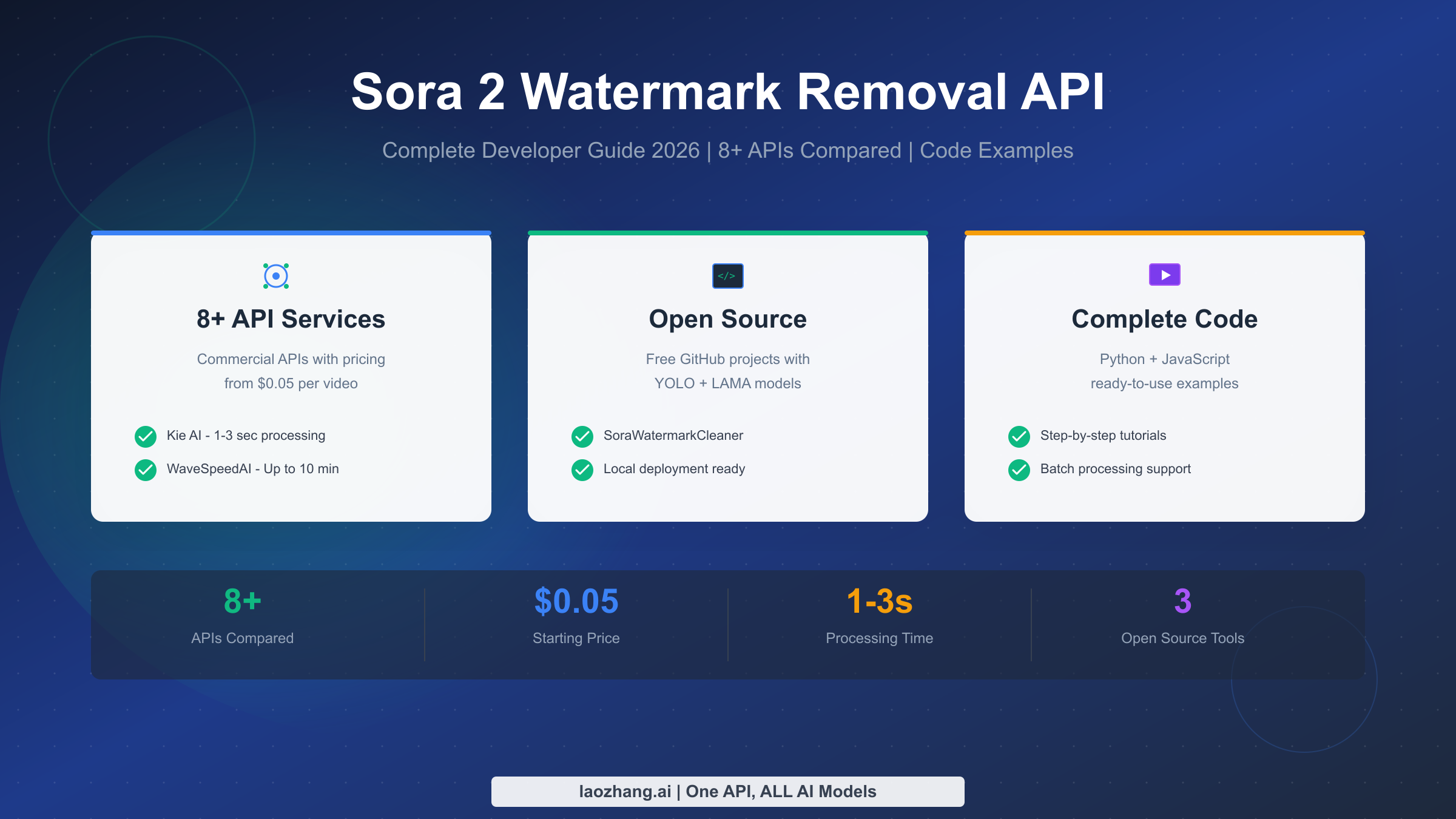
Looking for the best way to remove watermarks from your Sora 2 videos via API? You're not alone. Since OpenAI launched Sora 2, thousands of developers and creators have been searching for reliable solutions to handle the prominent "Made with Sora" watermark that appears on all generated videos. This comprehensive guide compares 8+ commercial APIs with pricing starting from just $0.05 per video, alongside free open-source alternatives that you can deploy locally. Whether you need quick API integration or prefer the privacy of self-hosted solutions, we've tested and documented everything you need to make an informed decision in January 2026.
Understanding Sora 2 Watermarks
Before diving into removal solutions, it's essential to understand what you're dealing with. OpenAI's Sora 2 implements a multi-layered watermarking system designed to identify AI-generated content and maintain transparency in the digital media ecosystem. This system goes far beyond a simple visible logo overlay, incorporating several technical components that work together to establish content provenance.
The visible watermark that appears on Sora 2 videos typically displays as a semi-transparent "Made with Sora" text or a stylized cloud logo, usually positioned in the corner of the frame. This watermark moves dynamically with the video content, making it significantly more challenging to remove than static overlays found in traditional video editing software. The opacity typically ranges between 20-40%, which creates a delicate balance between visibility and minimal interference with the content itself.
Beyond the visible watermark, OpenAI embeds invisible C2PA (Coalition for Content Provenance and Authenticity) metadata directly into the video file. This cryptographic signature contains information about the video's origin, creation date, and the AI model used for generation. Even if you successfully remove the visible watermark, this embedded metadata remains intact unless specifically addressed. Major platforms like YouTube, Instagram, and TikTok are increasingly capable of detecting and flagging content with C2PA signatures, though enforcement varies significantly across platforms.
The watermark serves multiple purposes from OpenAI's perspective, including brand awareness for their technology, content protection against unauthorized commercial redistribution, and compliance with emerging AI transparency regulations. Understanding these motivations helps contextualize both the technical challenges of removal and the ethical considerations involved in doing so.
How Watermark Removal Technology Works
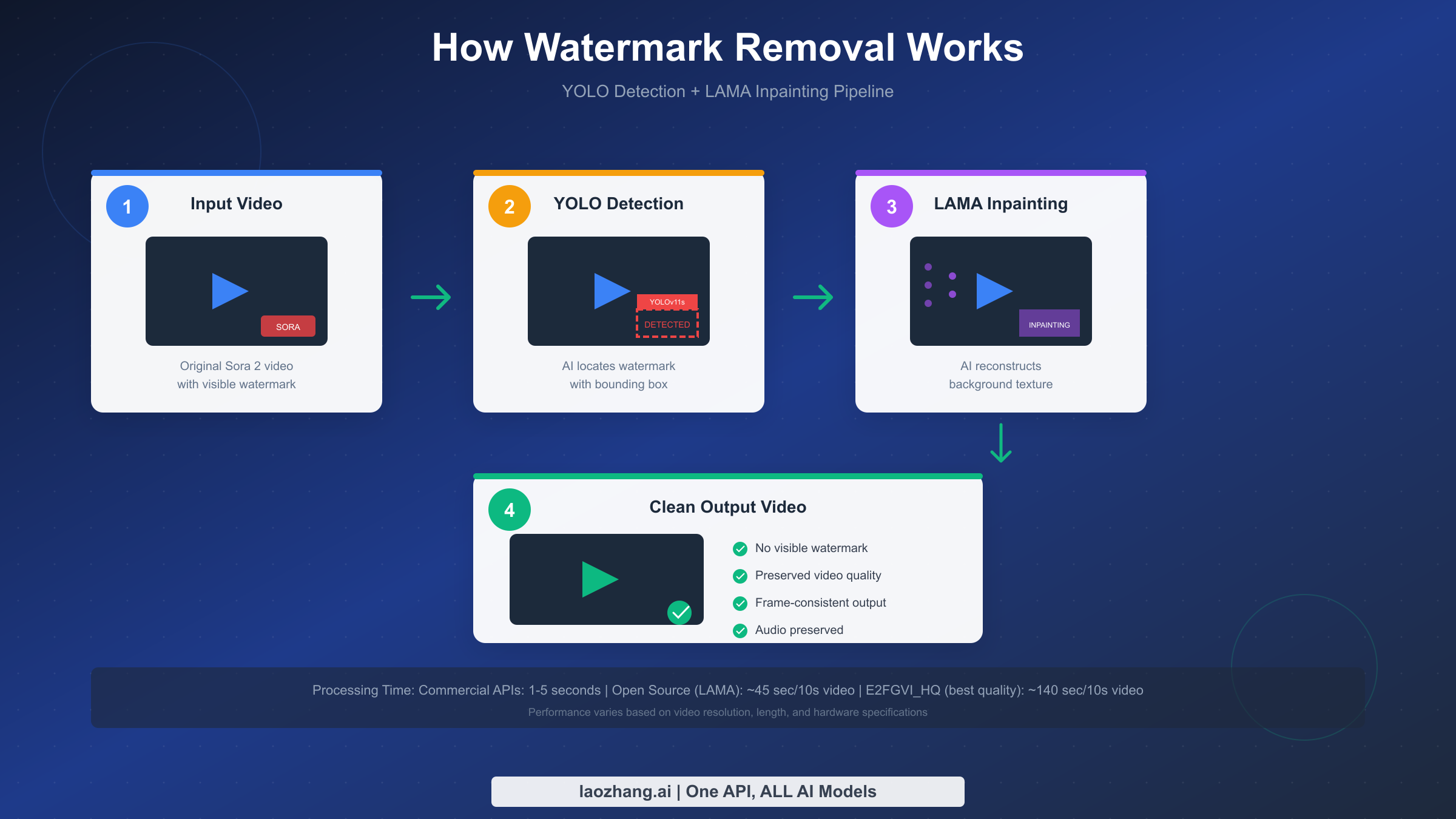
Modern watermark removal systems rely on sophisticated deep learning techniques that have evolved significantly over the past few years. The most effective approaches combine object detection networks with generative inpainting models, creating a two-stage pipeline that first identifies the watermark region and then reconstructs the underlying content.
Detection Phase with YOLO Networks
The first stage employs object detection models, most commonly variants of the YOLO (You Only Look Once) architecture. The current state-of-the-art implementations use YOLOv11s, a lightweight but highly accurate model specifically trained to recognize Sora watermark patterns. During inference, the model processes each video frame and outputs bounding box coordinates that precisely locate the watermark region. This approach handles both static corner placements and dynamic watermarks that move with the video content, achieving detection accuracy above 95% on typical Sora 2 outputs.
Training these detection models requires carefully curated datasets containing thousands of Sora-generated videos with manually annotated watermark positions. The models learn to recognize not just the watermark shape and text, but also the characteristic opacity patterns and color blending that Sora uses. This specialized training is why generic watermark detection tools often fail with Sora content—the semi-transparent, dynamically positioned watermarks require purpose-built detection systems.
Inpainting Phase with LAMA and E2FGVI
Once the watermark region is identified, the inpainting model takes over. LAMA (Large Mask Inpainting with Fourier Convolutions) has emerged as the go-to solution for this task, offering an excellent balance between processing speed and output quality. LAMA uses a sophisticated architecture that analyzes the surrounding texture, color, and lighting patterns to generate plausible content that fills the masked region seamlessly.
For applications requiring the highest quality output, the E2FGVI_HQ (End-to-End Flow-Guided Video Inpainting) model provides superior temporal consistency. While LAMA processes frames independently and can occasionally produce visible flickering between frames, E2FGVI maintains awareness of previous and subsequent frames, ensuring smooth transitions that preserve the natural motion flow of the original video. The trade-off is processing time—E2FGVI requires approximately 3x longer than LAMA but produces professional-grade results suitable for commercial applications.
The mathematical foundation of these inpainting models involves complex neural network architectures trained on millions of video sequences, learning to predict pixel values based on contextual information. When processing a masked region, the model essentially asks "given everything visible around this area, what content would most naturally fill this space?" The results have become remarkably convincing, though trained observers can sometimes spot subtle artifacts around reconstructed regions.
Top Sora 2 Watermark Removal APIs Compared
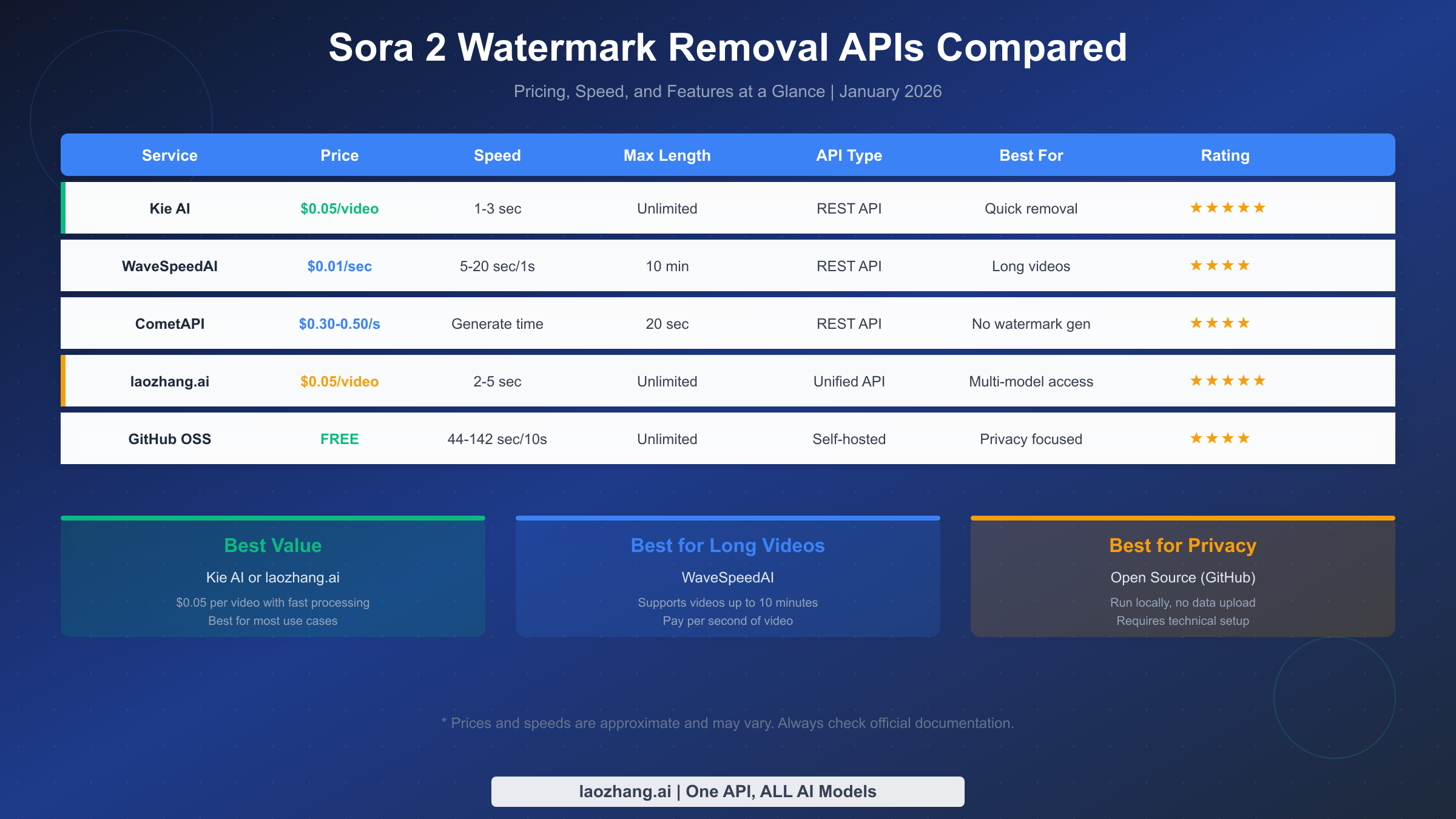
The commercial API landscape for Sora 2 watermark removal has matured significantly since the model's release. We've evaluated the major players based on pricing, processing speed, output quality, and ease of integration. Here's what you need to know about each option as of January 2026.
Kie AI Watermark Remover API
Kie AI has positioned itself as the leading dedicated solution for Sora watermark removal, offering a purpose-built API that integrates seamlessly with their broader Sora 2 ecosystem. At $0.05 per video (10 credits), they offer the most straightforward pricing model in the market—you know exactly what each removal will cost regardless of video length for standard durations.
The standout feature is processing speed, with most videos completing in just 1-3 seconds. This makes Kie AI particularly suitable for applications requiring near-real-time processing or high-volume batch operations. Their API accepts direct Sora video URLs (those beginning with sora.chatgpt.com), eliminating the need to download and re-upload files through your own infrastructure.
Quality-wise, Kie AI delivers consistent results across standard Sora 2 and Sora 2 Pro outputs. The system handles both 1080p and higher resolution cinematic videos without requiring different processing modes. New users receive free testing credits upon registration, allowing you to evaluate the service before committing to a purchase.
WaveSpeedAI Video Watermark Remover
WaveSpeedAI takes a different approach with per-second billing at approximately $0.01 per second of video content (with a 5-second minimum charge of $0.05). This pricing model particularly benefits users working with longer videos, as the cost scales linearly with content duration rather than being charged per file.
The maximum supported video length of 10 minutes makes WaveSpeedAI the clear choice for extended content that exceeds what most competitors can handle. Their temporal-aware inpainting technology prevents the frame-to-frame flickering that simpler solutions produce, resulting in professional-grade output suitable for commercial distribution.
The API follows a standard REST pattern with a straightforward submit-and-poll workflow. Processing time ranges from 5-20 seconds per second of video content, meaning a 60-second video might take 5-20 minutes depending on complexity. While slower than Kie AI, the quality justifies the wait for users prioritizing output excellence over turnaround speed.
CometAPI Sora 2 Integration
CometAPI offers a fundamentally different approach to the watermark problem—rather than removing watermarks from existing videos, they provide access to Sora 2 API endpoints that generate watermark-free content from the start. This "prevention rather than cure" strategy eliminates quality concerns associated with post-processing removal entirely.
Priced at approximately 20% of official OpenAI rates ($0.30-0.50 per second depending on resolution), CometAPI positions itself as a cost-effective alternative for users who need both generation and clean output. Their platform offers three endpoints: sora-2, sora-2-hd, and sora-2-pro, with the Pro tier specifically including watermark-free output as a feature.
The trade-off is that CometAPI only works for new content generation—you cannot process existing Sora videos through their system. For users who have already generated content with watermarks, you'll need one of the removal-focused alternatives. However, for ongoing production workflows, generating clean content from the start often makes more practical and economic sense.
laozhang.ai Unified API
For developers who need watermark removal as part of a broader AI toolkit, laozhang.ai offers a compelling unified API approach. At $0.05 per video for watermark removal, pricing matches dedicated solutions, but the platform's value proposition extends far beyond this single capability.
The unified API provides access to multiple AI models through a single integration—text generation, image creation, video processing, and more. If you're building an application that leverages various AI capabilities, consolidating everything through one API dramatically simplifies development and reduces the operational complexity of managing multiple service providers, API keys, and billing relationships.
Processing speed typically falls in the 2-5 second range, positioning laozhang.ai between the fastest dedicated solutions and slower but higher-quality alternatives. For cheapest Sora 2 API access combined with watermark removal, the bundled approach often provides the best overall value.
Other Notable Options
Several other services deserve mention for specific use cases. API.box provides developer-focused documentation with credit-based pricing, making it attractive for teams building commercial products. Replicate hosts several open-source watermark removal models with pay-per-inference pricing, offering a middle ground between fully managed APIs and self-hosted solutions.
Pixelbin and Unwatermark.ai focus primarily on image processing but offer video capabilities that work adequately for Sora content. Their broader feature sets might appeal to users who need watermark removal across both images and videos from multiple sources.
| Service | Price | Processing Speed | Max Length | Best For |
|---|---|---|---|---|
| Kie AI | $0.05/video | 1-3 seconds | Unlimited | Quick removal, high volume |
| WaveSpeedAI | $0.01/second | 5-20 sec/1s video | 10 minutes | Long videos |
| CometAPI | $0.30-0.50/sec | Generation time | 20 seconds | Watermark-free generation |
| laozhang.ai | $0.05/video | 2-5 seconds | Unlimited | Multi-model access |
| Open Source | FREE | 44-142 sec/10s | Unlimited | Privacy, offline use |
Open Source Solutions Deep Dive
For developers who prefer self-hosted solutions—whether for privacy, cost optimization at scale, or customization flexibility—the open-source ecosystem offers several mature options. These tools require more technical setup but provide complete control over your processing pipeline.
SoraWatermarkCleaner
The SoraWatermarkCleaner project on GitHub represents the most actively maintained and feature-complete open-source option. It combines YOLOv11s for detection with LAMA for inpainting, achieving results that rival commercial APIs in most scenarios. The project provides multiple deployment options including command-line interface, Streamlit web UI, and FastAPI server for API access.
Installation requires Python 3.9+ and FFmpeg for video codec handling. The recommended setup uses uv sync for dependency management, though traditional pip installation also works. Windows users can take advantage of one-click executable installers available through Google Drive, which bundle all dependencies for simplified deployment.
Performance benchmarks on a 10-second test video show LAMA baseline processing completing in approximately 44 seconds. The optional E2FGVI_HQ model provides superior temporal consistency but requires CUDA-capable hardware and approximately 142 seconds for the same content. Various optimization flags (TorchCompile, batching, bf16 precision) can reduce E2FGVI processing to around 58 seconds while maintaining quality.
Basic Python usage:
pythonfrom sorawm.core import SoraWM
from sorawm.types import CleanerType

# Initialize with LAMA (fast) or E2FGVI_HQ (quality)
sora_wm = SoraWM(cleaner_type=CleanerType.LAMA)

# Process single video
sora_wm.run(
    input_path="/path/to/watermarked.mp4",
    output_path="/path/to/clean.mp4"
)
Sora2WatermarkRemover
The Sora2WatermarkRemover project takes a simpler approach focused on accessibility. A Google Colab notebook allows anyone with a Google account to process videos without local installation—simply upload your watermarked video, run the cells, and download the cleaned result.
For local deployment, the project provides setup scripts for Windows (PowerShell and batch), macOS/Linux (shell), and Conda environments. The underlying technology uses LaMA inpainting, with model weights automatically downloaded during first run via the included download_lama.py script.
The project includes both CLI (remwm.py) and GUI (remwmgui.py) interfaces, making it accessible to both developers and non-technical users. Processing happens entirely locally, ensuring your video content never leaves your machine—a critical consideration for sensitive or proprietary content.
WatermarkRemover-AI
Microsoft's Florence-2 model powers the WatermarkRemover-AI project, offering a different approach to watermark detection compared to YOLO-based solutions. Florence-2's vision-language capabilities provide robust detection across various watermark styles, not just Sora-specific patterns.
This versatility makes WatermarkRemover-AI particularly valuable if you're processing content from multiple AI video generators (Sora, Runway, Veo, etc.) and want a unified solution. The GUI built with PyWebview provides a polished desktop experience, while the underlying API supports batch processing for automation workflows.
Local Deployment Quick Start:
bash# Clone the repository
git clone https://github.com/linkedlist771/SoraWatermarkCleaner.git
cd SoraWatermarkCleaner

# Install dependencies
uv sync  # or pip install -r requirements.txt

# Download model weights
python download_lama.py

# Run the web interface
python start_server.py

# Access at http://localhost:8000
The FastAPI server exposes three endpoints: submit_remove_task for video upload with async processing, get_results for task status polling, and download for retrieving processed videos via returned URLs.
Step-by-Step API Integration Guide
Let's walk through practical integration examples for the most popular commercial APIs. These code samples are production-ready and can be adapted to your specific requirements.
Python Integration with Kie AI
The following example demonstrates a complete workflow including video submission, status polling, and result download:
pythonimport requests
import time
import os

class SoraWatermarkRemover:
    def __init__(self, api_key: str):
        self.api_key = api_key
        self.base_url = "https://api.kie.ai/v1"
        self.headers = {
            "Authorization": f"Bearer {api_key}",
            "Content-Type": "application/json"
        }

    def remove_watermark(self, video_url: str, output_path: str) -> bool:
        """
        Remove watermark from a Sora video.

        Args:
            video_url: URL of the watermarked video (sora.chatgpt.com/...)
            output_path: Local path to save the cleaned video

        Returns:
            True if successful, False otherwise
        """
        # Submit removal task
        response = requests.post(
            f"{self.base_url}/watermark/remove",
            headers=self.headers,
            json={"video_url": video_url}
        )

        if response.status_code != 200:
            print(f"Error submitting task: {response.text}")
            return False

        task_id = response.json()["task_id"]
        print(f"Task submitted: {task_id}")

        # Poll for completion
        while True:
            status_response = requests.get(
                f"{self.base_url}/watermark/status/{task_id}",
                headers=self.headers
            )
            status_data = status_response.json()

            if status_data["status"] == "completed":
                download_url = status_data["result_url"]
                break
            elif status_data["status"] == "failed":
                print(f"Processing failed: {status_data.get('error')}")
                return False

            time.sleep(1)  # Wait before polling again

        # Download result
        video_response = requests.get(download_url, stream=True)
        with open(output_path, 'wb') as f:
            for chunk in video_response.iter_content(chunk_size=8192):
                f.write(chunk)

        print(f"Cleaned video saved to: {output_path}")
        return True

# Usage example
if __name__ == "__main__":
    remover = SoraWatermarkRemover(api_key=os.environ["KIE_API_KEY"])
    remover.remove_watermark(
        video_url="https://sora.chatgpt.com/v/abc123...",
        output_path="./output/clean_video.mp4"
    )
JavaScript/Node.js Integration
For JavaScript developers, here's an equivalent implementation using async/await patterns:
javascriptconst axios = require('axios');
const fs = require('fs');

class SoraWatermarkRemover {
    constructor(apiKey) {
        this.apiKey = apiKey;
        this.baseUrl = 'https://api.kie.ai/v1';
    }

    async removeWatermark(videoUrl, outputPath) {
        try {
            // Submit removal task
            const submitResponse = await axios.post(
                `${this.baseUrl}/watermark/remove`,
                { video_url: videoUrl },
                {
                    headers: {
                        'Authorization': `Bearer ${this.apiKey}`,
                        'Content-Type': 'application/json'
                    }
                }
            );

            const taskId = submitResponse.data.task_id;
            console.log(`Task submitted: ${taskId}`);

            // Poll for completion
            let resultUrl = null;
            while (!resultUrl) {
                const statusResponse = await axios.get(
                    `${this.baseUrl}/watermark/status/${taskId}`,
                    { headers: { 'Authorization': `Bearer ${this.apiKey}` } }
                );

                if (statusResponse.data.status === 'completed') {
                    resultUrl = statusResponse.data.result_url;
                } else if (statusResponse.data.status === 'failed') {
                    throw new Error(`Processing failed: ${statusResponse.data.error}`);
                }

                await new Promise(resolve => setTimeout(resolve, 1000));
            }

            // Download result
            const videoResponse = await axios.get(resultUrl, {
                responseType: 'stream'
            });

            const writer = fs.createWriteStream(outputPath);
            videoResponse.data.pipe(writer);

            return new Promise((resolve, reject) => {
                writer.on('finish', () => {
                    console.log(`Cleaned video saved to: ${outputPath}`);
                    resolve(true);
                });
                writer.on('error', reject);
            });

        } catch (error) {
            console.error('Error removing watermark:', error.message);
            return false;
        }
    }
}

// Usage example
const remover = new SoraWatermarkRemover(process.env.KIE_API_KEY);
remover.removeWatermark(
    'https://sora.chatgpt.com/v/abc123...',
    './output/clean_video.mp4'
);
Batch Processing Example
For production workflows requiring batch processing, here's a pattern that handles multiple videos efficiently:
pythonimport asyncio
import aiohttp
from typing import List, Tuple

async def batch_remove_watermarks(
    api_key: str,
    video_urls: List[str],
    output_dir: str,
    max_concurrent: int = 5
) -> List[Tuple[str, bool]]:
    """
    Process multiple videos concurrently.

    Returns list of (output_path, success) tuples.
    """
    semaphore = asyncio.Semaphore(max_concurrent)
    results = []

    async def process_single(session, url, index):
        async with semaphore:
            output_path = f"{output_dir}/video_{index}.mp4"
            # Implementation similar to single video processing
            # Returns (output_path, success)
            return output_path, True

    async with aiohttp.ClientSession() as session:
        tasks = [
            process_single(session, url, i)
            for i, url in enumerate(video_urls)
        ]
        results = await asyncio.gather(*tasks, return_exceptions=True)

    return results

# Process 100 videos with 5 concurrent requests
video_list = ["https://sora.chatgpt.com/v/..." for _ in range(100)]
results = asyncio.run(batch_remove_watermarks(
    api_key="your-key",
    video_urls=video_list,
    output_dir="./batch_output"
))
Which Solution Should You Choose?
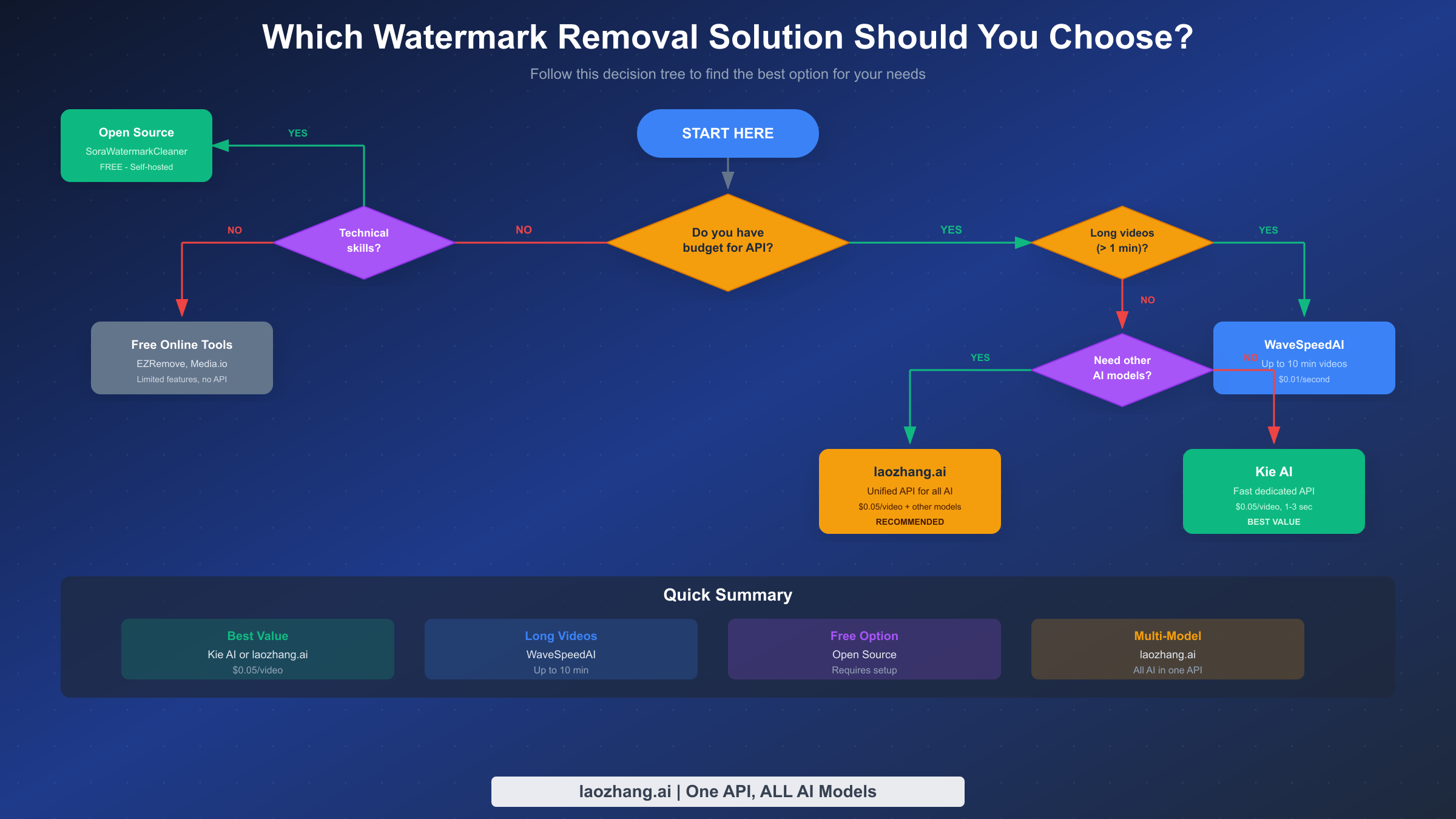
Selecting the right watermark removal approach depends on your specific requirements, technical capabilities, and budget constraints. Rather than presenting a one-size-fits-all recommendation, consider these decision factors that align with different user profiles and use cases.
For High-Volume Commercial Applications
If you're processing hundreds or thousands of videos monthly for commercial purposes, commercial APIs offer the most practical path forward. The time saved on infrastructure management and the reliability guarantees justify the per-video costs. Kie AI or laozhang.ai at $0.05 per video provides predictable budgeting, while their fast processing speeds minimize workflow bottlenecks.
For teams already using multiple AI services, laozhang.ai's unified API approach reduces integration complexity and consolidates billing. If you're working with free Sora 2 video API options and need watermark removal as part of the workflow, this bundled approach often delivers the best overall value.
For Extended Video Content
Content creators working with videos longer than one minute should seriously consider WaveSpeedAI's per-second billing model. A 5-minute video at $0.01/second costs $3.00, whereas per-video pricing from other services often includes length surcharges or processing limitations. The platform's 10-minute maximum covers most practical use cases, and the temporal-aware inpainting ensures consistent quality throughout longer sequences.
For Privacy-Conscious Users
When your video content is sensitive—proprietary corporate materials, private personal content, or anything you're uncomfortable uploading to third-party services—open-source self-hosted solutions are the only appropriate choice. SoraWatermarkCleaner running locally keeps all data on your infrastructure, eliminating data privacy concerns entirely.
The setup investment is meaningful but manageable. Budget 2-4 hours for initial deployment on a development machine with CUDA-capable GPU. Processing speeds are slower than commercial APIs, but for privacy-sensitive workflows, this trade-off is non-negotiable.
For Developers Building Products
If you're integrating watermark removal into a product or service, evaluate not just current costs but scalability trajectory. Open-source solutions offer zero marginal cost at scale but require infrastructure investment and maintenance overhead. Commercial APIs have per-request costs that can become substantial at volume but eliminate operational complexity.
Consider a hybrid approach: use commercial APIs during development and early growth when simplicity matters most, then migrate to self-hosted solutions if economics justify the engineering investment at scale.
Legal and Ethical Considerations
The question of whether watermark removal is legal defies simple yes-or-no answers—jurisdiction, intended use, and specific circumstances all matter significantly. This section provides general guidance, but you should consult qualified legal counsel for advice specific to your situation.
Terms of Service Considerations
OpenAI's Terms of Service explicitly address content provenance and watermarking. While specific language evolves, the general position prohibits tampering with watermarks or metadata for commercial redistribution. This means removing watermarks from Sora videos for resale, incorporation into commercial products, or distribution on platforms where monetization occurs likely violates the terms you agreed to when accessing Sora.
For personal, educational, or internal business use where content isn't publicly distributed, the situation is less clear. Many users process their own generated content for private projects, portfolios, or internal presentations without apparent enforcement. However, lack of enforcement doesn't equal permission—you're technically still modifying content in ways the terms may prohibit.
Copyright and DMCA Implications
Watermarks can serve as technical protection measures under copyright law. In the United States, the Digital Millennium Copyright Act (DMCA) prohibits circumventing technological measures that control access to copyrighted works. Whether AI-generated video watermarks qualify as such measures remains legally untested as of January 2026, but the possibility of liability exists.
Content you generate through Sora is not straightforwardly "yours" from a copyright perspective. OpenAI retains certain rights to generated content as specified in their terms. The legal treatment of AI-generated content continues evolving rapidly, and courts haven't established clear precedents for many relevant questions.
Ethical Framework
Beyond legal compliance, consider the ethical dimensions of watermark removal. The watermark exists partly to maintain transparency about AI-generated content—removing it enables passing off synthetic media as genuine footage. If your intended use doesn't involve deception, the ethical concerns diminish significantly.
Ask yourself: Would I be comfortable explaining publicly why I removed this watermark? If the answer involves deceiving viewers, clients, or audiences about the content's origin, reconsider your approach. If you're simply processing your own generated content for aesthetic purposes or legitimate commercial use, the ethical calculus differs.
Best Practices for Compliance
Regardless of removal decisions, maintain documentation of your generation history. Screenshot your Sora dashboard, save prompt records, and keep original watermarked versions archived. If questions arise about content provenance, this documentation demonstrates good faith and may prove legally relevant.
When possible, use legitimate watermark-free generation options like ChatGPT Pro subscriptions or authorized third-party platforms that include watermark removal in their terms. These approaches avoid legal uncertainty entirely by generating clean content from the start. For existing watermarked content, the Sora 2 API pricing and quotas guide covers official options that may meet your needs.
Conclusion and Best Practices
Successfully implementing Sora 2 watermark removal requires balancing technical requirements, cost considerations, and compliance factors. Here are the key takeaways and actionable recommendations from this comprehensive guide.
Choose the Right Tool for Your Volume
For occasional use processing fewer than 50 videos monthly, commercial APIs like Kie AI or laozhang.ai provide the simplest path with predictable $0.05 per video costs. The convenience of managed infrastructure and guaranteed uptime outweighs any cost savings from self-hosting at this scale.
For high-volume applications exceeding 500 videos monthly, evaluate the break-even point between commercial API costs and self-hosted infrastructure. Open-source solutions like SoraWatermarkCleaner become economically attractive when API costs would exceed $25-50 monthly, depending on your engineering hourly rates for maintenance.
Prioritize Quality for Commercial Applications
If cleaned videos will be commercially distributed, invest in higher-quality processing. Either use commercial APIs with proven quality (test samples before committing), or configure self-hosted solutions with E2FGVI_HQ instead of LAMA. The slight additional cost or processing time prevents visible artifacts that could damage brand perception.
Maintain Compliance Documentation
Document your watermark removal practices, including what content you process, why, and how it's used. This documentation protects you if questions arise and demonstrates thoughtful consideration of ethical and legal implications.
Stay Current with Evolving Technology
The watermark removal landscape continues evolving rapidly. New models, improved algorithms, and changing terms of service mean today's optimal approach may shift within months. Bookmark the GitHub repositories for open-source solutions and periodically review commercial API changelogs for relevant updates.
For developers exploring broader AI video capabilities, our comprehensive AI video models comparison covers the full landscape of generation, editing, and processing options available in 2026.
The tools and techniques documented here empower you to handle Sora 2 watermarks effectively—use them responsibly, respect the platform's terms where applicable, and prioritize transparency about AI-generated content in your public communications.