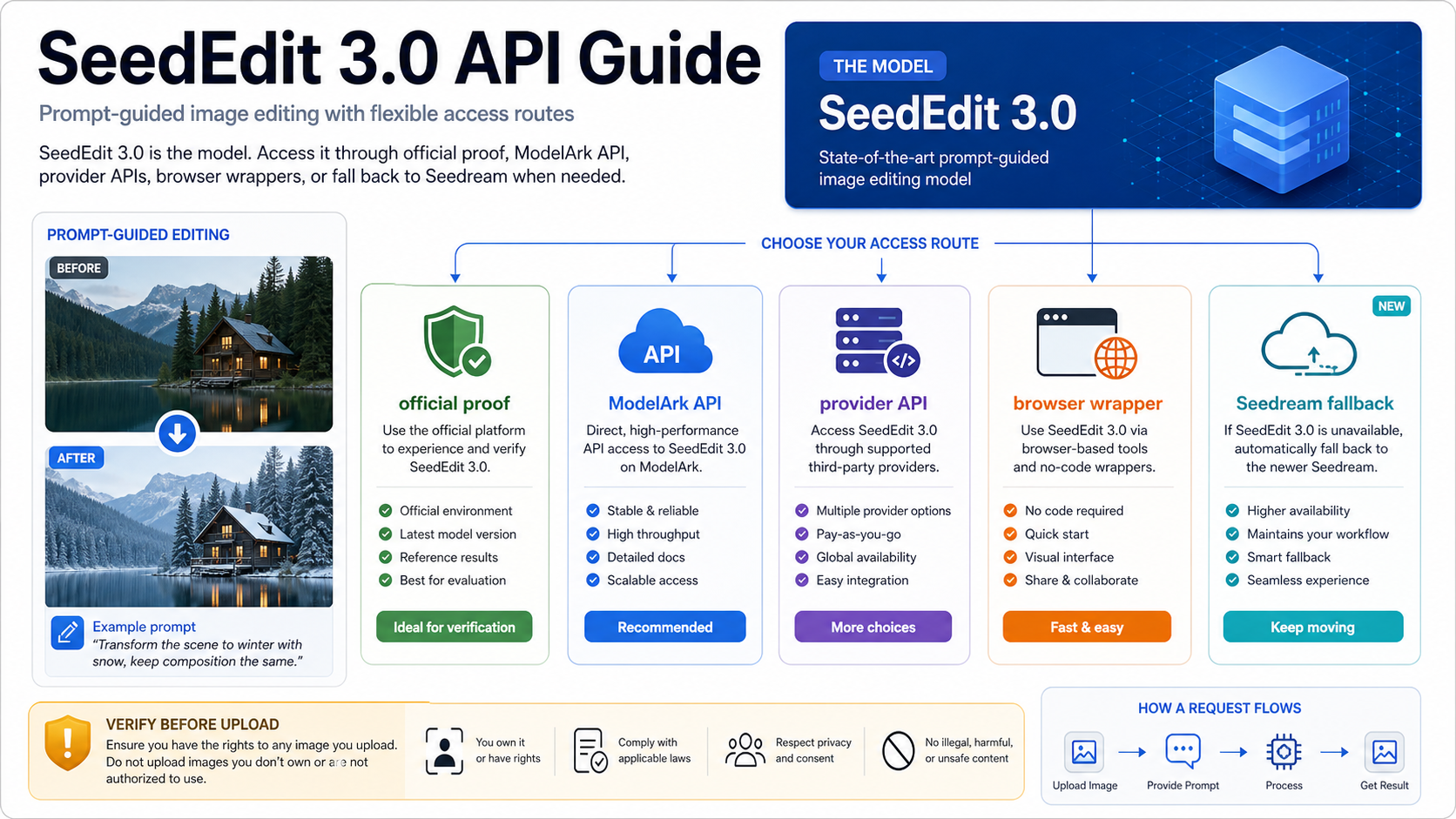
SeedEdit 3.0 is official ByteDance Seed image-editing work, but using it safely starts with route choice: official proof, ModelArk API, provider API, browser wrapper, or a newer Seedream path.
For developer use, verify the BytePlus/ModelArk model identity (seededit-3-0-i2i-250628 where available), the billing owner, upload retention, and current service status before sending valuable source images. Provider APIs and browser apps can be useful for testing, but their terms are their own contract, not ByteDance's default promise.
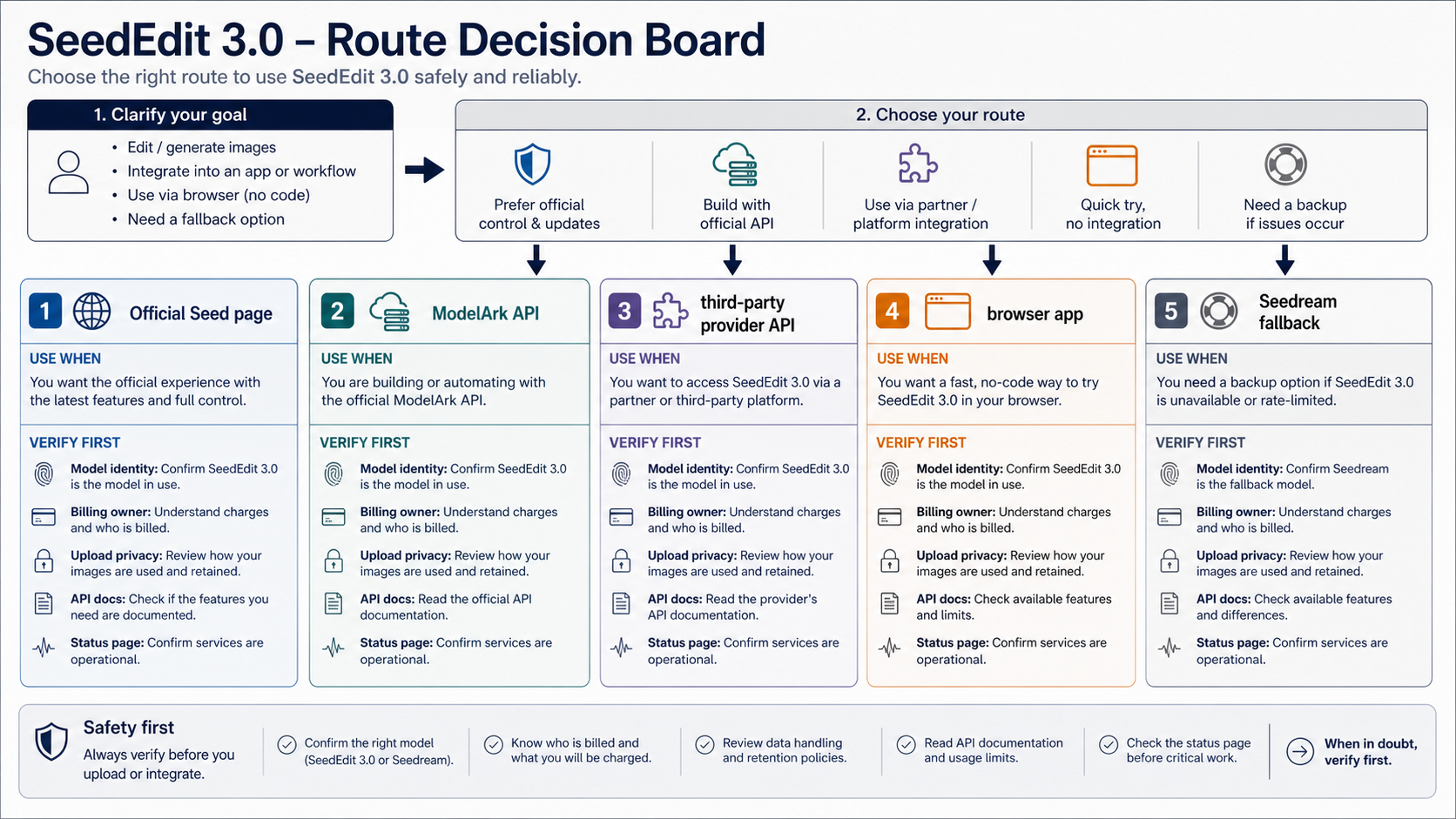
Do not upload private, client, or commercially sensitive images until the route proves four things on the same day you use it: the model is really SeedEdit 3.0 or the intended Seedream fallback, the account being billed is yours, the upload policy fits the source image, and the route is currently operational.
The route map in one table
Start with the route, not the benchmark. SeedEdit 3.0 can be a research result, an official ByteDance release, a ModelArk model ID, a provider API label, or a browser tool label depending on where you encounter it. Those are not the same contract.
| Route | Best for | What is verified | What to verify before use | Main mistake to avoid |
|---|---|---|---|---|
| ByteDance Seed and arXiv | Proving model identity and capability boundary | The model is official ByteDance Seed work, announced on June 6, 2025, with arXiv report 2506.05083 | Whether the public demo route from launch is still available to your region/account | Treating a release page as an API contract |
| BytePlus / ModelArk | Developer integration where ModelArk is available | Checked docs surface seededit-3-0-i2i-250628 and image-to-image parameters | Console availability, billing row, successful-image billing, quota, and current endpoint behavior | Treating a dated model ID as a permanent public product name |
| Provider API | Quick integration through a third-party provider | Provider pages may expose SeedEdit v3 endpoints and their own pricing | Provider model mapping, retention, failure billing, support path, and status | Calling provider terms official ByteDance terms |
| Browser wrapper | No-code exploration and prompt testing | A wrapper can make the model easier to try | Upload policy, account owner, output rights, and whether the route really uses SeedEdit 3.0 | Uploading valuable source images into an unknown contract |
| Newer Seedream route | Broader generation/editing workflows or when SeedEdit 3.0 is unavailable | ByteDance/BytePlus surfaces newer Seedream routes for unified generation and editing | Which Seedream version, task coverage, billing, and API surface apply | Forcing SeedEdit 3.0 when the newer route fits the job better |
The practical decision is simple: use official sources to prove what SeedEdit 3.0 is, use ModelArk only after the model ID and billing surface are current in your account, and treat every provider or browser route as separately owned. If your task is broader than prompt-guided editing of an existing source image, check the current Seedream route before you lock implementation around SeedEdit 3.0.
What ByteDance actually released
ByteDance Seed announced SeedEdit 3.0 on June 6, 2025 as a prompt-guided image editing model built on Seedream 3.0. The official release describes it as a system for natural-language edits that preserve image consistency while changing the requested part of the scene. The public examples cover common editing jobs such as character preservation, object removal, background changes, style shifts, relighting, and composition-aware edits.
The arXiv report, SeedEdit 3.0: Fast and High-Quality Generative Image Editing, is the cleanest technical identity proof. It ties SeedEdit 3.0 to Seedream 3.0, describes enhanced data curation plus joint diffusion and reward learning, and reports a 56.1% usability rate in the paper's internal benchmark setup. That benchmark is useful as model context, but it should not become a universal quality claim for every route. A provider endpoint, a browser wrapper, and a ModelArk deployment can differ in version, defaults, queue behavior, and post-processing.
The official release also matters for a negative reason: it does not turn every website using the SeedEdit name into an official ByteDance product. If a site offers an instant browser editor, treat it as a wrapper until it proves otherwise. If a provider exposes an endpoint called seededit-v3, treat that as provider shorthand. The public model name can stay SeedEdit 3.0, but the access contract belongs to the route you actually use.
One more boundary keeps the page useful in 2026: SeedEdit 3.0 is not the only ByteDance image-editing path readers may encounter. BytePlus and ByteDance surfaces now also describe newer Seedream routes with unified generation and editing. That does not erase SeedEdit 3.0, but it changes the decision. Use SeedEdit 3.0 when the exact editing route, model ID, or provider support is the job; use a newer Seedream route when you need a broader current image-generation and editing workflow.
The ModelArk API route to verify
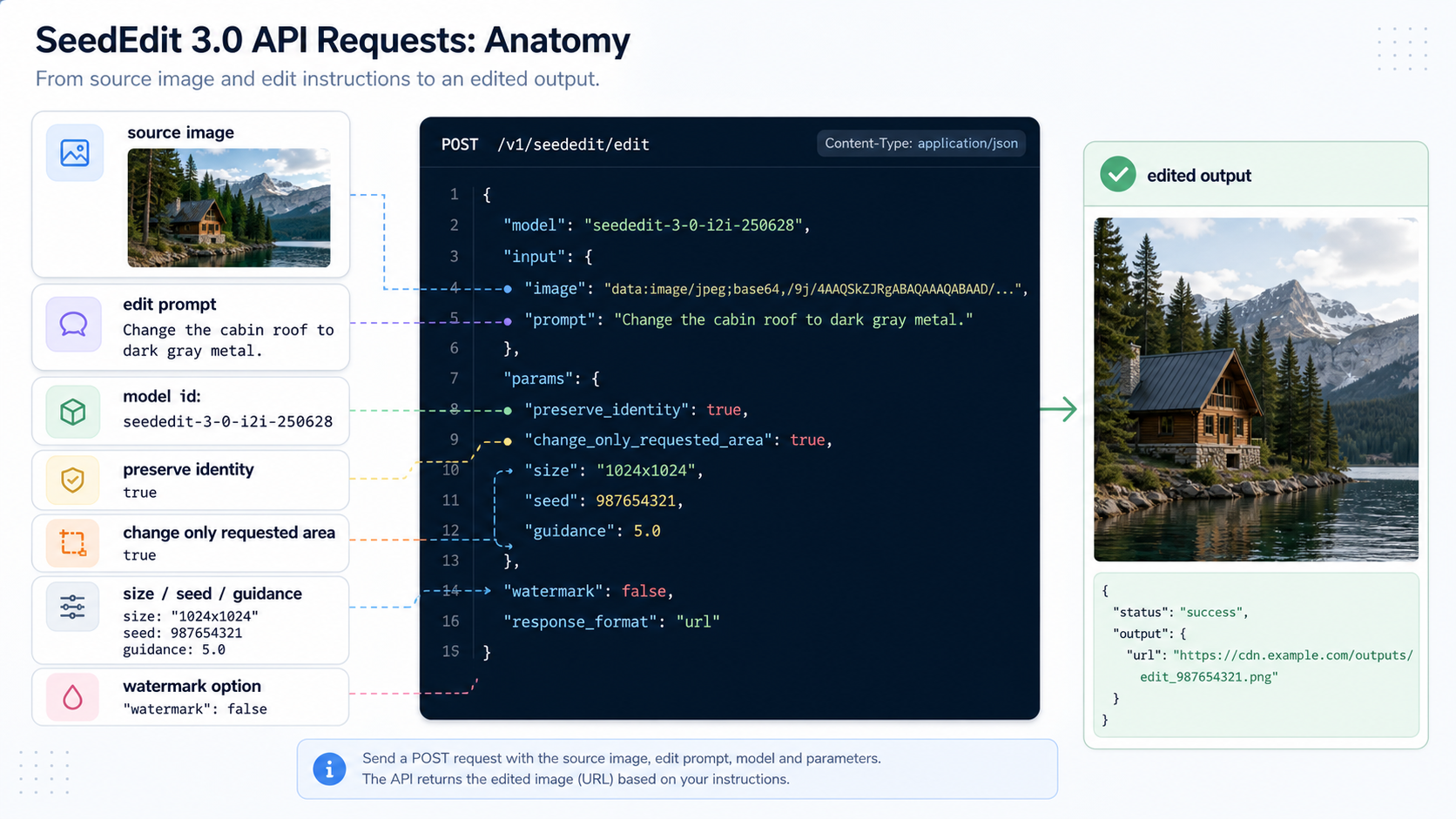
For direct developer access, the route to verify first is BytePlus ModelArk. The current checked evidence points to the image-to-image model ID seededit-3-0-i2i-250628, the base_url family https://ark.ap-southeast.bytepluses.com/api/v3, and request fields such as prompt, image, response_format, size, seed, guidance_scale, and watermark. Use those as a dated integration anchor, not as a promise that your account, region, or project has the same model row enabled.
A first request should prove the contract before it proves image quality. Keep the image low-risk, write a narrow edit prompt, and log the model ID returned or accepted by the route. The shape to verify looks like this:
{
  "model": "seededit-3-0-i2i-250628",
  "image": "data:image/jpeg;base64,...",
  "prompt": "Change the sofa color to deep blue, preserve the room layout, avoid adding text or extra objects.",
  "response_format": "url",
  "size": "1024x1024",
  "seed": 987654321,
  "guidance_scale": 5.0,
  "watermark": false
}
That is a request shape, not a claim that a local test succeeded here. Before production use, confirm the current ModelArk docs and console for four details: whether seededit-3-0-i2i-250628 is still the recommended model ID, whether billing is still per successful image, what the current price row says, and which quota or IPM limit applies to your account. Checked public docs and snippets on May 17, 2026 surfaced a 0.03 USD-per-image row and an IPM-style limit, but those are exactly the kind of values that can drift.
If your team already uses OpenAI-compatible SDK patterns, keep the mental model narrow. You are not choosing an "image API" in the abstract; you are choosing a BytePlus/ModelArk route for this model. For broader endpoint routing ideas, the separate OpenAI image generation API endpoint guide is useful context, but do not copy OpenAI endpoint names into a SeedEdit 3.0 integration.
Provider APIs and browser wrappers have their own contracts
Third-party routes are useful because they lower friction. They can expose a simple REST endpoint, a prepaid balance, or a browser interface long before a team has ModelArk fully configured. They are also where most production mistakes happen, because the model name starts to feel like the whole contract.
Provider pages checked for this run show why the distinction matters. WaveSpeed surfaces a route such as /api/v3/bytedance/seededit-v3 and a provider-owned price. Segmind surfaces /v1/seededit-v3 with its own generation pricing. Eachlabs appears in the same ecosystem but marks its SeedEdit model deprecated for new executions while still documenting execution pricing. Those are not contradictions about whether SeedEdit 3.0 exists. They are signals that provider availability, naming, and billing can drift independently.
Use a provider API when the provider can answer all of these questions in its own docs or console:
- Which upstream model and version is actually mapped to the endpoint?
- Who bills the request, and does a failed request cost anything?
- What happens to uploaded source images after processing?
- What size, format, watermark, queue, and retry behavior should you expect?
- Where is the status page or support route when image jobs stall?
A browser wrapper needs an even stricter upload decision. It may be fine for a public sample image, a style exploration, or a prompt-learning session. It is not automatically appropriate for client product photography, private portraits, unreleased campaign assets, or files covered by contractual restrictions. If the wrapper cannot prove model identity, billing owner, retention/deletion policy, and output rights, keep valuable source images out of that route.
Where SeedEdit 3.0 fits best
SeedEdit 3.0 is most useful when the task starts from an existing image and the edit can be expressed as a clear natural-language instruction. The strongest jobs are not "make a better image" but "change this target while preserving the rest." That distinction keeps prompts shorter and gives the model a preservation boundary.
Good first tests include product color changes, background replacement, seasonal scene changes, object removal, lighting adjustments, outfit changes, and portrait edits where identity preservation matters. A strong prompt names the change, names what must stay stable, and names what must not be introduced:
Change the bottle label to a matte black version, preserve the bottle shape and camera angle, avoid adding new text or extra objects.That pattern works because it separates the target edit from the preservation contract. If the source image contains brand marks, faces, client assets, or confidential details, the upload contract still matters more than the prompt quality. The model may be capable, but the route decides whether the file should be sent there.
Use SeedEdit 3.0 less confidently when the job is open-ended generation from scratch, multi-image campaign generation, large asset batches that need a current unified model, or workflows where the provider already recommends a newer Seedream model. In those cases, SeedEdit 3.0 can still be a useful comparison point, but it may not be the route to build around.
When a newer Seedream route is the better answer
SeedEdit 3.0 and Seedream are connected, but they should not be collapsed into one name. SeedEdit 3.0 was described by ByteDance as an editing model built on Seedream 3.0. Later Seedream routes are broader image-generation and editing surfaces. That means the right question is not "which name sounds newer?" The right question is "does the task require this SeedEdit 3.0 editing route, or does it require a current unified image route?"
Choose the SeedEdit 3.0 route when you are validating an exact model, reproducing provider support for SeedEdit v3, integrating the checked ModelArk image-to-image model, or writing a workflow around prompt-guided editing of a source image. Choose a newer Seedream route when you need generation and editing in one flow, current ByteDance image-model coverage, broader reference-image behavior, or provider support that has moved beyond SeedEdit-specific endpoints.
That branch also protects readers from stale route lock-in. A team can spend days wiring an older endpoint because it ranks well or appears in a tutorial, only to discover the provider prefers a newer Seedream model for the same job. If the first production requirement is a stable current image API, verify Seedream availability alongside SeedEdit before you commit. For a broader image-model comparison, the existing Nano Banana Pro vs Seedream v4 guide can help, but keep that separate from the SeedEdit 3.0 access decision.
Prompt and upload checklist
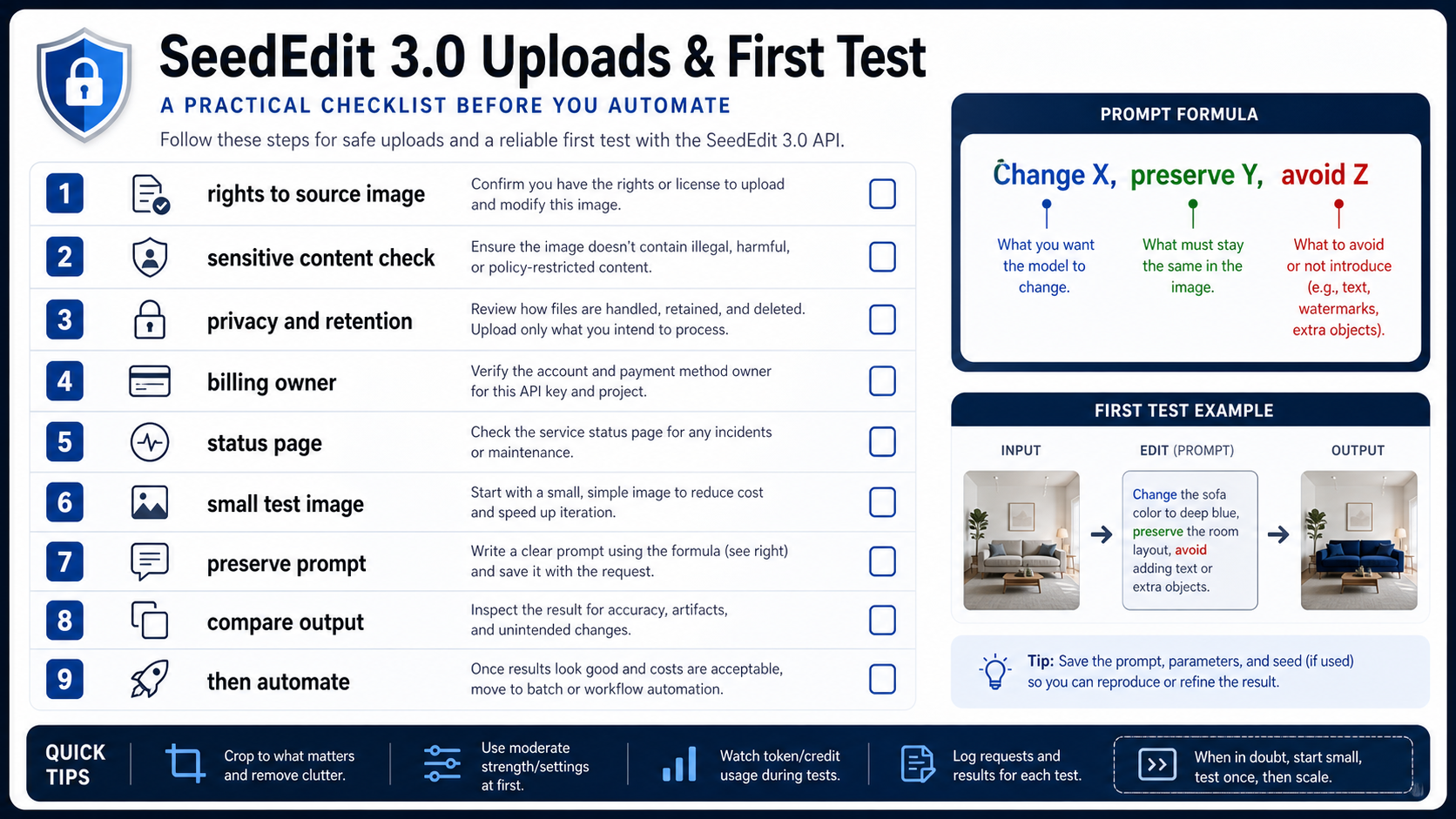
The first production-quality SeedEdit 3.0 test should be deliberately small. Use a source image you have the right to upload, choose a visible but reversible edit, and save the prompt, seed, model ID, provider route, and output. The goal is to prove the whole route, not to produce the most impressive image on the first call.
Use this checklist before any valuable upload:
| Check | What to confirm | Stop if |
|---|---|---|
| Source rights | You own the image or have permission to process and modify it | The image is client-owned, private, licensed narrowly, or contract-restricted |
| Model identity | The route explicitly maps to SeedEdit 3.0, SeedEdit v3, seededit-3-0-i2i-250628, or the intended Seedream fallback | The route only says "AI editor" or hides the upstream model |
| Billing owner | The account and payment method are yours or approved by your team | A third party, browser account, or unknown credit pool owns the charge |
| Upload policy | Retention, deletion, training use, and support boundaries are acceptable | The route cannot explain what happens to source images |
| Status and quota | The provider or ModelArk console is operational and quota is enough for the test | The service is degraded or quota behavior is unclear |
| Prompt preservation | The prompt states change X, preserve Y, avoid Z | The prompt asks for a broad makeover with no preservation boundary |
| Output review | The edit changed only the intended target and did not introduce policy or brand issues | The output adds text, objects, faces, marks, or unwanted style changes |
For teams, turn that checklist into a handoff rule. The person who chooses the route should record the route owner, date checked, model ID, billing owner, and upload policy link beside the first successful output. That tiny record prevents future team members from treating a temporary browser test as a production API route.
FAQ
Is SeedEdit 3.0 official ByteDance work?
Yes. ByteDance Seed announced SeedEdit 3.0 in June 2025, and the arXiv report 2506.05083 provides the technical identity proof. The official identity does not make every browser editor or provider endpoint official.
What is the SeedEdit 3.0 API model ID?
The current checked ModelArk route points to seededit-3-0-i2i-250628 for image-to-image editing. Verify the current model row in BytePlus/ModelArk before production because model IDs and availability can change.
Is SeedEdit 3.0 free to use?
Do not assume that. Public ModelArk and provider surfaces checked on May 17, 2026 showed pay-per-image style billing and provider-specific prices. Browser tools may offer trial usage, but that is a wrapper contract, not proof of a free official API.
Can I upload commercial or client images to a SeedEdit 3.0 wrapper?
Only if the wrapper proves the model route, billing owner, upload retention/deletion policy, output rights, and support path. If those details are missing, use a low-risk sample image or move to a route your team can audit.
Is SeedEdit 3.0 the same as Seedream?
No. SeedEdit 3.0 is an editing model tied to Seedream 3.0 in ByteDance's release and paper. Newer Seedream routes are broader generation/editing paths, so they should be treated as route-choice context rather than as a renamed SeedEdit page.
Should I use SeedEdit 3.0 or Seedream 4/5?
Use SeedEdit 3.0 when you specifically need the checked SeedEdit editing route, provider support, or ModelArk model ID. Check newer Seedream routes when the job is unified image generation plus editing, larger current-model coverage, or a provider workflow that no longer centers SeedEdit 3.0.