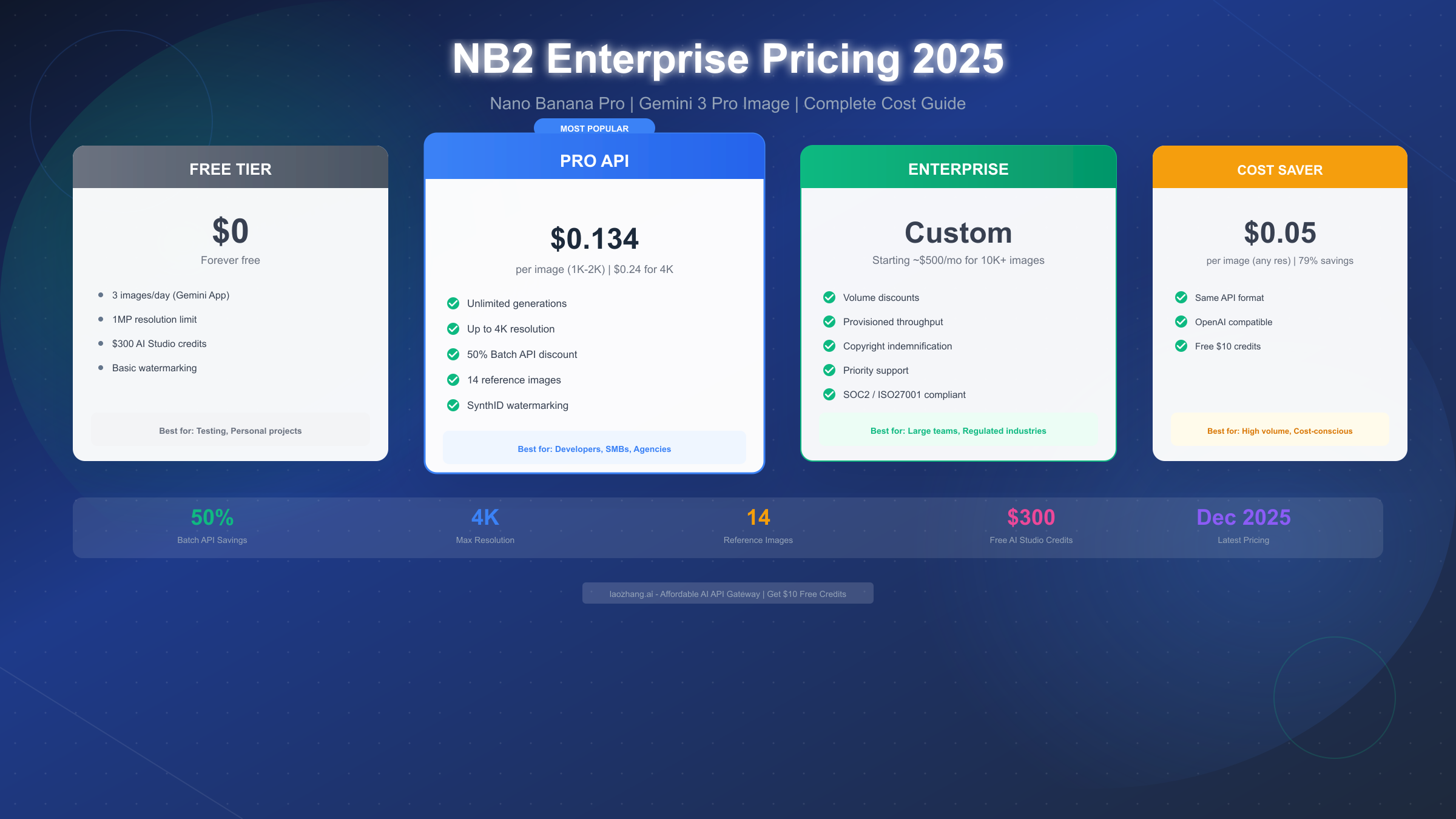
Nano Banana 2 enterprise pricing in December 2025 starts at $0.134 per image for standard resolutions (1K-2K) and $0.24 for 4K output through Google's official Gemini API. Enterprise plans offer custom pricing with volume discounts, typically ranging from $500-$10,000/month based on usage. The Batch API provides 50% savings for non-urgent workflows, while third-party providers like laozhang.ai offer up to 79% cost reduction for high-volume users seeking maximum efficiency.
This comprehensive guide breaks down every pricing tier, hidden cost, and optimization strategy for businesses evaluating NB2 (Nano Banana Pro / Gemini 3 Pro Image) for enterprise image generation needs.
What is Nano Banana 2 (NB2)?
Nano Banana 2 (NB2), officially known as Gemini 3 Pro Image in Google's product lineup, represents Google DeepMind's most advanced AI image generation model released on November 20, 2025. The whimsical codename "Nano Banana" reflects Google's internal naming convention, while the commercial product names align with the Gemini ecosystem.
Understanding the naming convention is essential for enterprise procurement:
| Internal Codename | Official Product Name | Release Date | Target Use Case |
|---|---|---|---|
| Nano Banana | Gemini 2.5 Flash Image | Q2 2025 | Fast, cost-effective generation |
| Nano Banana Pro | Gemini 3 Pro Image (NB2) | Nov 20, 2025 | Premium quality, enterprise features |
NB2 distinguishes itself from competitors through several enterprise-critical capabilities. The model supports up to 4K resolution output (3840 x 2160 pixels), making it suitable for commercial print and high-resolution digital assets. Unlike earlier models limited to 1MP, this resolution support eliminates the need for post-processing upscaling in many workflows.
The 14 reference image capability enables brand consistency at scale. Enterprise teams can upload brand assets, style guides, and previous campaign imagery to ensure generated content maintains visual coherence across thousands of outputs. This feature alone addresses one of the primary enterprise concerns: maintaining brand identity when using AI-generated imagery.
For compliance-conscious organizations, NB2 implements SynthID watermarking by default. This imperceptible digital watermark allows detection of AI-generated content without degrading image quality, addressing both regulatory requirements and corporate governance policies around AI transparency.
The model operates through Google's Gemini API infrastructure, providing enterprise-grade reliability with 99.9% uptime SLA for Vertex AI deployments. Integration options span REST API, Python SDK, Node.js SDK, and native plugins for Adobe Creative Cloud and Figma, enabling adoption across diverse enterprise tech stacks.
From a technical architecture perspective, NB2 leverages Google's latest multimodal foundation models, combining language understanding with image generation in a unified system. This enables more nuanced prompt interpretation compared to text-to-image-only models, resulting in outputs that more accurately reflect complex creative briefs.
Key Enterprise Capabilities
Understanding NB2's full capability set helps organizations evaluate fit for specific use cases:
Photorealistic Generation: NB2 excels at creating photorealistic imagery that passes human evaluation in blind tests. Enterprise applications include product photography, lifestyle imagery, and architectural visualization where realism is paramount.
Style Transfer and Consistency: Using reference images, enterprises can maintain consistent visual language across campaigns. Marketing teams report 60-80% reduction in style guide violations compared to manual generation workflows.
Multilingual Prompt Understanding: NB2 processes prompts in 40+ languages with equivalent quality, enabling global teams to work in native languages without translation overhead. This capability significantly reduces prompt engineering time for international deployments.
Aspect Ratio Flexibility: Unlike fixed-ratio models, NB2 supports custom aspect ratios from 1:4 to 4:1, accommodating diverse format requirements across social media, print, and web channels without cropping or post-processing.
Iterative Refinement: The API supports image-to-image refinement workflows, allowing progressive enhancement of generated outputs. This capability is particularly valuable for complex creative briefs requiring multiple revision cycles.
Common Enterprise Use Cases
Organizations deploying NB2 at scale typically fall into several categories:
E-commerce Product Photography: Generating consistent product imagery at scale, replacing traditional photography for catalog expansion. Enterprises report 70-90% cost reduction compared to traditional product shoots.
Marketing Content Automation: Creating social media imagery, email headers, and digital ad creative at volumes impossible through manual design. Typical deployments generate 1,000-10,000 images monthly.
Document and Report Enhancement: Generating custom illustrations, diagrams, and visual aids for internal documentation and client deliverables. This use case particularly benefits consulting firms and research organizations.
User-Generated Content Platforms: Embedding NB2 as a user-facing feature within consumer applications. This requires careful consideration of content moderation and usage policies.
Complete NB2 Enterprise Pricing Breakdown
Understanding NB2 pricing requires navigating Google's token-based billing model, which differs significantly from per-image pricing offered by competitors like Midjourney. For a deeper understanding of the underlying pricing structure, refer to our comprehensive Gemini API pricing breakdown.
Official API Pricing (December 2025)
Google's official pricing for NB2 through the Gemini API follows a resolution-based model:
| Resolution Tier | Output Size | Price per Image | Token Equivalent |
|---|---|---|---|
| Standard (1K) | 1024 x 1024 | $0.134 | ~4,000 tokens |
| Standard (2K) | 2048 x 2048 | $0.134 | ~4,000 tokens |
| High (4K) | 3840 x 2160 | $0.24 | ~7,200 tokens |
| Batch (1K-2K) | Up to 2048 x 2048 | $0.067 | ~2,000 tokens |
| Batch (4K) | 3840 x 2160 | $0.12 | ~3,600 tokens |
The Batch API deserves particular attention for enterprise deployments. By accepting 24-hour delivery windows instead of real-time generation, organizations achieve 50% cost reduction without quality degradation. This makes Batch API ideal for scheduled content production, catalog generation, and non-urgent creative workflows.
Enterprise Contract Pricing
Google's enterprise pricing operates through negotiated contracts rather than public rate cards. Based on industry benchmarks and reported enterprise deployments, here are estimated pricing ranges:
| Monthly Volume | Estimated Monthly Cost | Per-Image Effective Rate | Discount vs. Standard |
|---|---|---|---|
| 10,000 images | ~$500-700 | $0.05-0.07 | 48-63% |
| 50,000 images | ~$1,500-2,500 | $0.03-0.05 | 63-78% |
| 100,000 images | ~$3,000-5,000 | $0.03-0.05 | 63-78% |
| 500,000+ images | Custom | $0.02-0.03 | 78-85% |
Enterprise contracts typically include:
- Provisioned throughput guarantees: Reserved capacity ensuring consistent response times during peak demand
- Priority support: Dedicated account management and 4-hour response SLA for critical issues
- Copyright indemnification: Legal protection for commercial use of generated imagery
- Custom fine-tuning: Model customization for brand-specific outputs
- Data residency options: Regional processing for compliance requirements
Hidden Costs to Consider
Enterprise TCO extends beyond per-image pricing. Budget planners should account for:
Infrastructure overhead: Vertex AI deployment requires Google Cloud Platform billing, adding compute, storage, and networking costs. Expect 10-15% additional overhead for a fully managed deployment.
Integration development: Initial API integration typically requires 40-80 engineering hours. Ongoing maintenance adds 5-10 hours monthly for monitoring, error handling updates, and SDK version management.
Prompt engineering: Complex enterprise use cases require specialized prompt development. Organizations report 20-40 hours of prompt optimization to achieve consistent quality for specific domains.
Quality assurance: AI-generated imagery requires human review for commercial use. Factor 0.5-2 minutes per image for QA review in production workflows.
Enterprise Contract Negotiation Tips
Successfully negotiating enterprise contracts requires understanding Google's pricing flexibility and typical contract terms:
Volume commitments matter: Google offers best pricing for committed volumes rather than pay-as-you-go arrangements. Committing to 12-month minimum volumes typically unlocks 20-30% additional discount compared to monthly billing.
Combine services for leverage: Organizations already using Google Cloud services (GCP, Workspace) can negotiate bundled pricing. Combined contracts often achieve 10-15% better rates than standalone Gemini API agreements.
Request provisioned throughput: For production workloads, negotiate reserved capacity (provisioned throughput) rather than shared capacity. This eliminates rate limiting during peak demand but requires volume commitment.
Time negotiations strategically: Google's fiscal year ends in December. Contract negotiations in Q4 often yield better pricing as sales teams work toward annual targets.
Document competitive quotes: Present pricing from third-party alternatives (laozhang.ai, fal.ai) during negotiations. Google frequently matches or beats competitive pricing for committed customers.
Clarify all fees upfront: Ensure contracts specify all potential charges including data egress, storage, and premium support. Hidden fees can add 15-25% to expected costs if not addressed during negotiation.
Free Tier and Getting Started
For organizations evaluating NB2 before committing to enterprise contracts, Google provides several no-cost entry points. Understanding these options helps teams validate use cases without budget allocation.
Google AI Studio Credits
New Google Cloud accounts receive $300 in AI Studio credits, applicable to Gemini API usage including NB2 generation. At standard pricing ($0.134/image), this translates to approximately 2,200 free images for evaluation purposes.
Credit allocation tips for maximum evaluation value:
- Start with 1K resolution to maximize image count during testing
- Use Batch API when delivery timing isn't critical, doubling your test volume
- Document prompt iterations to avoid regenerating the same concepts
- Test edge cases early to identify model limitations before production planning
For teams seeking additional free options, our guide to free Gemini Flash Image API access covers alternative approaches.
Gemini App Free Tier
Individual team members can access NB2 through the consumer Gemini app with limited free generations:
| Access Method | Daily Limit | Resolution Cap | Commercial Rights |
|---|---|---|---|
| Gemini Free | 3 images/day | 1MP | Personal use only |
| Gemini Advanced ($20/mo) | Unlimited* | 1MP | Personal use only |
*Subject to fair use policies
Note that Gemini App generations do not include commercial usage rights. Enterprise deployments must use the API or Vertex AI deployment for commercial applications.
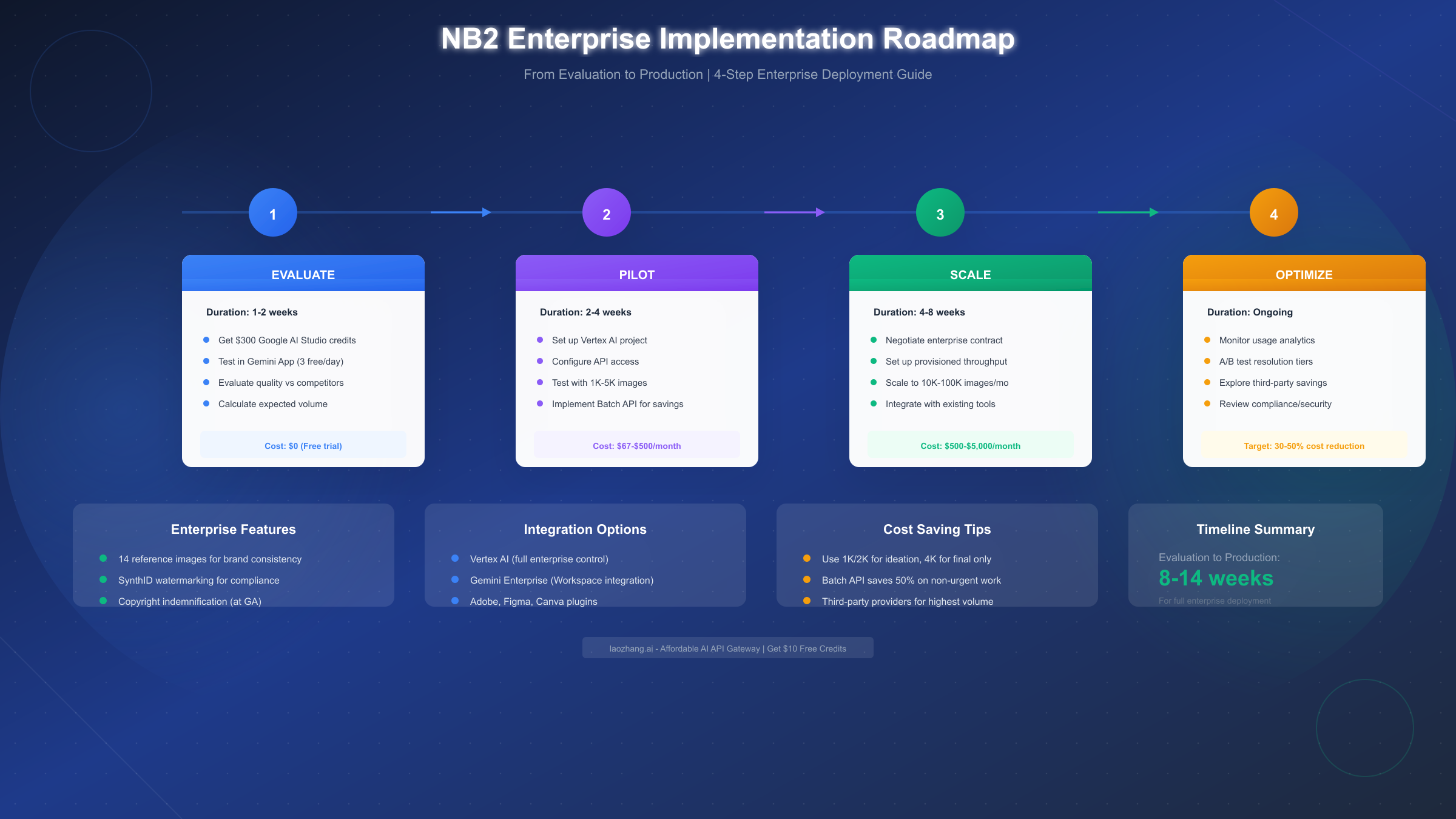
Recommended Evaluation Path
For enterprise evaluation, follow this structured approach:
Week 1-2: Technical Validation
- Configure API access using AI Studio credits
- Generate 100-200 images across target use cases
- Measure quality against existing workflow outputs
- Document prompt patterns achieving desired results
Week 3-4: Workflow Integration
- Build prototype integration with existing tools
- Test Batch API for applicable workflows
- Evaluate throughput requirements
- Identify edge cases requiring human fallback
Week 5-6: Cost Modeling
- Calculate projected monthly volume
- Compare standard, Batch, and enterprise pricing
- Model total cost of ownership including hidden costs
- Prepare business case for enterprise contract negotiation
Cost Optimization Strategies
Maximizing value from NB2 requires strategic approaches beyond simply choosing the lowest per-image rate. Enterprise teams can achieve significant savings through technical optimization, operational efficiency, and strategic provider selection.
Batch API Implementation
The Batch API represents the most impactful optimization for non-real-time workflows, delivering 50% cost savings on every generation. Implementation requires restructuring workflows around asynchronous processing.
Batch API characteristics:
| Feature | Batch API | Standard API |
|---|---|---|
| Delivery Time | Up to 24 hours | 3-15 seconds |
| Price (1K-2K) | $0.067 | $0.134 |
| Price (4K) | $0.12 | $0.24 |
| Rate Limits | Higher throughput | Standard limits |
| Minimum Batch | 10 images | 1 image |
Implementation patterns for enterprise workflows:
Scheduled content production: Queue next-day social media imagery overnight, retrieving completed generations before workday begins.
Catalog generation: Submit product imagery requests in batches of 100-500, processing entire catalog updates within 24-hour cycles.
A/B test variants: Generate multiple creative variants via batch, then review and select winning concepts for campaigns.
Code example for Batch API submission:
pythonfrom google.generativeai import BatchRequest

batch = BatchRequest(model="gemini-3-pro-image")

# Queue multiple generation requests
for product in product_catalog:
    batch.add_request(
        prompt=f"Professional product photo of {product.name}, "
               f"white background, studio lighting",
        resolution="2048x2048"
    )

# Submit batch and retrieve job ID
job_id = batch.submit()
# Results available within 24 hours via job_id
Resolution Optimization
Matching output resolution to actual usage requirements prevents overspending on unnecessary pixel density:
| Use Case | Recommended Resolution | Price Impact |
|---|---|---|
| Social media thumbnails | 1024 x 1024 | $0.134 |
| Website hero images | 2048 x 2048 | $0.134 |
| Print collateral | 3840 x 2160 | $0.24 |
| Email headers | 1024 x 1024 | $0.134 |
The 1K-2K tier shares identical pricing, so always generate at 2048 x 2048 when uncertain—upscaling is free within the tier, while downscaling never costs extra.
Third-Party API Alternatives
For developers seeking maximum cost savings, API relay services offer substantially reduced rates by aggregating demand across multiple customers. For strategies applicable across image generation models, see our GPT Image-1 cost optimization strategies.
Third-party provider comparison (December 2025):
| Provider | Price per Image | Savings vs. Official | API Compatibility | Free Credits |
|---|---|---|---|---|
| Google Official | $0.134 | — | Native | $300 |
| laozhang.ai | $0.05 | 63% | OpenAI-compatible | $10 |
| kie.ai | $0.02 | 85% | OpenAI-compatible | $5 |
| fal.ai | $0.08 | 40% | Custom SDK | $5 |
laozhang.ai stands out for enterprise consideration due to OpenAI-compatible API format, enabling drop-in replacement for existing integrations. The $0.05 per image rate delivers 79% savings compared to 4K official pricing, making high-volume generation financially viable for smaller organizations. New accounts receive $10 in free credits for evaluation.
When evaluating third-party providers, consider:
- Latency impact: Relay services add 100-500ms latency
- Support SLA: Response times vary significantly
- Data handling: Review privacy policies for sensitive content
- Rate limits: May differ from official API quotas
- Model version: Ensure access to latest NB2 version
Prompt Optimization for Cost Efficiency
Efficient prompting directly impacts costs by reducing failed generations and regeneration cycles:
Structured prompt templates: Develop standardized templates for common use cases. Organizations report 30-40% reduction in regeneration needs when using well-tested templates versus ad-hoc prompts.
Negative prompts: Explicitly specify unwanted elements to reduce generation failures. Example: "without text overlays, no watermarks, avoiding cluttered backgrounds" prevents common quality issues.
Resolution matching: Generate at the exact resolution needed for final use. Downscaling from 4K to 1K wastes 44% of per-image cost compared to generating at target resolution.
Reference image selection: Carefully curated reference images improve first-pass success rates. Poor reference images lead to 2-3x regeneration cycles, effectively doubling or tripling effective per-image costs.
Batch prompt testing: Before scaling production, test prompts on 10-20 image batches to measure success rates. A prompt with 80% success rate effectively costs 25% more per successful image than a 100% success rate prompt.
Caching and Deduplication Strategies
Enterprise deployments should implement caching layers to avoid regenerating identical or similar content:
Hash-based deduplication: Hash prompt + settings combinations to detect duplicate requests. Even 5-10% duplicate elimination meaningfully reduces costs at scale.
Semantic similarity matching: Use embedding models to identify semantically similar prompts that might produce equivalent outputs. Threshold-based matching can safely serve cached results for minor prompt variations.
CDN integration: Store generated images in content delivery networks with appropriate cache headers. Serving cached images eliminates regeneration for repeat requests.
Version-controlled prompt libraries: Maintain versioned prompt libraries to prevent accidental variations that generate functionally identical images.
Enterprise Cost Calculator
Translating per-image pricing into real-world budgets requires modeling specific organizational scenarios. Below are detailed cost analyses for three enterprise profiles.
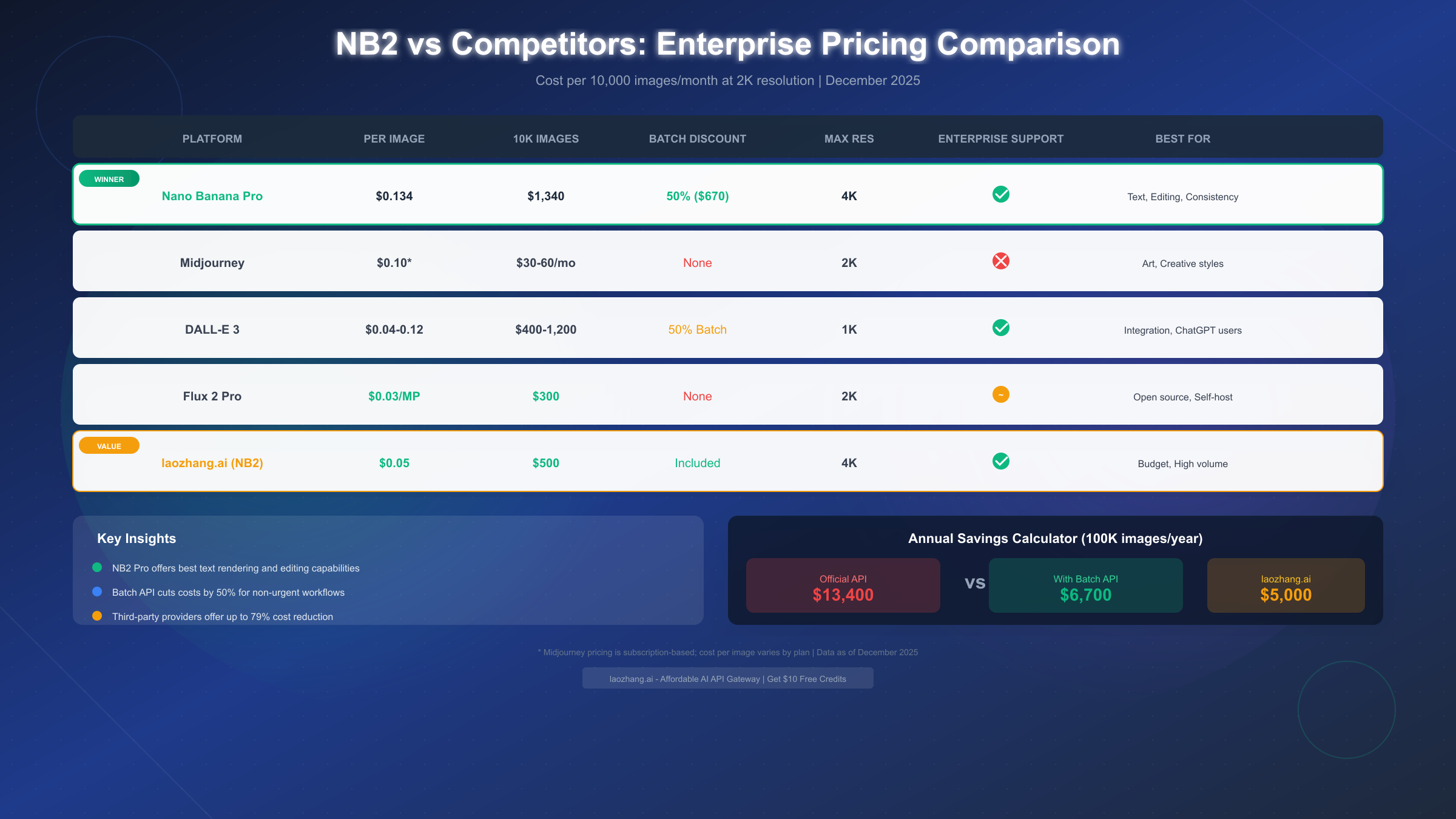
Scenario 1: Marketing Agency (1,000 images/month)
A mid-size marketing agency generating campaign imagery for multiple clients.
Usage profile:
- 800 social media images (1024 x 1024)
- 150 website banners (2048 x 2048)
- 50 print-ready assets (4K)
Cost comparison:
| Provider | Standard Rate | Batch Rate (70% usage) | Monthly Total | Annual Total |
|---|---|---|---|---|
| Google Official | $145 | $84 | $229 | $2,748 |
| laozhang.ai | $50 | N/A | $50 | $600 |
| Enterprise Contract | — | — | ~$70 | ~$840 |
Recommendation: At 1,000 images monthly, third-party providers like laozhang.ai offer the best value. Enterprise contracts typically require higher minimums to justify negotiation overhead.
Scenario 2: E-commerce Platform (10,000 images/month)
A mid-market e-commerce company generating product imagery at scale.
Usage profile:
- 8,000 product photos (2048 x 2048)
- 1,500 lifestyle images (2048 x 2048)
- 500 hero banners (4K)
Cost comparison:
| Provider | Standard Rate | Batch Rate (80% usage) | Monthly Total | Annual Total |
|---|---|---|---|---|
| Google Official | $1,460 | $699 | $2,159 | $25,908 |
| Google Enterprise | — | — | ~$500-700 | ~$6,000-8,400 |
| laozhang.ai | $500 | N/A | $500 | $6,000 |
Recommendation: This volume justifies enterprise contract negotiation. Request quotes from Google and compare against third-party alternatives. Enterprise contracts at this tier typically match or beat relay service pricing while adding support and indemnification benefits.
Scenario 3: Enterprise SaaS (100,000+ images/month)
A large enterprise embedding image generation in their platform.
Usage profile:
- 80,000 user-generated content images (1024 x 1024)
- 15,000 template variations (2048 x 2048)
- 5,000 premium outputs (4K)
Cost comparison:
| Provider | Standard Rate | Optimized Approach | Monthly Total | Annual Total |
|---|---|---|---|---|
| Google Official | $14,600 | Batch + Resolution optimization | $8,200 | $98,400 |
| Google Enterprise | — | Custom contract | ~$3,000-5,000 | ~$36,000-60,000 |
| Hybrid Approach | — | Enterprise + relay fallback | ~$4,000 | ~$48,000 |
Recommendation: At 100K+ monthly volume, enterprise contracts become essential. Negotiate provisioned throughput for core workflows while maintaining third-party access for overflow capacity. This hybrid approach optimizes both cost and reliability.
Scenario 4: Startup MVP (500 images/month)
A startup validating product-market fit with limited budget.
Usage profile:
- 300 product mockups (1024 x 1024)
- 150 marketing visuals (2048 x 2048)
- 50 premium assets (4K)
Cost comparison:
| Provider | Standard Rate | Batch Rate (50% usage) | Monthly Total | Annual Total |
|---|---|---|---|---|
| Google Official | $72 | $43 | $115 | $1,380 |
| laozhang.ai | $25 | N/A | $25 | $300 |
| Free Tier + Strategic Use | $0* | N/A | $0* | $0* |
*Using $300 AI Studio credits strategically over 12 months
Recommendation: Startups should maximize free AI Studio credits during MVP phase. At 500 images monthly, credits last approximately 4-5 months, buying time to validate use case before committing budget. Supplement with laozhang.ai for overflow needs at $25/month.
ROI Calculation Framework
Beyond direct API costs, enterprise buyers need ROI justification for procurement approval. Use this framework:
Cost savings calculation:
- Traditional photography cost per image: $50-500 (depending on complexity)
- NB2 cost per image: $0.05-0.24
- Savings per image: 95-99%
- Monthly savings at 1,000 images: $49,750-$499,750
Time savings calculation:
- Traditional design time: 2-8 hours per image concept
- NB2 generation + review: 10-30 minutes per image
- Productivity multiplier: 4-16x
Revenue impact calculation:
- Faster time-to-market for campaigns
- A/B testing capacity (10x more variants)
- Personalization scale (individual customer imagery)
Present these calculations alongside cost comparisons when building business cases for enterprise adoption.
Total Cost of Ownership Summary
| Volume Tier | Best Option | Monthly Budget | Annual Budget |
|---|---|---|---|
| < 1,000 | Third-party (laozhang.ai) | $50-100 | $600-1,200 |
| 1,000-10,000 | Third-party or Enterprise | $100-700 | $1,200-8,400 |
| 10,000-50,000 | Enterprise Contract | $500-2,500 | $6,000-30,000 |
| 50,000+ | Enterprise + Hybrid | $2,500-5,000+ | $30,000-60,000+ |
Enterprise Security and Compliance
Enterprise deployments require comprehensive security evaluation beyond pricing considerations. NB2 and Google's infrastructure provide robust compliance frameworks suitable for regulated industries.
SynthID Watermarking
All NB2-generated images include SynthID, Google DeepMind's imperceptible watermarking technology. Key characteristics:
- Invisible to human perception: No visible artifacts or quality degradation
- Robust against manipulation: Survives cropping, compression, and format conversion
- Detection API available: Verify AI-generated content programmatically
- Regulatory alignment: Supports emerging AI transparency requirements
Organizations subject to AI disclosure regulations (EU AI Act, FTC guidelines) should document SynthID implementation in compliance programs.
Data Handling and Privacy
Google's data handling for NB2 via Vertex AI includes:
Data isolation: Enterprise Vertex AI deployments process data in isolated environments. Customer prompts and generated images are not used for model training without explicit consent.
Retention policies: Default 30-day log retention for API requests. Configurable down to 0 days for sensitive applications.
Geographic processing: Data residency options available for EU (europe-west1), US (us-central1), and APAC (asia-southeast1) regions.
Encryption: TLS 1.3 in transit, AES-256 at rest for all data.
Compliance Certifications
Google Cloud (including Vertex AI for NB2 deployment) maintains:
| Certification | Coverage | Relevance |
|---|---|---|
| SOC 1, SOC 2, SOC 3 | Financial controls, security | Enterprise audit requirements |
| ISO 27001 | Information security management | Global security standard |
| ISO 27017 | Cloud security controls | Cloud-specific security |
| ISO 27018 | Personal data protection | Privacy compliance |
| HIPAA | Healthcare data | US healthcare organizations |
| FedRAMP | US government | Government contractors |
| GDPR | EU data protection | EU operations |
Enterprise contracts can include additional compliance commitments. Discuss specific regulatory requirements during contract negotiation.
Content Safety Filters
NB2 implements multi-layer content safety:
Input filtering: Prompt analysis blocks requests for harmful, illegal, or policy-violating content.
Output filtering: Generated images are scanned before delivery, preventing distribution of unsafe content.
Configurable thresholds: Enterprise deployments can adjust sensitivity levels for specific use cases (e.g., medical imagery requires lower false positive rates).
Human review integration: API supports flagging for human review when automated systems are uncertain.
For organizations in regulated industries, document safety filter configuration in AI governance policies.
Enterprise Governance Implementation
Organizations implementing NB2 at scale should establish comprehensive governance frameworks:
Usage policies: Define acceptable use cases, prohibited content categories, and approval workflows for new applications. Document policies in employee handbooks and contractor agreements.
Audit logging: Enable comprehensive API logging for compliance audits. Retain logs for minimum 7 years for financial services, 6 years for healthcare (HIPAA), or as specified by industry regulations.
Access controls: Implement role-based access to API credentials. Separate development, staging, and production credentials with distinct usage quotas.
Cost allocation: Tag API requests by department, project, or cost center for accurate chargebacks. Google Cloud labels enable granular cost attribution across the organization.
Quality metrics: Establish KPIs for generation quality, including human review pass rates, regeneration frequencies, and prompt success rates. Track trends to identify optimization opportunities.
Incident response: Define procedures for content safety incidents, API outages, and data breaches. Integrate NB2 into existing enterprise incident response frameworks.
Third-Party Risk Management
When considering third-party API providers like laozhang.ai for cost optimization, evaluate additional risk factors:
Vendor due diligence: Request SOC 2 reports, security questionnaires, and data processing agreements. Ensure vendors meet your organization's third-party risk standards.
Data flow documentation: Map how prompts and generated images traverse third-party infrastructure. Document for privacy impact assessments and regulatory compliance.
Exit strategy: Plan for vendor discontinuation. Ensure ability to migrate to Google direct API or alternative providers without service disruption.
Contract protections: Include data protection commitments, breach notification requirements, and indemnification clauses in third-party agreements.
NB2 vs Alternatives for Enterprise
Selecting an enterprise image generation solution requires evaluating NB2 against established alternatives. Each platform offers distinct advantages for specific use cases.
NB2 vs Midjourney Enterprise
| Factor | NB2 (Gemini 3 Pro) | Midjourney | Winner |
|---|---|---|---|
| Enterprise API | Full REST API | Limited (Discord-based) | NB2 |
| Max Resolution | 4K (3840 x 2160) | 2048 x 2048 | NB2 |
| Batch Processing | 50% discount | Not available | NB2 |
| Artistic Style | Versatile, photorealistic | Artistic, distinctive | Use case dependent |
| Reference Images | 14 images | 4 images | NB2 |
| Enterprise Support | Google Cloud SLA | Premium support | NB2 |
| Price (per image) | $0.134-0.24 | $0.01-0.03* | Midjourney |
*Midjourney pricing based on Pro plan subscription ($60/month for ~2,000 fast generations)
Recommendation: NB2 excels for enterprise API integration and high-resolution needs. Midjourney remains cost-effective for creative teams comfortable with Discord-based workflows.
NB2 vs DALL-E 3
| Factor | NB2 (Gemini 3 Pro) | DALL-E 3 | Winner |
|---|---|---|---|
| Enterprise API | Full REST API | Full REST API | Tie |
| Max Resolution | 4K (3840 x 2160) | 1792 x 1024 | NB2 |
| Batch Processing | 50% discount | Not available | NB2 |
| Text Rendering | Good | Excellent | DALL-E 3 |
| Reference Images | 14 images | Not available | NB2 |
| Compliance | Google Cloud certifications | OpenAI enterprise | Tie |
| Price (per image) | $0.134 (2K) | $0.080 (HD) | DALL-E 3 |
Recommendation: DALL-E 3 offers better text-in-image rendering and lower per-image pricing. NB2 provides superior resolution and reference image capabilities critical for brand consistency.
NB2 vs Flux 2 Pro
For detailed Flux pricing analysis, see our Flux image generation API pricing guide.
| Factor | NB2 (Gemini 3 Pro) | Flux 2 Pro | Winner |
|---|---|---|---|
| Enterprise API | Full REST API | Full REST API | Tie |
| Max Resolution | 4K (3840 x 2160) | 2048 x 2048 | NB2 |
| Generation Speed | 3-15 seconds | 2-8 seconds | Flux |
| Photorealism | Excellent | Excellent | Tie |
| Fine-tuning | Enterprise contracts | LoRA support | Flux |
| Open Source Option | No | Flux Schnell (Apache 2.0) | Flux |
| Price (per image) | $0.134 | $0.055 | Flux |
Recommendation: Flux offers cost advantages and fine-tuning flexibility. NB2 provides higher resolution output and deeper Google Cloud integration for existing GCP enterprises.
Enterprise Selection Matrix
| Priority | Best Choice | Rationale |
|---|---|---|
| Maximum resolution | NB2 | Only model with 4K output |
| Brand consistency | NB2 | 14 reference image support |
| Lowest cost | Third-party (laozhang.ai) | Up to 79% savings |
| Text rendering | DALL-E 3 | Superior text accuracy |
| Artistic style | Midjourney | Distinctive aesthetic |
| GCP integration | NB2 | Native Vertex AI deployment |
| Self-hosting | Flux | Open source options |
Multi-Model Strategy Considerations
Many enterprises achieve optimal results through multi-model approaches rather than single-provider commitments:
Primary + Fallback architecture: Use NB2 as primary with laozhang.ai as cost-optimized fallback during peak demand or budget constraints. This hybrid approach provides enterprise reliability with startup economics.
Use-case routing: Route different content types to optimal models:
- Product photography → NB2 (photorealism)
- Marketing creative → Midjourney (artistic style)
- Text-heavy imagery → DALL-E 3 (text accuracy)
- High-volume background generation → Flux (cost efficiency)
A/B testing across models: Generate variants from multiple models, letting performance data guide allocation. Some enterprises report 20-30% engagement improvements through model-optimized creative selection.
Vendor diversification: Avoiding single-provider dependency reduces risk from pricing changes, service disruptions, or quality regressions. Maintain active integrations with at least two providers.
Frequently Asked Questions
How much does NB2 cost per image?
NB2 (Nano Banana Pro / Gemini 3 Pro Image) costs $0.134 per image for 1K-2K resolution and $0.24 per image for 4K resolution through Google's official API. The Batch API provides 50% savings ($0.067 for 1K-2K, $0.12 for 4K) for non-urgent workflows. Enterprise contracts offer additional volume discounts, potentially reducing costs to $0.02-0.05 per image at high volumes.
Is there a free tier for NB2?
Yes, Google provides multiple free options. New Google Cloud accounts receive $300 in AI Studio credits (approximately 2,200 images at standard pricing). The consumer Gemini app includes 3 free images daily, though without commercial usage rights. For evaluation purposes, we recommend using AI Studio credits for API testing.
How can I reduce NB2 API costs?
The most effective cost reduction strategies include:
- Use Batch API for 50% savings on non-urgent generation
- Optimize resolution to match actual usage requirements
- Consider third-party providers like laozhang.ai for up to 79% savings
- Negotiate enterprise contracts for volumes exceeding 10,000 images monthly
- Implement caching to avoid regenerating identical prompts
What's the difference between Nano Banana and Nano Banana Pro?
Nano Banana (Gemini 2.5 Flash Image) is optimized for speed and cost-efficiency, suitable for high-volume, lower-fidelity use cases. Nano Banana Pro (Gemini 3 Pro Image / NB2) delivers premium quality with 4K resolution support, 14 reference images, and enhanced photorealism. For enterprise applications requiring maximum quality, NB2 (Pro) is the recommended choice.
Does NB2 support commercial use?
Yes, NB2 generated images through the API or Vertex AI deployment include commercial usage rights. Consumer Gemini app generations are limited to personal use. Enterprise contracts can include additional copyright indemnification protecting against infringement claims.
How does NB2 handle content safety?
NB2 implements multi-layer content safety including input prompt filtering, output image scanning, and configurable sensitivity thresholds. All outputs include SynthID watermarking for AI transparency. Enterprise deployments can customize safety parameters while maintaining compliance with platform policies.
What integrations are available for NB2?
NB2 integrates through REST API, Python SDK, Node.js SDK, and native plugins for Adobe Creative Cloud and Figma. Enterprise deployments via Vertex AI enable additional integration with Google Cloud services including BigQuery, Cloud Storage, and Cloud Functions.
How does NB2 pricing compare to Midjourney?
Midjourney offers lower per-image pricing (approximately $0.01-0.03 via subscription plans) but lacks enterprise API access and is limited to Discord-based interaction. NB2 provides full API support, higher resolution (4K vs 2K), and enterprise-grade compliance certifications, justifying the pricing premium for organizations requiring programmatic integration.
What SLA does NB2 offer?
Google provides 99.9% uptime SLA for Vertex AI deployments. Enterprise contracts can include enhanced SLA commitments, priority support with 4-hour response times, and dedicated account management. Standard API access does not include formal SLA guarantees.
Can I fine-tune NB2 for my brand?
Enterprise contracts can include custom fine-tuning options for brand-specific outputs. Additionally, the 14 reference image capability allows substantial brand consistency without full fine-tuning. Contact Google Cloud sales to discuss fine-tuning requirements and associated pricing.
What are the rate limits for NB2 API?
Standard API access includes the following rate limits:
- Requests per minute (RPM): 60 for free tier, 1,000 for paid accounts
- Images per day (IPD): 1,500 for standard, unlimited for enterprise
- Concurrent requests: 10 for standard, configurable for enterprise
Enterprise contracts can negotiate higher limits or provisioned throughput eliminating rate limiting entirely.
How does billing work for failed generations?
Google bills based on successful generations only. Failed requests due to content filtering, API errors, or quality failures do not incur charges. However, images that generate successfully but don't meet your subjective quality standards are still billed. Implement quality checks on your end before serving to production.
Can I use NB2 for generating faces or people?
Yes, NB2 can generate photorealistic human faces and figures. However, enterprise users should be aware of:
- Likeness concerns: Generated faces may inadvertently resemble real individuals
- Consent implications: Using AI-generated people in commercial contexts has evolving legal considerations
- Disclosure requirements: Some jurisdictions require disclosure of AI-generated humans in advertising
Consult legal counsel before deploying NB2-generated human imagery in commercial applications.
What happens if NB2 pricing increases?
Enterprise contracts typically lock pricing for the contract term (usually 12-24 months). Pay-as-you-go pricing may change with 30-60 days notice per Google's terms. To protect against price increases:
- Negotiate multi-year contracts with fixed pricing
- Include price protection clauses in enterprise agreements
- Maintain third-party provider relationships as fallback options
How do I migrate from DALL-E or Midjourney to NB2?
Migration typically involves:
- Prompt adaptation: NB2 prompt syntax differs from competitors. Plan 10-20 hours for prompt library conversion.
- API integration: Replace API endpoints in your codebase. laozhang.ai's OpenAI-compatible format simplifies migration from DALL-E.
- Quality calibration: Generated outputs differ between models. Budget time for quality assessment and prompt refinement.
- Cost modeling: Compare actual costs post-migration against projections. Adjust usage patterns as needed.
Most organizations complete migration within 2-4 weeks for straightforward integrations.
Does NB2 support image editing or inpainting?
Yes, NB2 supports several image manipulation capabilities:
- Inpainting: Replace specific regions of existing images
- Outpainting: Extend images beyond original boundaries
- Style transfer: Apply artistic styles to existing images
- Image-to-image: Generate variations based on reference images
These features use the same pricing model as generation, calculated based on output resolution.
What's the maximum prompt length for NB2?
NB2 supports prompts up to 4,000 tokens (approximately 3,000 words). For most use cases, optimal prompt length is 50-200 words. Longer prompts don't necessarily improve output quality and may introduce conflicting instructions that degrade results.
Best practices:
- Focus on specific, concrete descriptions
- Use structured formatting for complex briefs
- Test prompt variations to find optimal length for your use case
How do I handle NB2 in CI/CD pipelines?
Enterprise deployments often integrate NB2 into automated workflows:
Testing environments: Use mock responses or low-volume test accounts to avoid production billing during development.
Staging environments: Configure reduced resolution (1K) to minimize costs while validating integrations.
Production deployment: Implement circuit breakers, retry logic, and fallback providers to handle API outages gracefully.
Cost controls: Set billing alerts and hard caps to prevent runaway costs from bugs or misconfiguration.
Summary and Recommendations
Navigating NB2 enterprise pricing requires matching organizational needs with available options. Based on our comprehensive analysis, here are tier-specific recommendations:
Decision Framework by Volume
Low Volume (< 1,000 images/month)
- Recommended: Third-party provider (laozhang.ai)
- Monthly budget: $50-100
- Rationale: Enterprise contracts don't justify at this volume; relay services provide best value
- Action: Register at laozhang.ai for $10 free credits and evaluate API compatibility
Medium Volume (1,000-10,000 images/month)
- Recommended: Third-party or begin enterprise negotiation
- Monthly budget: $100-700
- Rationale: Threshold where enterprise contracts become competitive
- Action: Request quotes from Google Cloud sales while maintaining third-party access
High Volume (10,000-50,000 images/month)
- Recommended: Google Enterprise Contract
- Monthly budget: $500-2,500
- Rationale: Volume discounts match or beat alternatives; adds compliance and support benefits
- Action: Negotiate enterprise contract with provisioned throughput guarantees
Enterprise Scale (50,000+ images/month)
- Recommended: Enterprise Contract + Hybrid Fallback
- Monthly budget: $2,500-5,000+
- Rationale: Core capacity via enterprise contract, overflow via third-party for cost optimization
- Action: Structure multi-tier contract with Google while maintaining relay service for elasticity
Key Takeaways
-
Batch API is essential: 50% savings with no quality impact makes Batch API mandatory for non-real-time workflows
-
Resolution optimization matters: Generate at actual usage resolution; 1K-2K tier shares pricing, so default to 2K when uncertain
-
Enterprise contracts unlock value: At 10,000+ monthly images, enterprise pricing beats all alternatives while adding compliance benefits
-
Third-party providers fill gaps: For cost-conscious deployments or overflow capacity, services like laozhang.ai deliver substantial savings
-
Plan for total cost: Per-image pricing is only part of TCO; factor infrastructure, integration, and QA costs
Next Steps
- Evaluate immediately: Use $300 AI Studio credits to validate NB2 quality for your use cases
- Model your costs: Apply scenarios from this guide to your specific volume projections
- Request enterprise quotes: Contact Google Cloud sales with volume estimates for formal pricing
- Test alternatives: Register at laozhang.ai for comparison testing with $10 free credits
- Plan implementation: Budget 40-80 engineering hours for initial integration
NB2 represents a significant advancement in enterprise image generation capabilities. Whether through direct Google contracts, Batch API optimization, or strategic use of third-party providers, organizations can now access premium AI image generation at costs suitable for production deployment. The key is matching your specific requirements—volume, quality, compliance, integration depth—with the pricing tier that delivers optimal value.
Implementation Timeline
For organizations ready to proceed, here's a realistic timeline:
Week 1-2: Initial evaluation using AI Studio credits. Test core use cases, document prompt patterns, measure quality against requirements.
Week 3-4: Integration development. Build API integration, implement error handling, configure monitoring and alerting.
Week 5-6: Pilot deployment. Deploy to limited production traffic, measure actual costs, refine prompts based on real usage patterns.
Week 7-8: Scale planning. Based on pilot data, model full-scale costs and negotiate enterprise contracts if volumes justify.
Week 9+: Production rollout. Gradual traffic migration with monitoring, continuous optimization of prompts and workflows.
Future Pricing Considerations
While we can't predict future pricing changes, historical trends in AI API pricing suggest:
- Downward price pressure: Competition typically drives prices lower over time
- Feature differentiation: Premium features may command pricing premiums
- Volume incentives: Enterprise discounts likely to increase as market matures
- Third-party ecosystem: Alternative providers will continue offering cost arbitrage
Maintain flexibility in your architecture to adapt to pricing changes. Avoid deep coupling to any single provider that would make migration costly.
For ongoing updates on NB2 pricing and optimization strategies, bookmark this guide as we maintain it with the latest pricing changes and industry developments. Questions about implementation? Reach out through our contact form, and our team will help navigate your specific enterprise requirements.