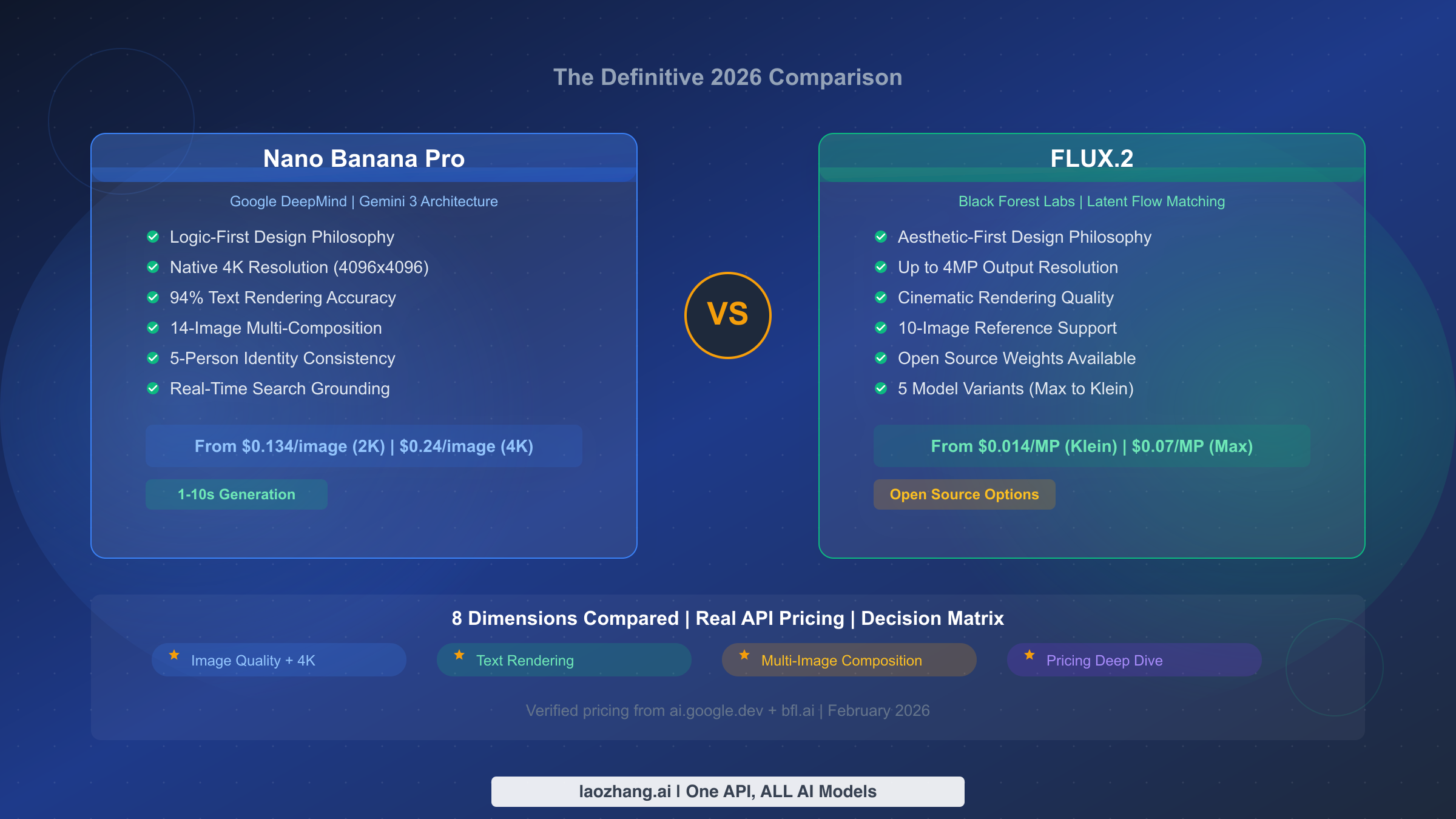
Choosing between Nano Banana Pro and FLUX.2 in 2026 comes down to a fundamental question: do you need precision-first intelligence or aesthetic-first artistry? Nano Banana Pro, built on Google DeepMind's Gemini 3 architecture and released on November 20, 2025, approaches image generation as a reasoning problem — planning scenes before rendering them, achieving 94% text accuracy, and supporting native 4K output. FLUX.2, launched five days later by Black Forest Labs on November 25, 2025, takes the opposite approach with its latent flow matching architecture, prioritizing cinematic depth, painterly textures, and atmospheric richness. Both models represent the cutting edge of AI image generation, but they excel in fundamentally different ways. This comparison breaks down exactly where each model wins, what each one costs down to the penny, and which one you should choose for your specific workflow — all backed by pricing data verified directly from ai.google.dev and bfl.ai on February 9, 2026.
TL;DR
Nano Banana Pro wins on precision metrics: native 4K resolution, 94% text rendering accuracy, 14-image multi-composition, 5-person identity consistency, and generation speed (1-10 seconds). FLUX.2 wins on aesthetics, cost flexibility, and openness: cinematic rendering quality, per-megapixel pricing starting at just $0.014 with Klein variants, and open-source weights for self-hosting. For most production workflows requiring accuracy and text, choose Nano Banana Pro. For creative projects prioritizing visual mood and budget efficiency, choose FLUX.2. For the smartest approach, use both through a unified API — Nano Banana Pro for final production assets and FLUX.2 for concept exploration.
Understanding the Contenders — Origins and Design Philosophy
Nano Banana Pro and FLUX.2 emerged from fundamentally different AI research traditions, and understanding these origins explains why each model excels where it does. Nano Banana Pro is Google DeepMind's flagship image generation model, built on the Gemini 3 Pro architecture that powers Google's most advanced multimodal AI systems. Unlike traditional image generators that simply map text prompts to pixels, Nano Banana Pro operates as a reasoning engine — it parses complex instructions, plans spatial layouts, and generates images that reflect genuine understanding of the scene being described. This logic-first approach is why the model achieves unprecedented text rendering accuracy, handles numerical concepts correctly (counting objects, maintaining proportions), and can compose scenes with up to 14 reference images while maintaining structural coherence. For a deeper look at all of Nano Banana Pro's capabilities beyond image generation, see our complete capabilities reference.
FLUX.2 comes from Black Forest Labs, the company founded by the original creators of Stable Diffusion. Where Nano Banana Pro approaches image generation as a reasoning problem, FLUX.2 treats it as an aesthetic craft. Built on a latent flow matching architecture combined with a Mistral-3 based vision-language model and a rectified-flow transformer, FLUX.2 unifies generation and editing into a single pipeline that excels at producing images with cinematic depth, rich textural detail, and the kind of atmospheric quality that makes outputs feel like they came from a professional photographer or concept artist. Black Forest Labs' decision to release open-source weights for several FLUX.2 variants also reflects a fundamentally different philosophy about how AI models should be deployed — one that gives developers and researchers direct access to modify, fine-tune, and self-host the model.
The philosophical divide between these two models — logic versus aesthetics, closed versus open, reasoning versus rendering — is not merely academic but has direct practical consequences that every potential user should understand. When Nano Banana Pro generates an image, it first constructs an internal representation of the scene that accounts for spatial relationships, physical constraints, and semantic meaning before rendering any pixels. This is why the model can correctly count objects, place text legibly, and maintain structural coherence in complex multi-element scenes. When FLUX.2 generates an image, it works through a diffusion process that transforms noise into signal, guided by its understanding of visual aesthetics and the input prompt. This process naturally produces images with smooth gradients, rich textural variety, and the kind of organic visual quality that comes from an architecture optimized for visual beauty rather than logical accuracy. Understanding this fundamental difference is the key to making the right choice — not because one approach is inherently superior, but because each approach produces systematically better results for different categories of tasks.
The FLUX.2 Ecosystem — Choosing the Right Variant
One of the most significant differences between these two models is that FLUX.2 isn't a single model — it's a family of five distinct variants, each optimized for different use cases and budgets. Most comparison articles only discuss FLUX.2 [max] or [pro], but choosing the right variant is often more important than choosing between FLUX.2 and Nano Banana Pro in the first place.
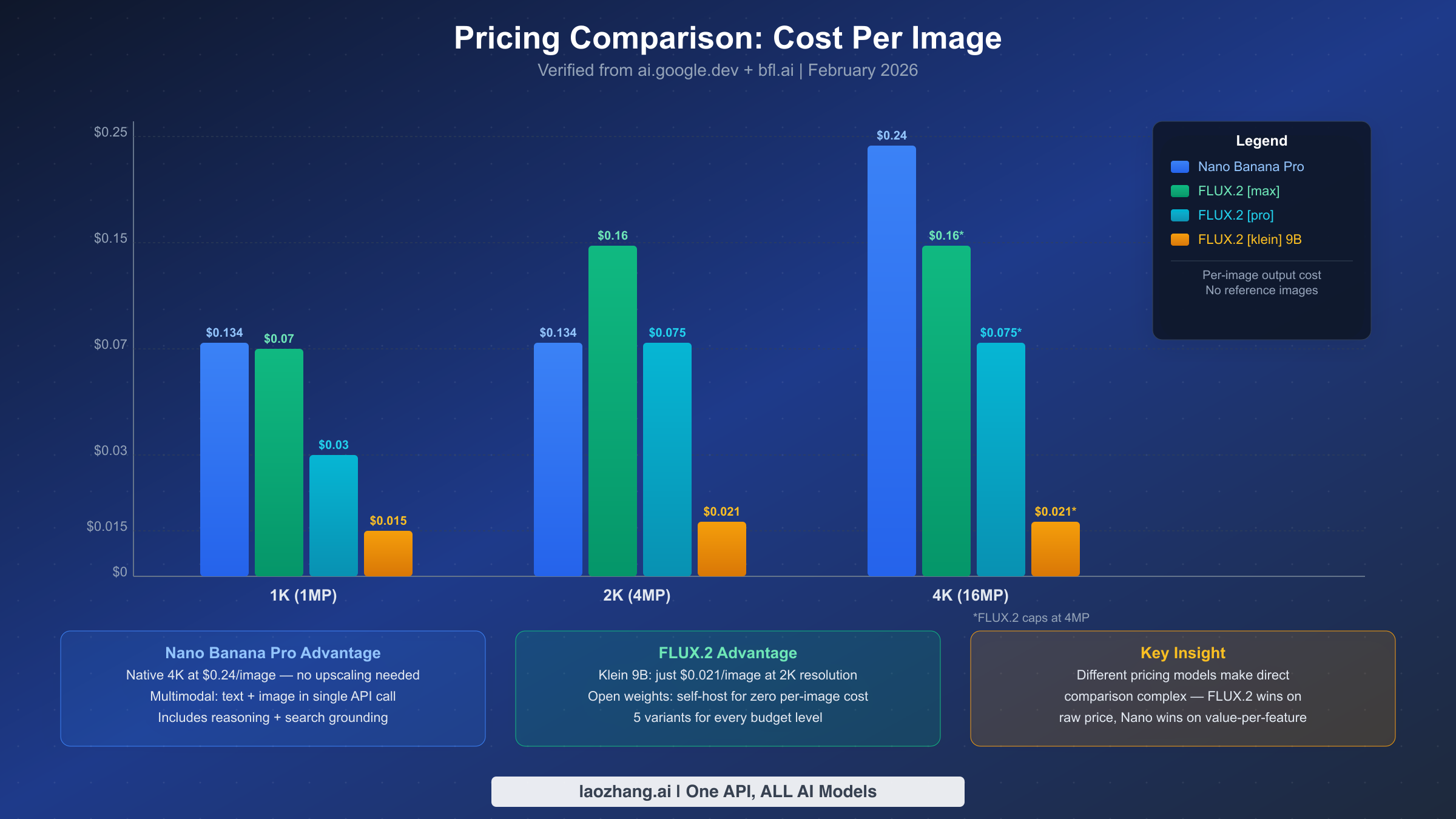
FLUX.2 [max] represents the pinnacle of Black Forest Labs' image generation technology. It charges $0.07 for the first generated megapixel and $0.03 for each subsequent megapixel, with reference images costing $0.03 per megapixel. This variant pushes image quality, prompt understanding, and editing consistency to the highest level in the FLUX.2 family, making it the direct competitor to Nano Banana Pro for professional-grade work. For structured layouts like infographics and product shots, FLUX.2 [max] delivers exceptionally stable results with strong prompt adherence.
FLUX.2 [pro] hits a sweet spot between quality and cost, charging $0.03 for the first generated megapixel and $0.015 for subsequent megapixels. Reference images cost $0.015 per megapixel. For many professional workflows, [pro] delivers 90-95% of [max]'s quality at roughly half the price, making it the most popular choice for production environments where you need consistent quality without the premium pricing. This variant handles most creative and commercial tasks well, though it may show slightly less refinement in extreme detail areas compared to [max].
FLUX.2 [flex] takes a different approach with a flat $0.05 per megapixel for both input and output. This simplified pricing model makes cost estimation straightforward, and the variant is designed for workflows that need predictable budgeting. While it lacks some of the fine-grained control of [pro] and [max], its editing capabilities and consistent quality make it a solid middle-ground option for teams that value simplicity.
The two FLUX.2 [klein] variants — 9B and 4B parameters — represent the budget tier. Klein 9B charges $0.015 for the first megapixel and just $0.002 for each subsequent one, while Klein 4B is even cheaper at $0.014 and $0.001 respectively. These models sacrifice some quality for dramatically lower costs and faster generation speeds. For high-volume applications like social media content, thumbnail generation, or rapid prototyping, the Klein variants offer remarkable value — you can generate a standard 1MP image for as little as $0.014, roughly 10x cheaper than Nano Banana Pro's equivalent output.
Nano Banana Pro, by contrast, is a single unified model. There are no variants to choose from — you get Google's full reasoning engine every time. This simplicity has both advantages (no decision paralysis, consistent quality) and disadvantages (no budget-tier option, no self-hosting). The model's pricing is token-based rather than megapixel-based: $2.00 per million input tokens and $120.00 per million image output tokens, which works out to approximately $0.134 per 2K image and $0.24 per 4K image (ai.google.dev/pricing, verified February 9, 2026).
Image Quality Showdown — Visual Capabilities Compared
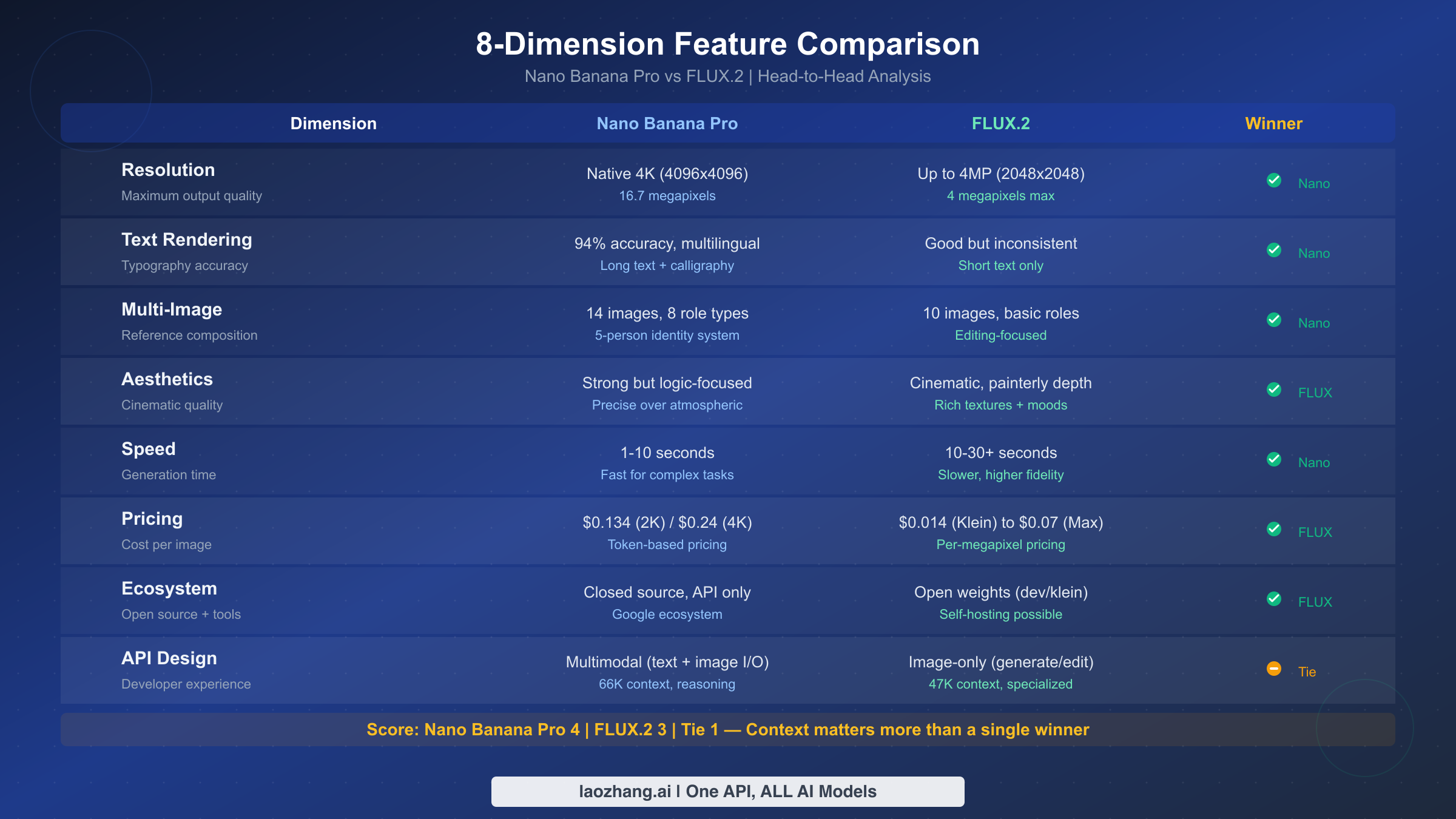
The image quality comparison between these two models defies simple "winner" declarations because they optimize for fundamentally different aspects of visual output. Nano Banana Pro produces images with extraordinary structural precision — objects are correctly placed, text is readable, numerical concepts are accurate, and spatial relationships make physical sense. When you ask Nano Banana Pro to generate a product photography scene with a specific arrangement of items, the result will closely match your instructions with correct proportions, lighting that follows physical rules, and text elements that a viewer can actually read.
FLUX.2, particularly the [max] variant, produces images with a different kind of excellence — cinematic atmosphere. A landscape generated by FLUX.2 will have richer color gradients, more nuanced lighting transitions, and textural details that give the image a painterly quality reminiscent of high-end concept art or professional photography. The model excels at capturing mood, atmosphere, and the subtle visual qualities that make an image feel emotionally resonant rather than technically perfect. For creative professionals who prioritize visual impact over precision, this aesthetic advantage is decisive.
Text rendering stands as Nano Banana Pro's most significant technical advantage, and the gap between the two models in this dimension is not a matter of degree but of kind. With a verified 94% accuracy rate across multiple languages including complex scripts like CJK characters, Arabic, and Devanagari, Nano Banana Pro can reliably render legible text directly within generated images. This capability extends beyond simple titles to include long paragraphs, calligraphic styles, and multilingual layouts where different scripts appear in the same image. The practical implications are enormous: a marketing team can generate a social media ad with a tagline and send it directly to publication, a product designer can create packaging mockups with realistic labels, and an infographic creator can produce data-rich visuals where every number and label is readable at full resolution. FLUX.2 can render text as well, but its accuracy is notably lower — particularly with longer text passages, small font sizes, and non-Latin scripts. Short English titles may render acceptably in FLUX.2 outputs, but anything beyond simple headings risks misspellings, character substitutions, or illegible rendering that requires manual correction. For any workflow that requires readable text in images, Nano Banana Pro's text rendering advantage is categorical rather than incremental. For detailed techniques on maximizing text accuracy across different resolution levels, see our 4K image generation techniques guide.
Resolution represents another dimension where Nano Banana Pro holds a clear and quantifiable lead. The model supports native 4K output at 4096x4096 pixels, which translates to 16.7 megapixels of genuine detail generated at the model level rather than interpolated through post-processing. This native 4K capability has practical significance that extends beyond simple pixel counts: text rendered at 4K maintains crisp edges and consistent stroke widths, fine textural details like fabric weave or metallic grain are resolved rather than approximated, and edge transitions between objects show clean boundaries without the softening artifacts that plague upscaled images. FLUX.2's maximum resolution is capped at 4 megapixels — approximately 2048x2048 pixels — with any image exceeding this limit automatically resized to fit within the constraint. For print-ready materials, large-format displays, presentation slides that will be projected on theater-sized screens, or any application where resolution directly impacts perceived quality, Nano Banana Pro's 4x megapixel advantage is substantial and cannot be bridged through post-processing alone.
Prompt adherence — how closely the generated output matches the input instructions — reveals interesting philosophical differences between the models that have practical consequences for different workflows. Nano Banana Pro's reasoning engine means it handles complex, multi-constraint prompts with remarkable fidelity. You can specify exact object counts, precise spatial arrangements, color relationships between elements, lighting direction, and stylistic requirements, and the model will attempt to satisfy all constraints simultaneously because it understands the logical relationships between them. Request "three red apples arranged in a triangle on a wooden table with warm afternoon light from the left" and Nano Banana Pro will produce exactly three apples, correctly arranged, with physically plausible lighting. FLUX.2 interprets prompts more loosely, often producing creative interpretations that may diverge from literal instructions but frequently feel more artistically interesting. The same apple prompt in FLUX.2 might yield four apples with different lighting, but the image could possess a warmth and photographic quality that feels more naturally beautiful. Whether this creative license is a strength or weakness depends entirely on whether your workflow demands precision or welcomes pleasant surprises.
Advanced Features — Multi-Image Composition, Identity, and Editing
Multi-image composition represents one of the most complex challenges in AI image generation, and both models approach it differently. Nano Banana Pro supports up to 14 reference images in a single composition, organized through a sophisticated role assignment system with 8 distinct role types. The first 6 image slots receive high-fidelity processing, ensuring that the most important reference elements are rendered with maximum detail, while slots 7 through 14 serve as supplementary references that influence the overall composition without demanding the same level of individual attention. This architectural decision reflects a practical understanding of how complex compositions work — not every element needs equal emphasis, and the most important characters or objects should receive priority processing. For a complete guide to multi-image workflows, see our multi-image composition guide.
FLUX.2 supports up to 10 reference images, with its multi-reference system designed primarily for editing and style transfer rather than complex scene composition. The model excels at using reference images to guide style, maintain visual consistency during editing operations, and blend elements from multiple sources into a coherent output. Where Nano Banana Pro treats multi-image as a compositional tool for building complex scenes, FLUX.2 treats it as an editing tool for refining and combining visual elements. Both approaches have merit, but for scenarios requiring many characters or objects with maintained identity — group photos, product catalogs, storyboard sequences — Nano Banana Pro's 14-image system with role-based assignments provides more granular control.
Identity consistency across multiple generations is critical for professional workflows like character design, brand mascots, and storyboarding. Nano Banana Pro's 5-person identity system can maintain consistent facial features, body proportions, and styling across separate generation calls, allowing creators to build visual narratives where the same characters appear in different scenes while remaining recognizably themselves. FLUX.2 handles identity preservation through its reference image system, which works well for style consistency but offers less precise control over individual character features across multiple generations. The practical difference becomes apparent in production scenarios: Nano Banana Pro's identity system is designed for consistent character work, while FLUX.2's system is designed for consistent style work.
Editing capabilities show a more balanced competition where each model's design philosophy directly shapes its editing strengths. FLUX.2's architecture was explicitly designed to unify generation and editing into a single pipeline, and the model handles localized edits — changing specific regions of an image while preserving everything else — with impressive precision and natural blending that avoids the seam artifacts that plague simpler editing approaches. The practical value becomes apparent in workflows like product photography editing, where a designer might need to change the background, adjust lighting on a specific area, or modify a single element while keeping the rest of the image pixel-perfect. FLUX.2's reference image system also supports multi-step editing chains where each edit builds on the previous one, maintaining consistency throughout the process. Nano Banana Pro takes a conversational approach to editing, allowing users to describe modifications in natural language rather than specifying regions programmatically. This means you can say "change the sky to sunset colors" or "add a reflection in the window" and the model will interpret and execute the edit using its reasoning capabilities. Both models handle standard editing tasks well, and the choice between them often comes down to whether you prefer programmatic precision (FLUX.2) or natural language flexibility (Nano Banana Pro) in your editing workflow.
Speed differences are significant for production environments and affect more than just user experience — they directly impact throughput economics and pipeline architecture. Nano Banana Pro typically generates images in 1 to 10 seconds, with the median latency around 4 seconds (OpenRouter data, verified February 9, 2026). This fast generation speed means a production pipeline can process 500-800 images per hour on a single API connection, enabling real-time or near-real-time applications like dynamic ad generation, personalized content creation, and interactive design tools where users expect immediate visual feedback. FLUX.2's generation times vary significantly by variant: the [max] variant typically requires 15 to 30+ seconds per image for its highest quality output, [pro] runs in 10 to 20 seconds, while the Klein variants can complete generations in 5 to 15 seconds. For batch processing workflows where thousands of images need to be generated overnight, this speed differential is manageable by running parallel requests. But for time-sensitive workflows like live content generation, A/B testing visual ads in real-time, or interactive design applications, Nano Banana Pro's 3-5x speed advantage translates directly into capabilities that FLUX.2 simply cannot match at equivalent quality tiers.
Pricing Deep Dive — Every Dollar Counted
Understanding the true cost of these models requires converting their different pricing structures into a common metric: cost per image at specific resolutions. Nano Banana Pro uses token-based pricing ($2.00 per million input tokens, $120.00 per million image output tokens), while FLUX.2 uses per-megapixel pricing that varies by variant. Here is the complete breakdown using official pricing verified from ai.google.dev and bfl.ai on February 9, 2026.
For a standard 1K image (1 megapixel, approximately 1024x1024), Nano Banana Pro costs approximately $0.134 while FLUX.2 [max] costs $0.07, FLUX.2 [pro] costs $0.03, and FLUX.2 [klein] 9B costs just $0.015. At this resolution, every FLUX.2 variant is cheaper than Nano Banana Pro, with the Klein 9B variant costing roughly 9x less. However, this raw price comparison omits a crucial detail: Nano Banana Pro's $0.134 includes multimodal reasoning, text output, and search grounding capabilities that FLUX.2 cannot match. You are paying for an image generation system that understands context, reasons about content, and can ground its outputs in real-world information — not just a pixel renderer.
At 2K resolution (4 megapixels), the price gap narrows slightly. Nano Banana Pro remains at approximately $0.134 for 2K output, while FLUX.2 [max] increases to $0.16 (first megapixel at $0.07 plus 3 additional megapixels at $0.03 each), actually surpassing Nano Banana Pro's price at this resolution. FLUX.2 [pro] comes to $0.075, and Klein 9B to $0.021. This crossover point at 2K resolution is important: FLUX.2 [max] becomes more expensive than Nano Banana Pro for higher-resolution outputs, while [pro] and [klein] remain cheaper. For detailed pricing analysis and cost optimization strategies specific to Nano Banana Pro, see our complete Nano Banana Pro pricing breakdown.
At 4K resolution (16 megapixels), Nano Banana Pro is the only model that natively supports this output. The cost is approximately $0.24 per 4K image. FLUX.2 caps images at 4 megapixels, so its highest-resolution output remains at the 2K pricing tier. If you need native 4K without upscaling artifacts, Nano Banana Pro is your only option between these two models, and $0.24 for a 16.7-megapixel image with reasoning-backed quality is remarkably competitive.
For batch processing scenarios, consider the total monthly cost. If you generate 1,000 images per month at 2K resolution: Nano Banana Pro costs approximately $134, FLUX.2 [max] costs $160, FLUX.2 [pro] costs $75, and FLUX.2 [klein] 9B costs just $21. At 10,000 images per month, those figures become $1,340, $1,600, $750, and $210 respectively. The right choice depends heavily on whether the quality differences between these tiers justify the price differences for your specific application.
FLUX.2 also offers a path to dramatically reduced marginal cost that Nano Banana Pro's closed architecture cannot match: self-hosting. With open-source weights available for the [dev] and [klein] variants, organizations with GPU infrastructure can run FLUX.2 locally, paying only for compute rather than per-image API fees. A single NVIDIA A100 GPU can run the Klein 4B variant and generate images at approximately 2-5 seconds per image, which at sustained utilization translates to roughly 17,000-43,000 images per day. At cloud GPU rental rates of approximately $1-2 per hour for an A100, this works out to $0.002-$0.005 per image — roughly 25x cheaper than even the Klein API pricing and 65x cheaper than Nano Banana Pro. However, self-hosting requires significant engineering investment in deployment infrastructure, scaling, monitoring, and model updates that API-based services handle automatically, making it primarily viable for organizations that already have GPU infrastructure and ML engineering capabilities. For organizations looking to manage API usage and rate limits effectively with Nano Banana Pro, our rate limits and quotas guide provides essential optimization strategies.
If you are looking for a way to reduce costs while maintaining access to both models, platforms like laozhang.ai offer unified API access to both Nano Banana Pro and FLUX.2 variants through a single endpoint, often with competitive pricing that can reduce your per-image costs compared to direct API access.
Which Model Should You Choose? — Decision Matrix
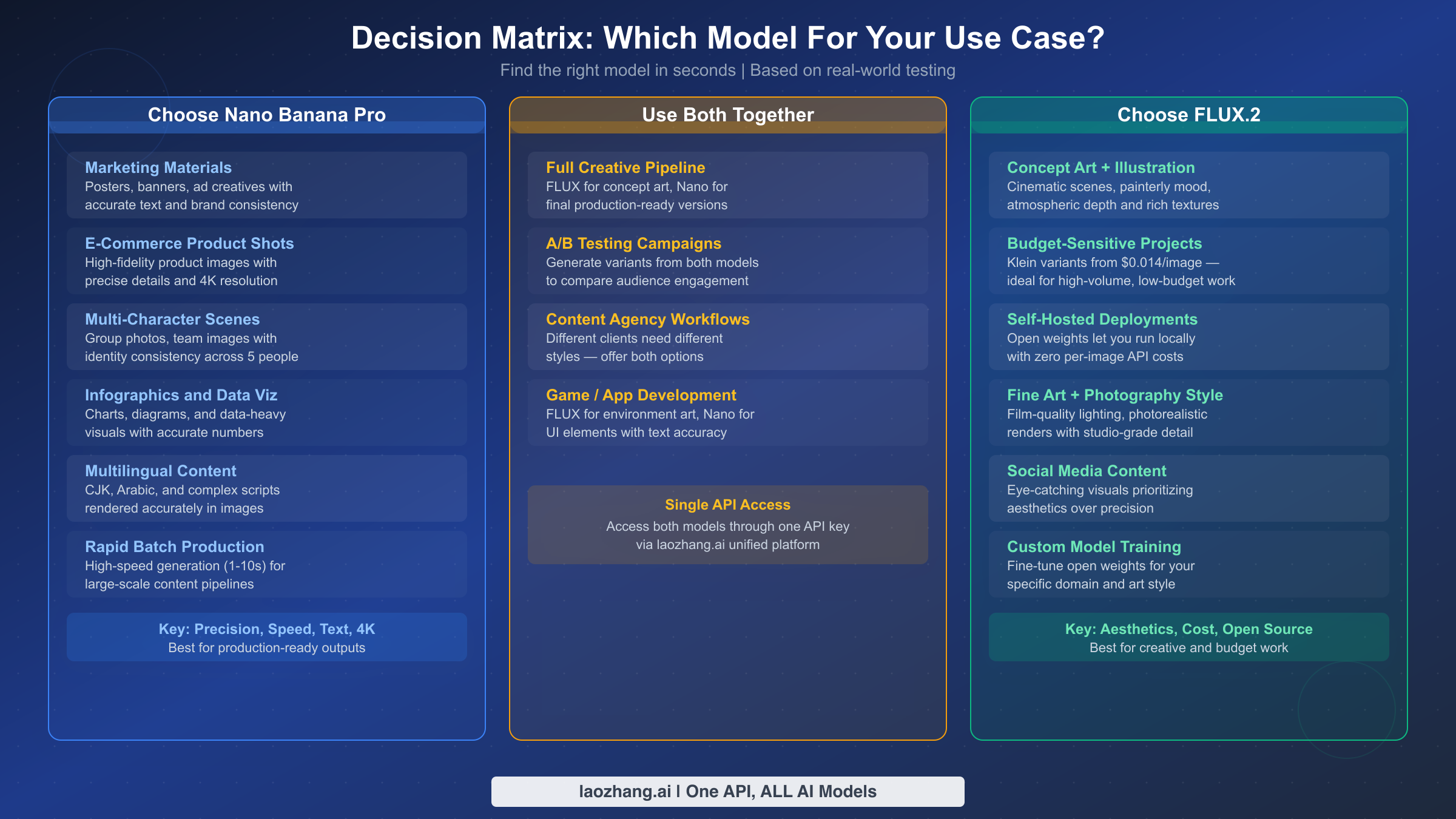
After analyzing pricing, features, quality, and speed across every dimension, the right choice depends on matching your specific workflow requirements to each model's strengths. Rather than declaring a universal winner, the following decision framework organizes recommendations by concrete use cases so you can find your answer in seconds.
Nano Banana Pro is the clear choice when precision and production-readiness matter most. Marketing materials and advertising represent the most obvious use case, where text accuracy is non-negotiable because campaign banners, social media ads with taglines, and promotional posters need to go directly from generation to publication without manual text correction. A marketing team generating 50 ad variations for a product launch cannot afford to manually fix text errors in every image, and Nano Banana Pro's 94% text accuracy makes this kind of automated creative production viable in ways that no other model currently matches. E-commerce product photography represents another strong use case, where Nano Banana Pro's structural precision and 4K resolution produce images where product details, dimensions, and labels are rendered with the fidelity that online shoppers expect. Multi-character scenes such as team photos, group illustrations, and storyboard sequences leverage the model's 5-person identity consistency system and 14-image composition capability to create coherent visual narratives where characters remain recognizably consistent across different scenes and contexts.
FLUX.2 becomes the preferred choice when aesthetics, budget, or ecosystem openness are your primary concerns. Concept art and illustration projects represent FLUX.2's ideal territory, where cinematic mood, atmospheric depth, and painterly texture matter more than structural precision. A game studio developing concept art for a fantasy world benefits from FLUX.2's ability to create environments that feel emotionally immersive and atmospherically rich, with the kind of lighting and textural nuance that evokes professional digital painting. Budget-sensitive projects with high volume requirements can leverage the Klein variants at $0.014 per image to produce social media content, thumbnail generation, and rapid prototyping at roughly one-tenth the cost of Nano Banana Pro, a cost differential that becomes decisive when you need to generate thousands of images per month and individual image quality matters less than production volume and cost efficiency. Organizations with GPU infrastructure can go further by self-hosting FLUX.2 using open-source weights, reducing per-image marginal costs to essentially zero after the initial hardware investment. And for teams that need to fine-tune an image model for specific domains, art styles, or brand aesthetics, FLUX.2's open-source variants are the only option — Nano Banana Pro's closed architecture does not support custom training.
The smartest approach for many organizations is to use both models strategically rather than choosing one exclusively, treating the selection as a per-task decision rather than a company-wide mandate. In a full creative pipeline, FLUX.2 serves as the exploration and concept development tool, generating multiple aesthetic variations quickly and cheaply with Klein variants to explore visual directions before committing to a final approach. A design team might generate 20-30 concept explorations with FLUX.2 [klein] for under $0.50, identify the most promising direction, and then use Nano Banana Pro to produce the final production-ready assets with precise text, accurate details, and 4K resolution that can go directly to publication or print. This dual-model workflow combines the best of both worlds — FLUX.2's creative breadth for exploration and Nano Banana Pro's precision for execution — at a total cost lower than using either model exclusively for both stages.
Content agencies serving diverse clients benefit particularly from having both models available because different projects demand fundamentally different visual strengths. An editorial illustration project might call for FLUX.2's atmospheric depth and painterly quality, while a product catalog for an e-commerce client demands Nano Banana Pro's structural precision and text accuracy. Game and application development teams can similarly split responsibilities, using FLUX.2 for environment art, atmospheric backgrounds, and concept exploration while relying on Nano Banana Pro for UI elements, text overlays, HUD graphics, and any in-game imagery that requires precise rendering of text or numerical information. The key insight is that these models are more complementary than competitive — their strengths and weaknesses are almost perfectly inverse, which means a dual-model strategy eliminates the compromises inherent in choosing just one.
Getting Started — API Access and Integration
Both models are accessible through their respective official APIs, and getting started requires understanding the different integration patterns each model uses. Nano Banana Pro is available through the Google AI Studio API (Gemini API) with the model identifier gemini-3-pro-image-preview. As a multimodal model, it accepts both text and image inputs and can produce both text and image outputs, meaning your API calls follow the standard Gemini chat completion format with image generation parameters. This multimodal design means you can combine reasoning, text generation, and image generation in a single API conversation, which is uniquely powerful for workflows that need contextual understanding alongside visual output. For prompt engineering techniques specific to Nano Banana Pro, see our prompt engineering for Nano Banana Pro guide.
FLUX.2 is accessible through the Black Forest Labs API at api.bfl.ai, with dedicated endpoints for each variant (/v1/flux-2-max, /v1/flux-2-pro, /v1/flux-2-flex, etc.). The API follows a different pattern than Nano Banana Pro — it is designed exclusively for image generation and editing rather than general multimodal reasoning, with parameters for output dimensions, reference images, and generation settings. The endpoint structure is straightforward, and the documentation at docs.bfl.ai provides clear examples for each variant and use case. One important architectural difference for developers to note is that FLUX.2's API is stateless and task-oriented, while Nano Banana Pro's API supports conversational context, meaning you can iteratively refine images through a multi-turn conversation with Nano Banana Pro but must issue complete, self-contained requests to FLUX.2. For open-source deployment, the [dev] and [klein] weights are available on Hugging Face at huggingface.co/black-forest-labs, with community-maintained implementations for popular inference frameworks like ComfyUI, diffusers, and vLLM.
The API integration patterns differ significantly between the two models in ways that affect development time and architecture decisions. Nano Banana Pro's multimodal nature means that image generation is just one capability within a broader conversation, and your application can seamlessly transition between text reasoning, image analysis, and image generation within a single session. This is particularly powerful for applications that need to analyze existing images, generate text descriptions, and then create new images based on that analysis — a workflow that would require three separate API calls across different services if using FLUX.2 alone. FLUX.2's specialized API, by contrast, offers more granular control over image generation parameters and is simpler to integrate if you only need image generation without the multimodal reasoning overhead.
For teams that want to use both models without managing separate API integrations, authentication systems, and billing, unified API platforms like laozhang.ai provide access to both Nano Banana Pro and all FLUX.2 variants through a single API key and endpoint. This approach simplifies integration significantly by consolidating billing, providing a single authentication mechanism, and allowing you to switch between models programmatically based on the specific requirements of each generation request. A content pipeline built on a unified API can automatically route text-heavy images to Nano Banana Pro and aesthetic-focused content to FLUX.2 without any changes to the calling code, making it straightforward to leverage the strengths of both models within a single application.
Frequently Asked Questions
One of the most common misconceptions about these two models is that they share underlying technology, which leads to confusion about their capabilities and limitations. Nano Banana Pro and FLUX.2 are built on completely different architectures by separate organizations. Nano Banana Pro uses Google DeepMind's Gemini 3 Pro multimodal architecture — a reasoning-first system designed for general intelligence that includes image generation as one of its capabilities. FLUX.2 uses Black Forest Labs' proprietary latent flow matching architecture combined with a Mistral-3 based vision-language model. They share no code, weights, or architectural components, though both represent the state of the art in AI image generation as of February 2026.
The question of which model produces "better" images overall is one that professionals in the field encounter constantly, and the answer is genuinely context-dependent rather than evasive. Nano Banana Pro produces more accurate, structurally precise images with reliable text rendering and native 4K resolution, which makes it measurably superior for production work that requires correctness and readability. FLUX.2 produces more aesthetically rich images with cinematic depth, painterly textures, and atmospheric quality that makes it the preferred tool for creative exploration and concept development. A marketing team would be poorly served by choosing FLUX.2 for text-heavy campaign materials, just as a concept artist would miss out on FLUX.2's atmospheric excellence by using only Nano Banana Pro for mood exploration. The right answer is almost always to choose based on the specific demands of each project rather than declaring a universal winner.
Pricing comparisons for high-volume usage reveal significant cost differences that compound at scale. At 10,000 images per month at 2K resolution, Nano Banana Pro costs approximately $1,340, FLUX.2 [max] costs $1,600, FLUX.2 [pro] costs $750, and FLUX.2 [klein] 9B costs just $210 (verified from ai.google.dev and bfl.ai, February 9, 2026). FLUX.2 additionally offers self-hosted deployment with open weights, which can reduce marginal costs to near zero for organizations with GPU infrastructure, making the total cost of ownership calculation more complex than a simple per-image comparison suggests.
For teams wondering whether they can use both models through a single integration, the answer is yes — platforms like laozhang.ai provide unified API access to both Nano Banana Pro and all FLUX.2 variants through a single API key. This allows developers to programmatically route requests to the optimal model based on each image's requirements without managing separate integrations, authentication systems, or billing accounts, which significantly reduces the engineering overhead of a dual-model strategy.
Text rendering represents the single most decisive capability gap between these two models, and it is worth addressing in detail because it affects so many practical use cases. Nano Banana Pro achieves 94% text accuracy across multiple languages including complex scripts like CJK characters, Arabic, and Devanagari, making it viable for automated content production where generated images go directly to publication without manual text correction. FLUX.2 can render short English text passages acceptably but struggles with accuracy for longer text, smaller font sizes, and non-Latin scripts, requiring manual correction for any text-critical application.
The resolution question also deserves explicit clarification because it directly impacts print and display workflows. FLUX.2 caps output resolution at 4 megapixels (approximately 2048x2048 pixels), with images exceeding this limit automatically resized to fit the constraint. Native 4K output at 4096x4096 pixels, delivering 16.7 megapixels of genuine detail, is only available through Nano Banana Pro. While FLUX.2 outputs can be upscaled using third-party super-resolution tools, upscaled images lack the native sharpness, consistent text clarity, and fine textural detail of Nano Banana Pro's native 4K output because upscaling interpolates detail rather than generating it at the model level.