Nano Banana 2 (Google's Gemini 2.5 Flash Image model) excels at text rendering with 94% accuracy and generates images in under 15 seconds, while Midjourney v7 dominates artistic quality with its new Draft Mode and personalization features that launched in April 2025. As of December 2025, both tools serve distinctly different purposes: choose Nano Banana for precision editing and photorealism, Midjourney for creative artistry and atmospheric compositions. Most professional teams ultimately use both—Nano Banana for production-ready assets with accurate text, and Midjourney for creative exploration and moodboards.
Quick Comparison at a Glance
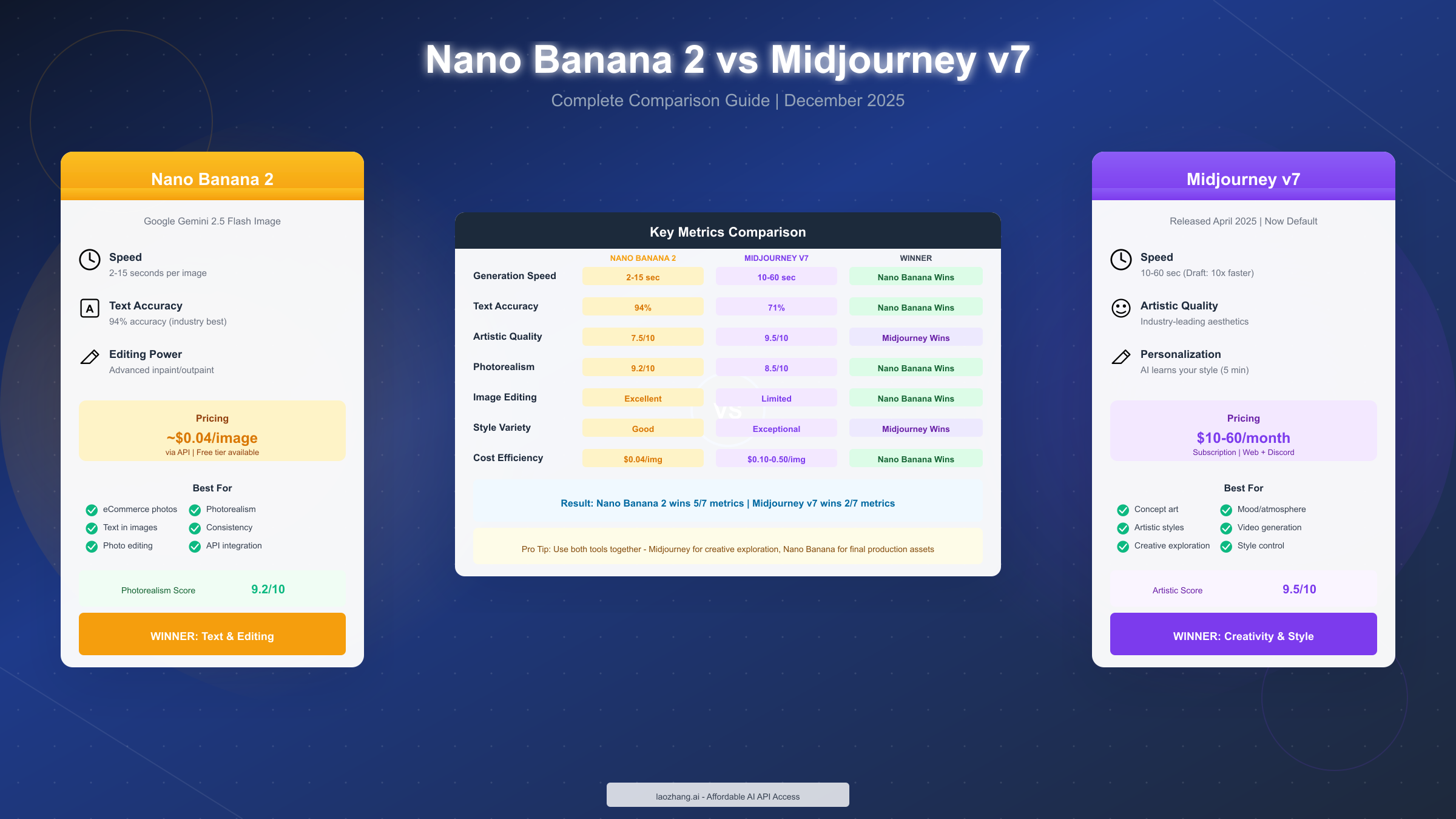
Before diving into the details, here's what you need to know to make a quick decision. The following table summarizes the key differences between these two AI image generation powerhouses based on extensive testing and research conducted throughout 2025.
| Feature | Nano Banana 2 | Midjourney v7 | Winner |
|---|---|---|---|
| Generation Speed | 2-15 seconds | 10-60 seconds | Nano Banana |
| Text Accuracy | 94% | 71% | Nano Banana |
| Artistic Quality | 7.5/10 | 9.5/10 | Midjourney |
| Photorealism | 9.2/10 | 8.5/10 | Nano Banana |
| Image Editing | Excellent | Limited | Nano Banana |
| Style Variety | Good | Exceptional | Midjourney |
| Cost per Image | ~$0.04 | $0.10-0.50 | Nano Banana |
| Learning Curve | Easy | Moderate | Nano Banana |
| API Access | Full | Limited | Nano Banana |
Quick Verdict by User Type:
If you're a photographer or eCommerce seller who needs photorealistic images with perfect text, choose Nano Banana 2. The combination of superior text rendering and editing capabilities makes it ideal for product photos, marketing materials, and any content requiring readable typography.
If you're a concept artist or creative director seeking striking visuals and atmospheric compositions, Midjourney v7 remains the industry standard. Its artistic interpretation capabilities and style control produce images that look like they belong in high-end fantasy art books.
If you're a marketing team or agency handling diverse projects, consider using both tools together. Start with Midjourney for creative exploration, then use Nano Banana for final production assets—this hybrid workflow delivers the best of both worlds.
What Are Nano Banana 2 and Midjourney v7?
Understanding the technology behind each tool helps explain why they excel in different areas. Both represent significant advances in AI image generation, but they're built on fundamentally different architectures with distinct design philosophies.
Nano Banana 2 is the community's affectionate nickname for Google's Gemini 2.5 Flash Image model, which became publicly available through the Gemini platform in late 2025. The "Nano Banana" name emerged from the AI community's tendency to create playful monikers for new models. Behind this casual name lies serious technology: Nano Banana 2 is built on Google's latest multimodal architecture, which enables it to understand both text and images in context.
What makes Nano Banana 2 particularly powerful is its conversational approach to image editing. Rather than forcing users to learn complex parameters or masks, you can simply describe what changes you want—"change the background to a beach at sunset" or "make the text blue instead of red"—and the model understands and executes your request. This accessibility has made it popular among users who previously found AI image tools intimidating.
The Nano Banana family actually includes three tiers: the original Nano Banana (based on Gemini 2.5 Flash), Nano Banana 2 (an enhanced version with improved consistency), and Nano Banana Pro (built on Gemini 3 Pro for maximum quality). For most users, Nano Banana 2 offers the best balance of capability and cost. If you're interested in accessing these models programmatically, check out our free Gemini Flash Image API guide for setup instructions.
Midjourney v7 represents a completely different approach. Released on April 3, 2025, and becoming the default model on June 17, 2025, V7 was described by CEO David Holz as having "a completely different architecture" compared to previous versions. This isn't just marketing speak—V7 introduces genuinely new capabilities that change how creators work with the tool.
The most significant V7 innovation is personalization. For the first time, Midjourney learns your visual preferences and adapts its outputs accordingly. After a brief five-minute setup process where you rate images, the model understands your aesthetic preferences and applies them automatically. This means two users entering the same prompt can receive images tailored to their individual styles—a game-changer for creators who've developed a distinctive visual identity.
V7 also introduced Draft Mode, which generates images at 10x the normal speed and half the GPU cost. This transforms Midjourney from a tool where you carefully craft each prompt into one where rapid iteration becomes practical. Creative exploration that previously took hours can now happen in minutes.
Beyond still images, Midjourney has expanded into video with its V1 video model released June 18, 2025. While we won't cover video in depth here, it's worth noting that Midjourney is positioning itself as a comprehensive creative platform rather than just an image generator. For those interested in video capabilities, our AI video models comparison provides detailed analysis.
Head-to-Head: Features Compared
The feature comparison between these tools reveals why neither is universally "better"—they're optimized for different workflows and outcomes. Understanding these differences helps you choose the right tool for each project.
Image Quality and Style
Midjourney v7 produces images with remarkable artistic sophistication that few competitors match. When given a prompt like "a mystical forest at twilight with glowing mushrooms and ethereal fog," Midjourney delivers compositions that feel like they belong in high-end fantasy art books. The atmospheric lighting, painterly textures, and emotional depth consistently impress even seasoned digital artists.
Nano Banana 2 approaches image generation differently. Its outputs lean toward cleaner, more commercial aesthetics with saturated colors and punchy contrasts optimized for practical use. While Midjourney might create a moody, artistic interpretation, Nano Banana tends toward clarity and readability—qualities that matter enormously for eCommerce, social media marketing, and any application where visual communication trumps artistic expression.
Testing across dozens of prompts reveals a consistent pattern: Midjourney excels when you want the AI's creative interpretation, while Nano Banana excels when you want precise execution of your vision. Neither approach is superior—they serve different needs.
Text Rendering Accuracy
Text in images has historically been AI image generation's Achilles heel. Nano Banana 2 changes this equation dramatically. With 94% accuracy on readable text rendering—covering signs, labels, logos, and typography—it significantly outperforms every competitor including Midjourney's 71% accuracy rate.
This gap matters tremendously for practical applications. Marketing teams creating social media graphics need text that's actually readable. eCommerce sellers want product images with accurate labels. UI/UX designers need mockups with legible interface text. In all these scenarios, Nano Banana's text handling provides a decisive advantage.
Midjourney v7 has improved text rendering compared to earlier versions, but it still treats text more as a visual element than a communication medium. The letters might look artistically interesting but often include subtle distortions, decorative strokes that reduce readability, or occasional spelling errors. For atmospheric text—like an ancient tome's mysterious writing or a vintage poster's stylized lettering—this artistic interpretation adds charm. For practical text applications, it's a significant limitation.
Speed and Performance
Speed comparisons reveal different design priorities. Nano Banana 2 generates images in 2-15 seconds depending on complexity and resolution, with most standard requests completing under 10 seconds. This speed enables conversational workflows where you iterate rapidly, making small adjustments until the image matches your vision.
Midjourney v7 takes 10-60 seconds per image in normal mode, though the new Draft Mode dramatically accelerates this to near-instantaneous results. The trade-off is that Draft Mode produces lower-resolution images intended for exploration rather than final output. Standard mode remains the choice for production-quality work.
The practical impact varies by workflow. If you're exploring creative directions and generating many variations, Midjourney's Draft Mode or Nano Banana's inherent speed both serve well. For production workflows where you're making targeted edits to specific images, Nano Banana's combination of speed and editing precision provides a smoother experience.
Editing Capabilities
Nano Banana 2's editing capabilities represent its strongest competitive advantage. The model excels at precise image manipulation: replacing backgrounds while preserving subject details, adjusting colors without affecting surrounding elements, adding or removing objects seamlessly, and maintaining character consistency across multiple edits.
One workflow that showcases this strength involves taking a Midjourney-generated fantasy character and using Nano Banana to create five outfit variations in under three minutes. This kind of iterative refinement is simply impossible in Midjourney, where each new request generates an entirely new image rather than modifying the existing one.
Midjourney v7 offers some editing through its variation and remix features, but you're fundamentally asking the model to regenerate with modifications rather than edit an existing image. This regeneration approach works well for exploring alternatives but poorly for precise adjustments where you want to preserve most of the original while changing specific elements.
Consistency and Control
For projects requiring consistent characters, objects, or styles across multiple images, both tools offer solutions with different strengths.
Nano Banana 2 achieves over 95% character consistency across edits—a 70% improvement over Midjourney according to testing by multiple independent reviewers. You can upload a character image, describe a new scene, and receive that same character in the new context with remarkable fidelity. This consistency extends to objects, brand elements, and stylistic treatments.
Midjourney v7's Omni-reference feature (--oref) provides similar functionality for placing consistent characters and objects into new scenes. The implementation differs: you're providing reference images that guide generation rather than editing an existing image. For some workflows this distinction matters; for others, either approach serves well.
Style control shows Midjourney's advantage. After years of community feedback through Discord, Midjourney responds predictably to negative prompts, style references, and parameter adjustments. You can lock a visual style and run variations without drift—an important capability for professional projects requiring consistent aesthetic across many images.
Pricing Deep Dive: Real Costs Compared
Pricing is where Nano Banana 2 demonstrates its most compelling advantage, but the comparison requires understanding different pricing models. One tool charges per image while the other uses subscriptions, making direct comparison tricky.
Nano Banana 2 Pricing
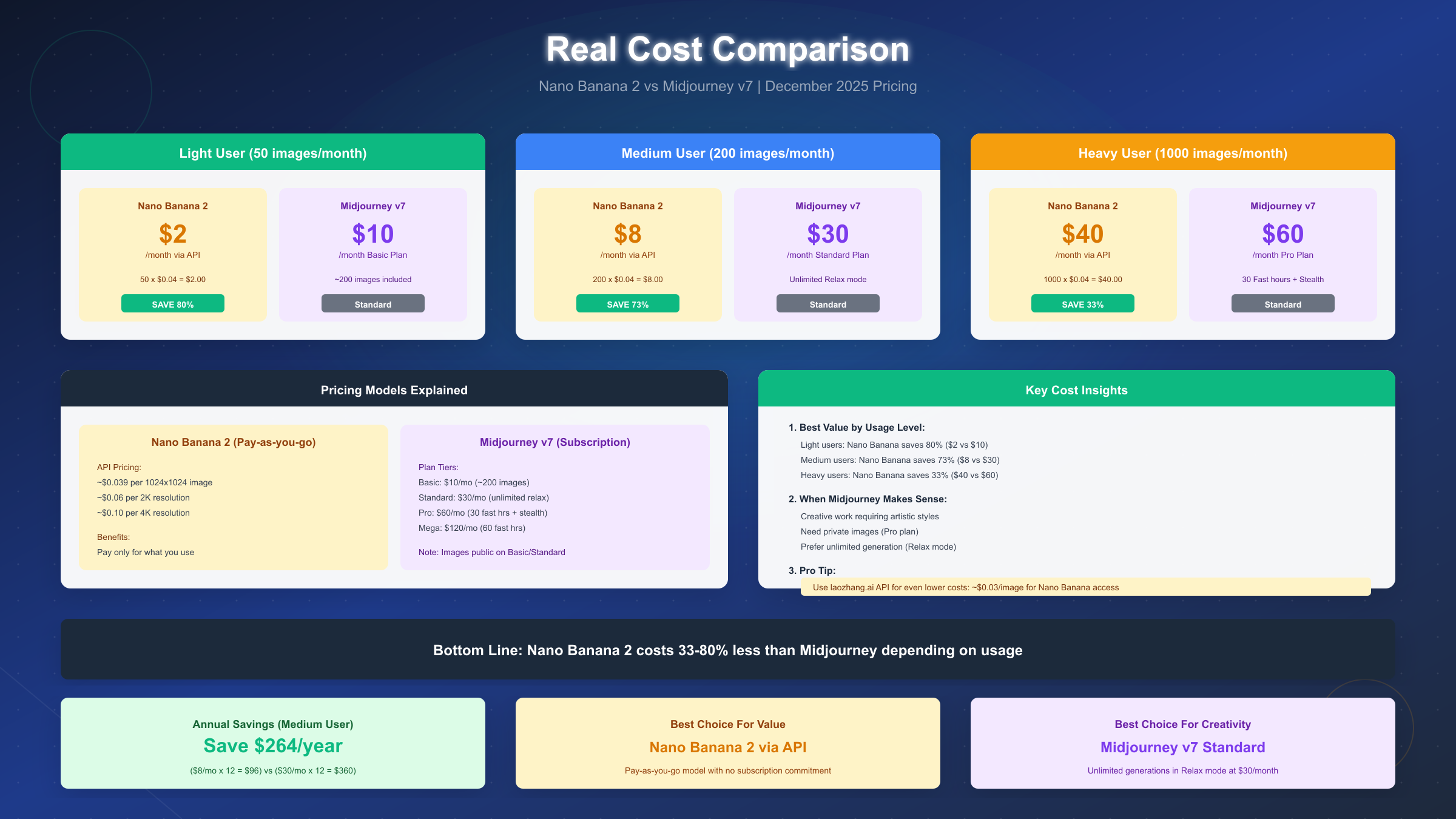
Nano Banana 2 uses pay-as-you-go pricing through Google's API. The base rate is approximately $0.039 per 1024x1024 image, scaling to around $0.06 for 2K resolution and $0.10 for 4K resolution. This pricing structure means you pay only for what you use, with no monthly commitment required.
For casual users generating 50 images monthly, the total cost comes to roughly $2. Medium-volume users creating 200 images monthly spend approximately $8. Even heavy users generating 1,000 images monthly face costs around $40—still less than Midjourney's Pro tier while gaining API access for automation.
Third-party services can reduce these costs further. Platforms like laozhang.ai offer proxied access at approximately $0.031 per image, representing meaningful savings for high-volume users. The API access also enables automation workflows impossible with Midjourney's primarily web/Discord interface.
Midjourney v7 Pricing
Midjourney uses subscription tiers with different features and generation limits:
- Basic ($10/month): Approximately 200 images, limited commercial rights
- Standard ($30/month): Unlimited relaxed mode generations, full commercial rights
- Pro ($60/month): 30 Fast hours, stealth mode for private images
- Mega ($120/month): 60 Fast hours, maximum generation priority
The subscription model means you pay the same whether you generate 1 or 1,000 images in a month. For consistent, high-volume users, this provides predictable budgeting. For sporadic users, it can mean paying for capacity you don't use.
An important consideration: images generated on Basic and Standard tiers are public by default. If your work requires confidentiality—client projects, unreleased products, proprietary designs—you'll need the Pro tier at minimum.
Real-World Cost Comparison
Let's calculate actual costs for three user profiles:
Light User (50 images/month):
- Nano Banana 2: 50 × $0.04 = $2/month
- Midjourney Basic: $10/month
- Savings with Nano Banana: 80%
Medium User (200 images/month):
- Nano Banana 2: 200 × $0.04 = $8/month
- Midjourney Standard: $30/month
- Savings with Nano Banana: 73%
Heavy User (1,000 images/month):
- Nano Banana 2: 1,000 × $0.04 = $40/month
- Midjourney Pro: $60/month
- Savings with Nano Banana: 33%
These calculations assume standard resolution. For 4K output, Nano Banana costs rise but typically remain competitive. The gap narrows at very high volumes, but Nano Banana maintains a cost advantage across all user profiles.
Annual savings can be substantial. A medium user choosing Nano Banana over Midjourney Standard saves $264 yearly ($96 vs $360). That's meaningful budget that could fund other tools, training, or creative resources.
Which Tool for Which Task?
Rather than declaring one tool universally superior, practical guidance matches tools to tasks. Each excels in specific scenarios, and understanding these strengths helps you make better decisions for individual projects.
eCommerce and Product Photography
Winner: Nano Banana 2
Product photography demands photorealism, consistency, and often readable text for labels or pricing. Nano Banana 2's strengths align perfectly with these requirements. You can upload a product photo and ask for background changes, lighting adjustments, or the addition of lifestyle elements while maintaining the product's accurate appearance.
The editing workflow proves particularly valuable here. Start with a basic product photo, then generate multiple variations: the same product in a kitchen setting, on a white background, in hands demonstrating use. Nano Banana maintains product consistency across these variations in ways Midjourney's regeneration approach cannot match.
For eCommerce platforms requiring hundreds or thousands of product images, Nano Banana's API access enables automation. Combined with lower per-image costs, this creates a significantly more scalable solution than manually generating images through Midjourney.
Art and Creative Illustration
Winner: Midjourney v7
When the goal is striking visual impact rather than commercial practicality, Midjourney v7 delivers unmatched results. Its artistic interpretation capabilities produce images with depth, atmosphere, and emotional resonance that technical accuracy alone cannot achieve.
Concept artists exploring visual directions find Midjourney's creative interpretation genuinely useful. Rather than executing prompts literally, it adds atmospheric elements, suggests compositions, and interprets scenes in ways that inspire further creative development. This "creative partnership" quality makes it valuable for ideation phases even if final assets come from other sources.
The personalization feature enhances this creative partnership over time. As Midjourney learns your preferences, its outputs increasingly align with your aesthetic sensibilities. For artists developing a signature style, this adaptive behavior accelerates creative work.
Marketing and Advertising
Winner: Both (Hybrid Workflow)
Marketing requires both creative impact and practical execution—exactly the combination that a hybrid workflow provides. The recommendation is to use Midjourney for initial creative exploration and concept development, then Nano Banana for production-ready final assets.
A typical hybrid workflow might proceed as follows: Generate 20-30 concept variations in Midjourney using Draft Mode, identify the winning direction, then use Nano Banana to produce the final version with accurate text, brand colors, and multiple size variations. This approach captures Midjourney's creative strengths while ensuring final assets meet practical requirements.
The cost structure supports this approach. Using Midjourney Standard for unlimited exploration ($30/month) plus Nano Banana for final production (perhaps $10-15/month for 200-300 final images) provides comprehensive capability for under $50 monthly—less than Midjourney Pro alone while delivering better results for text-heavy marketing content.
Social Media Content
Winner: Context-dependent
Social media spans diverse needs from artistic brand building to practical promotional content. The right choice depends on your specific content strategy.
For brands prioritizing aesthetic impact—fashion, lifestyle, art accounts—Midjourney's artistic output creates scroll-stopping images that build brand perception. The stylized quality that might seem impractical for eCommerce becomes an asset when the goal is visual distinctiveness.
For brands prioritizing clear communication—educational content, promotional offers, instructional posts—Nano Banana's text accuracy and editing speed enable rapid content production. Creating 10 variations of a promotional graphic with different text takes minutes rather than hours.
UI/UX Design Mockups
Winner: Nano Banana 2
Interface mockups require readable text, consistent elements, and precise editing—all Nano Banana strengths. Designers can generate interface concepts, then refine them through conversational editing: "make the buttons rounded," "change the header color to our brand blue," "add a search icon to the navigation bar."
The ability to maintain consistency across multiple screens proves particularly valuable. Generate a home screen concept, then create product pages, settings screens, and checkout flows that share visual language. Nano Banana's consistency features keep the design system coherent across these variations.
Midjourney can generate visually impressive UI concepts for inspiration, but attempting to use them as practical mockups typically requires significant manual refinement. The artistic interpretation that benefits creative projects works against the precision UI design demands.
Using Both Tools Together
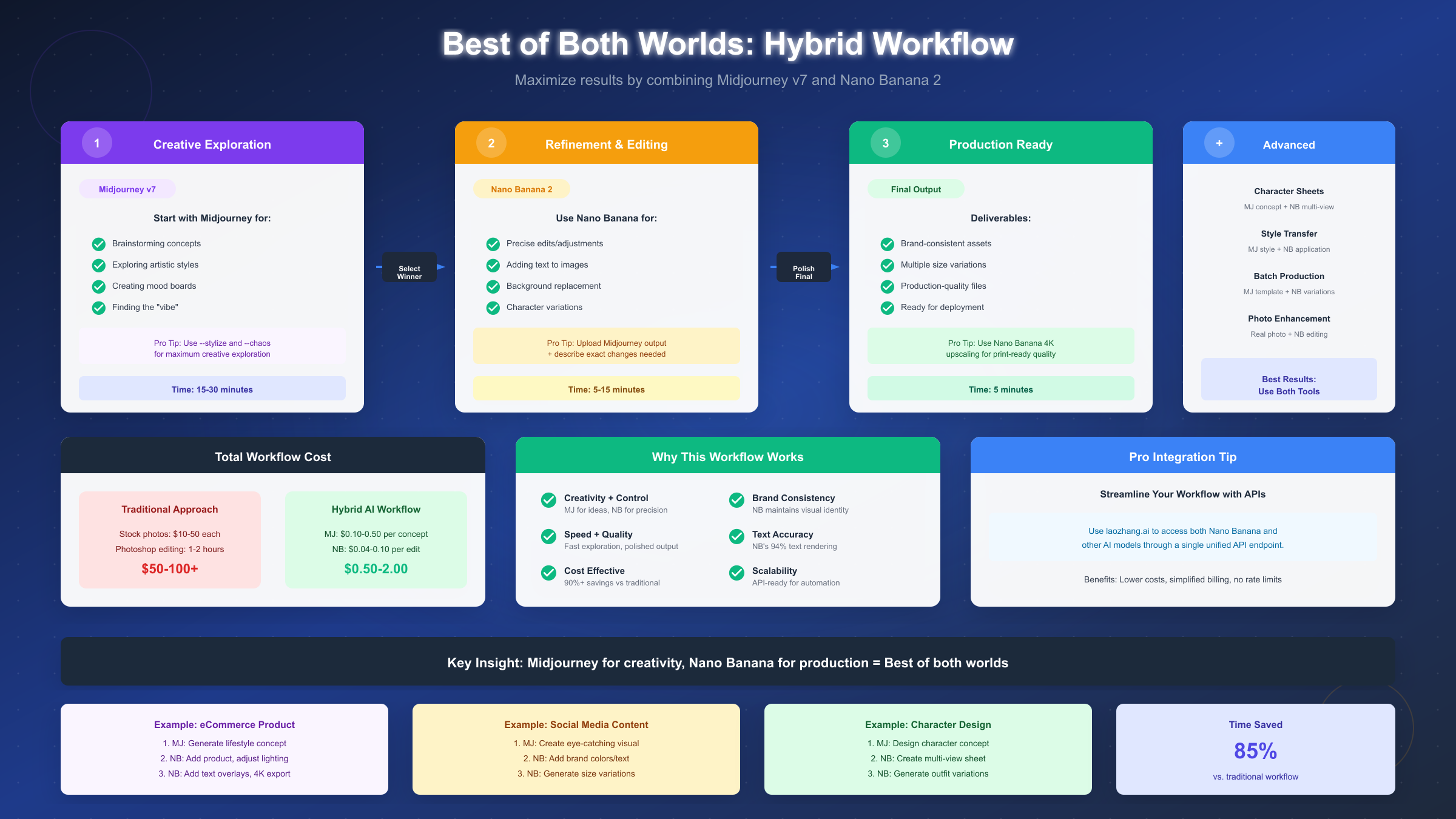
The most sophisticated approach combines both tools in a workflow that leverages their respective strengths. This isn't compromise—it's optimization, producing better results than either tool alone while managing costs effectively.
The Three-Stage Hybrid Workflow
Stage one focuses on creative exploration using Midjourney. Generate multiple concept variations rapidly using Draft Mode, exploring different artistic directions without concern for practical constraints. This is the ideation phase where quantity and variety matter more than polish.
Stage two moves winning concepts to Nano Banana for refinement and production. Upload the selected Midjourney output and describe needed changes: adjust colors to match brand guidelines, add readable text, replace elements, or generate variations for different formats and sizes.
Stage three delivers production-ready assets. Use Nano Banana's 4K upscaling for print materials, generate size variations for different platforms, and ensure all text renders accurately. The result combines Midjourney's creative vision with Nano Banana's practical execution.
Practical Example: Character Sheet Creation
Character design illustrates the hybrid workflow's power. Start with Midjourney to generate a character concept—perhaps "elegant elven warrior in detailed silver armor, fantasy art style." Midjourney's artistic interpretation produces a striking character with the atmospheric quality concept artists value.
Import this Midjourney output into Nano Banana and request multi-view generation: front view, back view, three-quarter views. Nano Banana's consistency features maintain the character's appearance across poses. Add outfit variations, different poses, or expression sheets—all building from the original Midjourney concept while maintaining character consistency that Midjourney alone couldn't achieve.
This workflow produces character sheets in under 30 minutes that would previously require hours of manual illustration or multiple Midjourney regeneration attempts hoping for consistency.
API Integration for Scale
For teams handling high-volume production, API integration enables automation. Nano Banana's full API access allows programmatic image generation and editing, enabling workflows like: monitor social media engagement, automatically generate new variations of high-performing content, and publish without manual intervention.
Services like laozhang.ai provide unified API access to multiple models including Nano Banana, simplifying integration when your workflow spans multiple AI tools. Rather than managing separate API credentials and rate limits for each service, a single endpoint handles all requests with consistent pricing and authentication.
Midjourney's API access remains limited, with official access restricted to certain partner integrations. Unofficial solutions exist but carry reliability and compliance risks that make them unsuitable for production workflows. For API-driven automation, Nano Banana provides the more robust foundation.
The Verdict: Making Your Decision
After comprehensive comparison, the verdict depends on your priorities and use cases. Neither tool is universally superior—each excels in different scenarios.
Choose Nano Banana 2 if:
- Text accuracy matters for your projects
- You need strong editing and refinement capabilities
- Cost efficiency is a priority
- You want API access for automation
- Photorealism is more important than artistic style
- You're building eCommerce, marketing, or UI/UX content
Choose Midjourney v7 if:
- Artistic quality and atmosphere are priorities
- You value creative interpretation over literal execution
- You're doing concept art, illustration, or creative exploration
- Style consistency across many images matters
- You want community resources and prompt libraries
- Video generation capabilities interest you
Choose both (hybrid workflow) if:
- Your projects span creative and practical needs
- You want the best possible results regardless of tool
- Budget allows approximately $40-50/month combined
- You're willing to learn both tools' workflows
- Team collaboration spans different specialties
For most professional users, the hybrid approach delivers the best results. Creative exploration in Midjourney followed by production refinement in Nano Banana captures each tool's strengths while mitigating weaknesses. The combined cost typically remains below Midjourney Pro alone while providing superior capability for text-heavy or editing-intensive projects. For teams seeking to streamline this workflow, API aggregators like laozhang.ai enable access to Nano Banana alongside other AI models through a single unified interface.
If budget constraints require choosing one tool, the decision hinges on your primary use case. Practical content creation—marketing, eCommerce, UI design—favors Nano Banana's precision and cost efficiency. Artistic creation—concept art, illustration, atmospheric imagery—favors Midjourney's creative capabilities.
Either way, December 2025 is an excellent time to adopt AI image generation. Both tools have matured significantly, with Midjourney v7's April release and Nano Banana 2's expanded availability making professional-quality AI imagery accessible to everyone from independent creators to enterprise teams.
Frequently Asked Questions
Is Nano Banana 2 free to use?
Nano Banana 2 offers a free tier with limited credits through the Gemini platform—new users typically receive 5 free credits to explore the tool. Beyond the free tier, pricing is pay-as-you-go at approximately $0.04 per 1024x1024 image. There's no monthly subscription required; you pay only for images you generate.
Can I use Midjourney without Discord?
Yes, as of 2025 Midjourney offers a web interface at midjourney.com that provides full functionality without requiring Discord. While Discord remains an option and offers some community benefits like seeing others' generations and accessing prompt libraries, it's no longer the only way to use the tool.
Which tool is better for text in images?
Nano Banana 2 significantly outperforms Midjourney for text rendering, achieving 94% accuracy compared to Midjourney's 71%. If your images require readable text—marketing materials, product labels, UI mockups—Nano Banana is the clear choice. For atmospheric or artistic text where perfect legibility isn't required, Midjourney can produce visually interesting results.
How fast is each tool?
Nano Banana 2 generates standard images in 2-15 seconds. Midjourney v7 takes 10-60 seconds in normal mode, though Draft Mode produces near-instant results at lower resolution. For iteration-heavy workflows, both tools now offer fast generation options.
Can I switch between them easily?
Yes, both tools work with standard image formats. You can generate a concept in Midjourney, download it, upload to Nano Banana for editing, and continue refining. This interoperability enables the hybrid workflows that produce the best results.
What about API access?
Nano Banana 2 offers full API access through Google's Vertex AI or third-party services like laozhang.ai, which provides cost-effective access with simplified billing. Midjourney's API access remains restricted to select partners, though unofficial solutions exist with varying reliability. For production automation and programmatic workflows, Nano Banana clearly provides more flexibility and reliability.
How can I reduce costs when using both tools?
The most effective cost reduction strategy combines smart usage patterns with optimized access methods. Use Midjourney's Draft Mode for exploration (half the GPU cost), then finalize in Nano Banana. For API access, platforms like laozhang.ai offer discounted rates on Nano Banana and other AI models, reducing per-image costs from $0.04 to approximately $0.031—savings that compound significantly for high-volume users. Additionally, consider batch processing during off-peak hours when API rates may be lower.
Which tool is better for beginners?
Nano Banana 2's conversational interface makes it more accessible for beginners—you can describe what you want in plain language without learning parameters or syntax. Midjourney requires some familiarity with prompt engineering and parameters like --ar, --stylize, and --chaos to get optimal results. However, Midjourney's community resources and prompt libraries can accelerate learning.
Do generated images have watermarks?
Nano Banana 2 applies an invisible SynthID watermark to indicate AI generation—this doesn't affect visual appearance but can be detected by certain tools. Midjourney doesn't apply watermarks to generated images, though images on Basic/Standard tiers are public by default.
This comparison was updated December 2025 to reflect the current state of both platforms. As AI image generation evolves rapidly, specific features and pricing may change. We recommend checking official sources for the latest information before making purchasing decisions.