
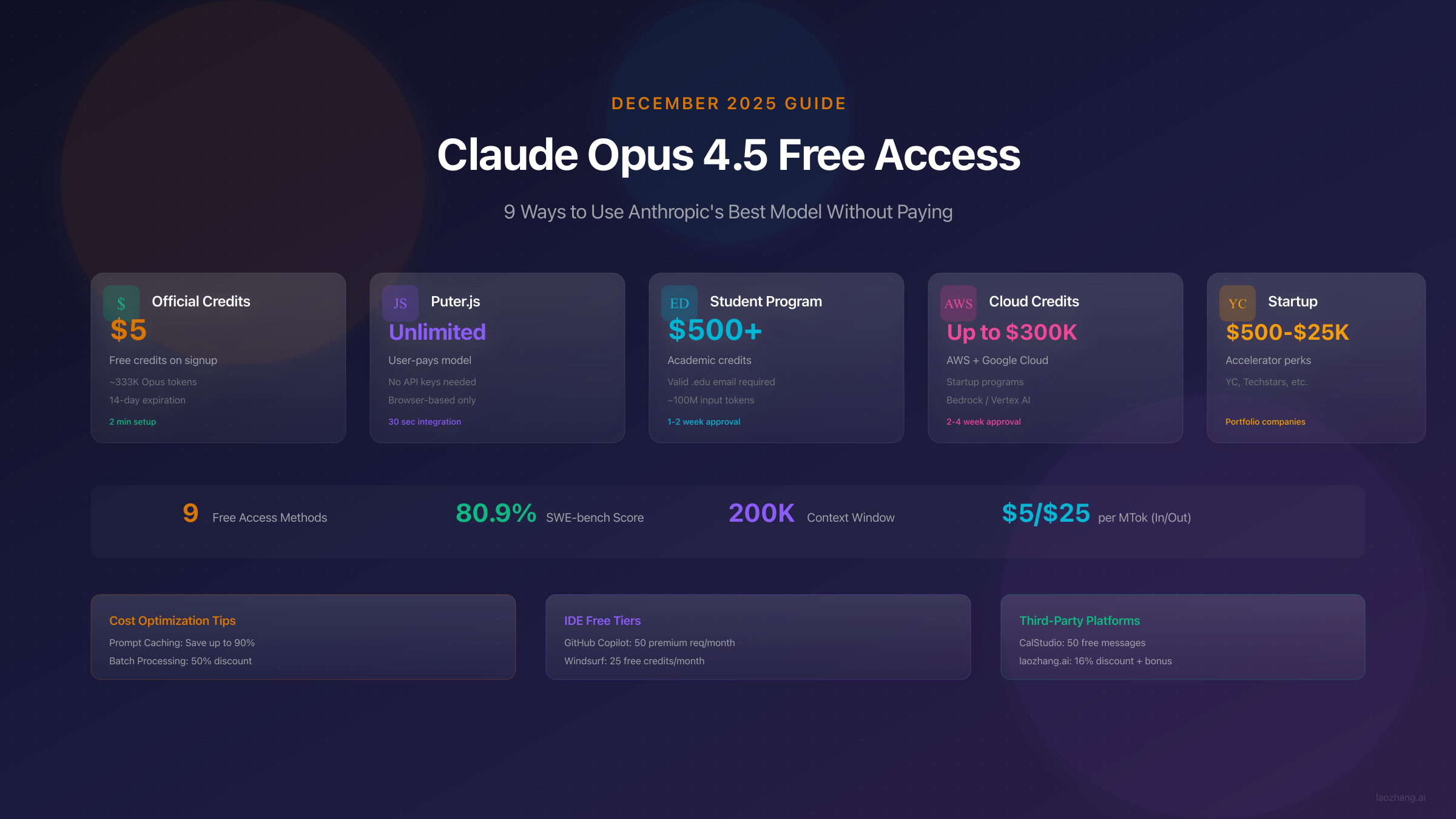
Claude Opus 4.5 represents Anthropic's most capable AI model, achieving 80.9% on SWE-bench Verified and setting new standards for code generation, agentic tasks, and complex reasoning. At $5 per million input tokens and $25 per million output tokens, the official pricing puts this flagship model out of reach for many developers. However, ten legitimate methods exist to access Opus 4.5 without paying standard rates—ranging from instant $5 credits to cloud partnerships worth $300,000 or more. This comprehensive guide covers every proven pathway with detailed setup instructions and production-ready code examples.
What Is Claude Opus 4.5 (And Why It Costs $5/$25 Per Million Tokens)
Anthropic released Claude Opus 4.5 on November 24, 2025, positioning it as their flagship model for enterprise-grade AI applications. The model represents a significant leap forward in several key dimensions that justify its premium pricing tier.
Technical capabilities that set Opus 4.5 apart include a 200,000 token context window, 64,000 token maximum output length, and what Anthropic describes as "state-of-the-art performance for coding, agents, and computer use." The model excels particularly in long-horizon autonomous tasks, handling complex workflows with fewer dead-ends than any predecessor. Internal testing shows 50-75% reductions in both tool calling errors and build/lint errors compared to earlier models.
The benchmark numbers tell a compelling story. On SWE-bench Verified, Opus 4.5 achieves 80.9%—outperforming all frontier models including GPT-4o and Gemini 2.0. For novel reasoning challenges, the ARC-AGI-2 benchmark shows Opus scoring nearly three times higher than Sonnet 4.5 (37.6% vs 13.6%). Perhaps most impressively, the model demonstrates remarkable token efficiency, using 76% fewer output tokens while matching Sonnet 4.5's best scores at medium effort levels.
The pricing structure reflects this premium positioning. Input tokens cost $5 per million while output tokens run $25 per million—approximately 67% less than the previous Opus 4.1 but still significantly higher than Sonnet 4.5 at $3/$15. For context, a typical coding session consuming 50,000 input tokens and 10,000 output tokens costs roughly $0.50. While reasonable for occasional use, production applications can quickly accumulate significant expenses.
Anthropic offers prompt caching for up to 90% savings on repeated context and batch processing for 50% discounts on non-time-sensitive workloads. However, for developers who need full access to test, prototype, and build applications, finding free or heavily discounted access paths becomes essential. The methods outlined in this guide address exactly that need.
Opus 4.5 vs Sonnet 4.5: When Free Access Really Matters
Understanding when Opus 4.5's capabilities genuinely outweigh Sonnet 4.5's cost advantages helps you prioritize which free access method to pursue. The performance gap varies dramatically depending on task complexity.
For routine development work, Sonnet 4.5 performs admirably. Day-to-day coding tasks like writing functions, fixing simple bugs, and generating documentation see minimal difference between models. Code reviews, standard refactoring, and API integrations work well with Sonnet's faster response times and lower costs. If your primary use case falls into these categories, pursuing Opus-specific free access may not be essential.
The gap becomes dramatic on genuinely difficult problems. Multi-system debugging scenarios where Opus succeeds on first attempt often require Sonnet to iterate three or four times. Complex architectural decisions benefit from Opus's deeper reasoning—it anticipates edge cases and integration challenges that Sonnet overlooks. Novel problems without clear patterns see particularly stark differences, as evidenced by the ARC-AGI-2 results where Opus outperforms by 2.8x.
Token efficiency presents another consideration. Set to medium effort, Opus 4.5 matches Sonnet's best scores while consuming 76% fewer output tokens. For applications where output volume matters—generating extensive documentation, writing comprehensive test suites, or producing detailed analyses—Opus can actually prove more cost-effective despite higher per-token pricing.
Production reliability favors Opus significantly. Testing reveals 50-75% reductions in tool calling errors and build/lint failures. For autonomous agents executing multi-step workflows, this reliability difference compounds across each step. A ten-step workflow with 90% per-step success in Sonnet yields 35% end-to-end success; the same workflow at 97% per-step with Opus achieves 74% success.
The practical recommendation: use Sonnet 4.5 as your daily driver for routine tasks, then switch to Opus 4.5 for challenging problems where the first-attempt success rate matters. Free access to Opus becomes most valuable for these high-stakes scenarios where iteration costs time and momentum.
10 Free Ways to Access Claude Opus 4.5
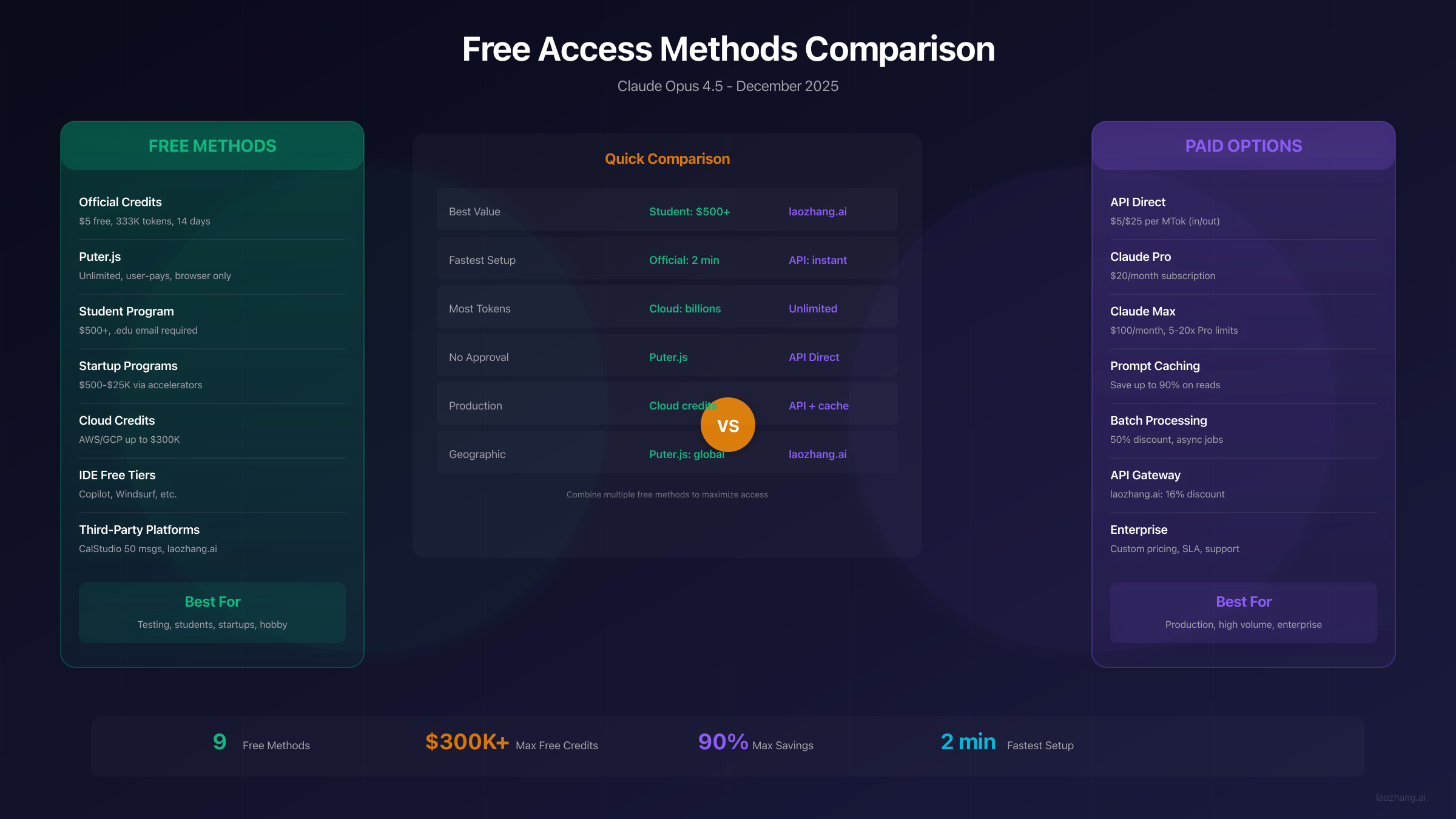
Ten legitimate pathways provide free or heavily subsidized access to Opus 4.5. Each method suits different user profiles, from individual developers seeking quick testing access to startups building production applications.
Method 1: Official Anthropic $5 Free Credits offers the fastest path to immediate access. Creating a new account at console.anthropic.com and completing phone verification instantly adds $5 in credits—approximately 1 million input tokens or 200,000 output tokens with Opus 4.5. The entire process takes under two minutes. Important caveats: credits expire in 14 days, UK phone numbers are explicitly excluded, and each phone number can only verify one account.
Method 2: Puter.js Unlimited Browser Access provides genuinely unlimited usage for web applications. The platform uses a "user-pays" model where your application accesses Claude Opus 4.5 without any API keys or backend servers, while end users cover their own usage costs. For developers building browser-based tools, this approach eliminates API expenses entirely. Setup requires only including a script tag and calling puter.ai.chat() with your prompt.
Method 3: Student Academic Programs ($500+ Credits) targets university students and researchers. Anthropic's academic partnership provides $500 or more in credits—enough for approximately 100 million input tokens, sufficient for an entire semester of research. Application requires a valid university email address. Options include the Campus Ambassador Program (10-week commitment with higher benefits) and Claude Builder Clubs (lighter requirements). Processing typically takes 1-2 weeks.
Method 4: Startup Accelerator Credits connects to venture capital and accelerator relationships. Y Combinator, Techstars, 500 Startups, and similar programs often include Anthropic credits in their startup packages. Credit amounts vary but typically range from $1,000 to $10,000. If you're already in an accelerator program, check with your program manager about available AI credits.
Method 5: AWS Activate Credits (Up to $100,000) leverages Amazon Web Services' startup program. Claude Opus 4.5 became available in Amazon Bedrock on November 24, 2025, meaning AWS credits can now cover Anthropic API usage. The AWS Activate program provides up to $100,000 in credits for qualifying startups. Application processing takes 2-4 weeks, and credits typically have 12-24 month validity periods.
Method 6: Google Cloud for Startups (Up to $100,000+) provides similar benefits through Google Cloud's Vertex AI, where Claude Opus 4.5 is also available. Google's startup program offers up to $100,000 in credits with potential additional funding for later-stage companies. The application process mirrors AWS Activate, requiring basic company information and a brief description of your AI use case.
Method 7: Microsoft for Startups Founders Hub ($150,000) offers the largest single-source credit pool. Azure provides Claude model access, and the Founders Hub program grants up to $150,000 in Azure credits over multiple years. Application requires LinkedIn verification and basic company formation documentation.
Method 8: IDE Integrations with Free Tiers include tools like Amp and Cursor that offer limited Opus 4.5 access. The Amp CLI provides Opus access through the command amp --try-opus during their preview period. Cursor Pro includes some Opus usage in its subscription. While not truly "free," these bundles can provide Opus access as part of tool subscriptions you might purchase anyway.
Method 9: API Gateway Services like laozhang.ai provide alternative access pathways with promotional credits. These services aggregate multiple AI providers, offering unified API access. Initial signup typically includes $5-10 in credits, and pricing often runs below official rates. For developers in regions with restricted Anthropic access, these gateways provide reliable alternatives with OpenAI-compatible API formats.
Method 10: Browser Extensions and Wrappers offer chat-based Opus 4.5 access without API setup. Platforms like HIX AI, Genspark, and Skywork.ai provide web interfaces for Claude Opus 4.5 interaction. While these don't provide programmatic API access, they enable testing and experimentation without any account setup. Genspark offers unlimited Opus 4.5 access for Plus and Pro users.
Rate Limits, Quotas & Token Economics
Understanding rate limits and token economics helps you maximize value from whatever free access method you choose. Each tier and platform imposes different constraints that affect practical usability.
Official Anthropic free tier limits set a baseline. New accounts with $5 credits operate under strict rate limits: 5 requests per minute (RPM), 10,000 tokens per minute (TPM), and 50,000 tokens per day (TPD). These limits exclude cache reads, meaning you can leverage context caching to effectively multiply throughput. Moving to the first paid tier increases limits to 50 RPM and 40,000 TPM.
Token economics for the $5 free credit allocation break down as follows. With Opus 4.5 pricing at $5 input / $25 output per million tokens, your $5 provides approximately 1 million input-only tokens OR 200,000 output-only tokens OR roughly 500,000 input plus 100,000 output in a realistic mixed workload. For context, 100,000 output tokens generates about 75,000 words of text or 200-300 complete function implementations.
Cloud platform credits (AWS/GCP/Azure) don't impose Anthropic-specific rate limits but follow each cloud provider's standard throttling. AWS Bedrock defaults to 100 RPM for Claude models with 100,000 TPM limits for most accounts. Google Cloud Vertex AI applies similar constraints. Enterprise agreements can negotiate higher limits. The advantage of cloud credits: you're limited by credit value rather than arbitrary rate caps.
Puter.js operates differently since it's browser-based with user-funded requests. The platform doesn't impose rate limits from the developer perspective—each user's requests are independently metered. This architecture means your application can handle unlimited concurrent users, each with their own effective rate allowance.
| Access Method | Rate Limit | Daily Cap | Credit Value | Expiration |
|---|---|---|---|---|
| Anthropic Free | 5 RPM, 10K TPM | 50K tokens | $5 | 14 days |
| Anthropic Tier 1 | 50 RPM, 40K TPM | None | Paid | None |
| AWS Bedrock | 100 RPM | None | Up to $100K | 12-24 months |
| Google Vertex | Variable | None | Up to $100K | 12-24 months |
| Azure | Variable | None | Up to $150K | 24+ months |
| Puter.js | Unlimited* | None | Free | None |
| laozhang.ai | 60 RPM | None | $5-10 | 30 days |
For a detailed breakdown of Claude API pricing tiers and optimization strategies, see our comprehensive Claude API pricing breakdown.
Step-by-Step Implementation Guide
Production-ready code examples demonstrate how to integrate each major free access pathway. These implementations include proper error handling, rate limit management, and best practices for maximizing your free credit value.
Anthropic Official API Setup begins with account creation and API key generation. Visit console.anthropic.com, complete phone verification to claim your $5 credits, then navigate to API Keys to generate a new key. Store this key securely—it provides full access to your account's credit balance.
pythonimport anthropic
import time
from typing import Generator


client = anthropic.Anthropic(api_key="your-api-key-here")

def generate_with_opus(prompt: str, max_tokens: int = 4096) -> str:
    """Generate text using Claude Opus 4.5 with rate limit handling."""
    try:
        message = client.messages.create(
            model="claude-opus-4-5-20251101",
            max_tokens=max_tokens,
            messages=[{"role": "user", "content": prompt}]
        )
        return message.content[0].text
    except anthropic.RateLimitError:
        print("Rate limited, waiting 60 seconds...")
        time.sleep(60)
        return generate_with_opus(prompt, max_tokens)
    except anthropic.APIError as e:
        print(f"API error: {e}")
        raise

def stream_response(prompt: str) -> Generator[str, None, None]:
    """Stream responses for better UX on long generations."""
    with client.messages.stream(
        model="claude-opus-4-5-20251101",
        max_tokens=4096,
        messages=[{"role": "user", "content": prompt}]
    ) as stream:
        for text in stream.text_stream:
            yield text
Puter.js Browser Integration requires minimal setup. Include the Puter script in your HTML, then call the AI functions directly. No API key management, no server-side code, no usage tracking required on your end.
javascript<!-- Include Puter.js -->
<script src="https://js.puter.com/v2/"></script>

<script>
async function generateWithOpus(prompt) {
    try {
        // Direct Claude Opus 4.5 access - no API key needed
        const response = await puter.ai.chat(prompt, {
            model: 'claude-opus-4-5'
        });
        return response;
    } catch (error) {
        console.error('Generation failed:', error);
        throw error;
    }
}

// Streaming for long responses
async function streamWithOpus(prompt, onChunk) {
    const response = await puter.ai.chat(prompt, {
        model: 'claude-opus-4-5',
        stream: true
    });

    for await (const chunk of response) {
        onChunk(chunk);
    }
}

// Example usage
generateWithOpus("Explain quantum computing in simple terms")
    .then(response => console.log(response));
</script>
AWS Bedrock Integration uses the standard AWS SDK with Bedrock runtime. Ensure your AWS credits include Bedrock access, then configure the client with appropriate region settings.
pythonimport boto3
import json

def invoke_claude_bedrock(prompt: str, region: str = "us-east-1") -> str:
    """Invoke Claude Opus 4.5 via AWS Bedrock."""
    bedrock = boto3.client(
        service_name='bedrock-runtime',
        region_name=region
    )

    body = json.dumps({
        "anthropic_version": "bedrock-2023-05-31",
        "max_tokens": 4096,
        "messages": [{"role": "user", "content": prompt}]
    })

    response = bedrock.invoke_model(
        modelId="anthropic.claude-opus-4-5-20251101-v1:0",
        body=body
    )

    response_body = json.loads(response['body'].read())
    return response_body['content'][0]['text']
For detailed API key setup instructions across all platforms, refer to our guide on getting your Claude API key.
Which Method Is Right for You?
Selecting the optimal free access pathway depends on your specific situation, timeline requirements, and intended use case. This decision framework helps match your profile to the most suitable method.
For immediate testing and prototyping, the Anthropic $5 credits offer the fastest path. Within two minutes of account creation, you have full API access to Opus 4.5. The 14-day expiration pushes you to use credits actively, which suits intensive testing sprints. If you need results today, start here.
For building browser-based applications, Puter.js provides an unmatched value proposition. Zero cost to you as the developer, unlimited usage potential, and no backend infrastructure requirements. The user-pays model works particularly well for consumer-facing tools where users expect to pay for premium AI features. If your application runs in browsers and you want to avoid all API costs, Puter.js is the clear choice.
For academic research and student projects, the student programs provide substantial credits with longer validity periods. $500 or more in credits supports extensive research work without constant concern about usage limits. The application process takes 1-2 weeks, so start early if you have upcoming project deadlines.
For startups building production applications, cloud platform credits offer the best combination of volume and flexibility. AWS, Google Cloud, and Azure together provide access to over $350,000 in potential credits. These credits work across the full cloud ecosystem, not just AI APIs. If you're already using cloud infrastructure, adding Claude access to existing credits maximizes value.
For developers in restricted regions, API gateway services like laozhang.ai bridge geographic limitations. These platforms accept international payment methods and provide OpenAI-compatible API formats, simplifying integration with existing codebases. For production workloads in regions without direct Anthropic access, consider exploring the laozhang.ai documentation for consolidated billing and unified API access.
For casual experimentation without accounts, browser-based chat interfaces offer zero-friction access. Genspark, HIX AI, and similar platforms let you interact with Opus 4.5 immediately without any registration. While these don't provide programmatic access, they're ideal for evaluating the model's capabilities before committing to API integration.
FAQ & Common Issues
Developers frequently encounter similar questions and obstacles when setting up free Claude Opus 4.5 access. These answers address the most common scenarios.
"My phone number was rejected for verification." UK numbers are explicitly excluded from Anthropic's verification system as of December 2025. Some virtual phone numbers and VoIP services also fail verification. Using a standard mobile carrier in supported regions resolves most cases. If you're in an excluded region, consider API gateway alternatives or cloud platform routes.
"My $5 credits disappeared before I used them." Free credits expire 14 days after claiming. The countdown starts immediately upon phone verification, not upon first API call. Plan your testing sprint accordingly—the 14-day window encourages focused exploration rather than occasional experimentation.
"I hit rate limits constantly with the free tier." The 5 RPM and 10,000 TPM limits are strict on free accounts. Implement request queuing with exponential backoff, batch similar requests where possible, and leverage prompt caching aggressively. If rate limits consistently block your workflow, consider the first paid tier at just $5 to unlock significantly higher limits.
"Puter.js works locally but fails in production." Ensure your production domain is properly configured with Puter. The platform requires user authentication through their OAuth flow—localhost bypasses some checks that production deployments enforce. Review Puter's deployment documentation for production-specific configuration.
"AWS Bedrock says the model isn't available." Claude Opus 4.5 availability varies by AWS region. As of December 2025, cross-region inference enables access from most locations, but some regions may have limited model availability. Check the Bedrock console for current regional availability and enable cross-region inference if needed.
"My student application was rejected." Academic programs require verifiable university email addresses and sometimes institutional enrollment confirmation. Ensure your .edu or equivalent academic email is properly configured and that you're applying during an active enrollment period. Some programs only accept applications at semester boundaries.
"I need more than $5 in free credits without qualifying for enterprise programs." Combine multiple methods: claim the $5 Anthropic credits for testing, use Puter.js for browser-based development, and apply for relevant programs (student, startup, cloud) in parallel. For detailed strategies on maximizing free API access, see our free Claude API credits guide.
Summary & Next Steps
Claude Opus 4.5 delivers exceptional capabilities for complex coding, reasoning, and autonomous agent tasks—and legitimate free access paths make these capabilities available to every developer. The ten methods covered in this guide range from instant $5 credits for quick testing to $300,000+ cloud partnerships for production applications.
For immediate access, start with Anthropic's official $5 credits through console.anthropic.com. The two-minute setup provides enough tokens for substantial testing while you explore longer-term options.
For sustainable development, evaluate which methods align with your profile. Students should pursue academic programs for $500+ in extended credits. Startups should leverage cloud platform partnerships across AWS, Google Cloud, and Azure. Browser-based application developers should implement Puter.js for unlimited access without API costs.
For production readiness, combine free access methods strategically. Use Anthropic credits for prototyping, cloud credits for staging environments, and establish paid accounts with appropriate rate limits for production traffic. Consider API gateways like laozhang.ai for consolidated billing across multiple AI providers.
The key insight: Opus 4.5's premium capabilities don't require premium spending during development. Whether you're a student researcher, indie developer, or funded startup, these pathways provide the access needed to build with Anthropic's most capable model.
For related API access strategies and pricing optimization, explore our guide on Claude 4 Opus free API options covering additional methods and integration patterns.