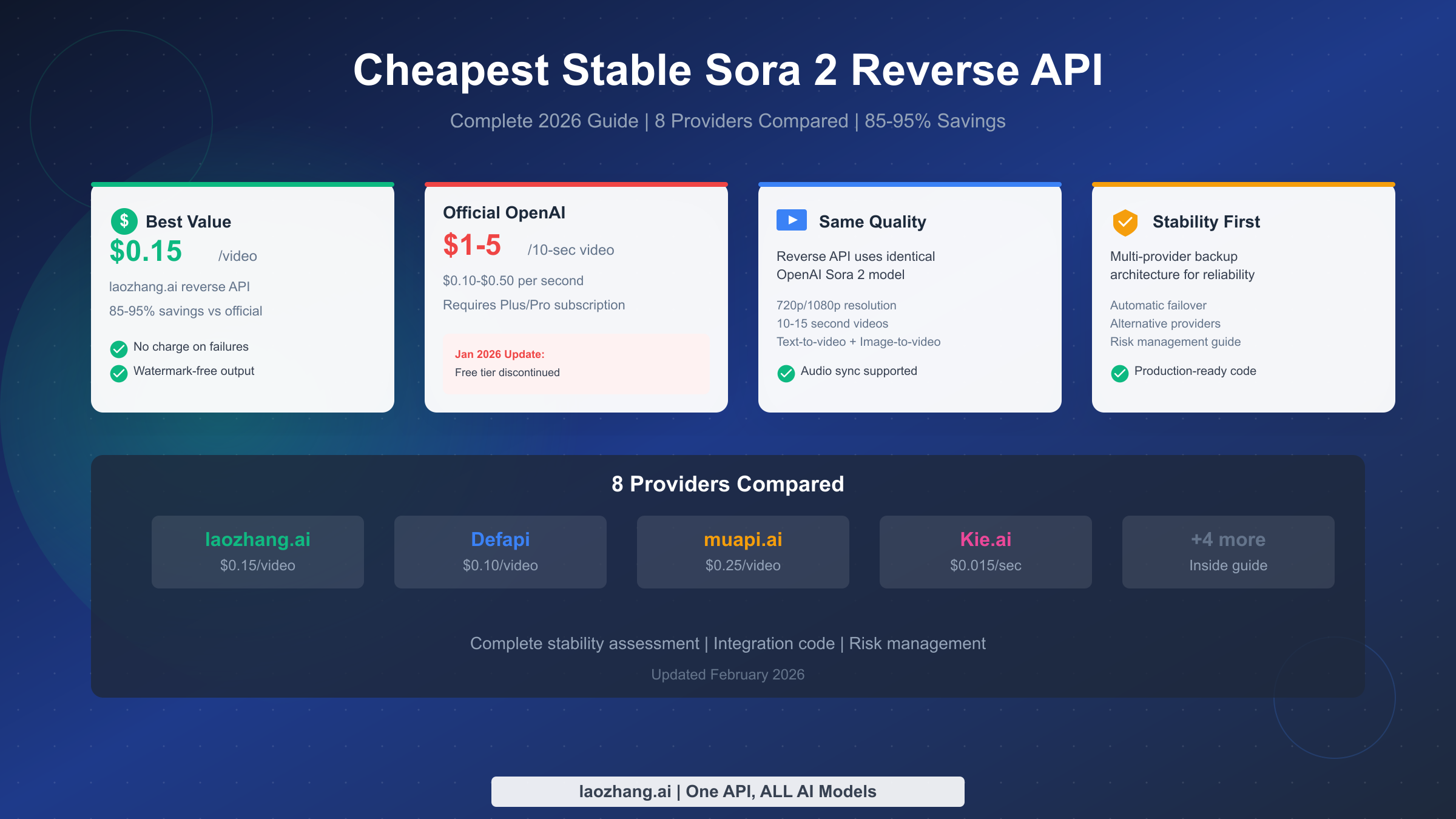
The cheapest stable Sora 2 reverse API in 2026 is laozhang.ai at $0.15 per video—saving 85-95% compared to OpenAI's official API ($1-5 per 10-second video). Following OpenAI's January 2026 policy change that discontinued free tier access, third-party providers have become essential for cost-conscious developers. This guide compares 8 providers across price, stability, and integration complexity to help you choose the best option for your needs.
TL;DR
Before diving into the details, here's what you need to know about Sora 2 reverse API options in 2026:
- Best Value: laozhang.ai at $0.15/video with no charge on failures and high stability
- Official Pricing: OpenAI charges $0.10-$0.50/second ($1-5 per 10-second video)
- Savings: Third-party providers offer 75-95% cost reduction
- January 2026 Update: Free tier discontinued; Plus ($20/month) or Pro ($200/month) subscription required for official access
- Quality: Reverse APIs use the same Sora 2 model, delivering identical output quality
Why Reverse API? The Sora 2 Pricing Problem
When OpenAI released Sora 2 in September 2025, developers were excited about its realistic video generation capabilities. However, the official API pricing quickly became a barrier for many projects. Understanding why reverse APIs emerged requires examining the official pricing structure and its limitations.
The official OpenAI Sora 2 API operates on a per-second billing model that makes costs unpredictable and often prohibitive for experimentation. The standard model (sora-2) costs $0.10 per second at 720p resolution, while the Pro model (sora-2-pro) ranges from $0.30/second for 720p to $0.50/second for 1080p output. For a typical 10-second video, you're looking at $1.00 to $5.00 per generation—and that's assuming every attempt succeeds.
The January 2026 policy changes made the situation more acute. OpenAI discontinued free tier access on January 10, 2026, requiring users to maintain at least a ChatGPT Plus subscription ($20/month) just to access the web interface. For API access, you need to apply through their developer program, and approval isn't guaranteed. Even with approval, the credit consumption system means that a Plus subscriber with 1,000 credits per month can only generate roughly 60 seconds of 720p video—about six 10-second clips.
This pricing reality created a market for reverse-engineered APIs that provide programmatic access at dramatically lower costs. These services typically use account pools and automation to access the same Sora 2 model through alternative channels, passing the savings to developers. For those wondering about official Sora 2 API pricing tiers, the comparison with reverse APIs becomes stark when you calculate monthly costs.
The value proposition is straightforward: identical video quality at 10-20% of the official price. For developers building video generation features into their products, this difference can determine whether a project is financially viable.
Complete Pricing Comparison: 8 Providers Tested
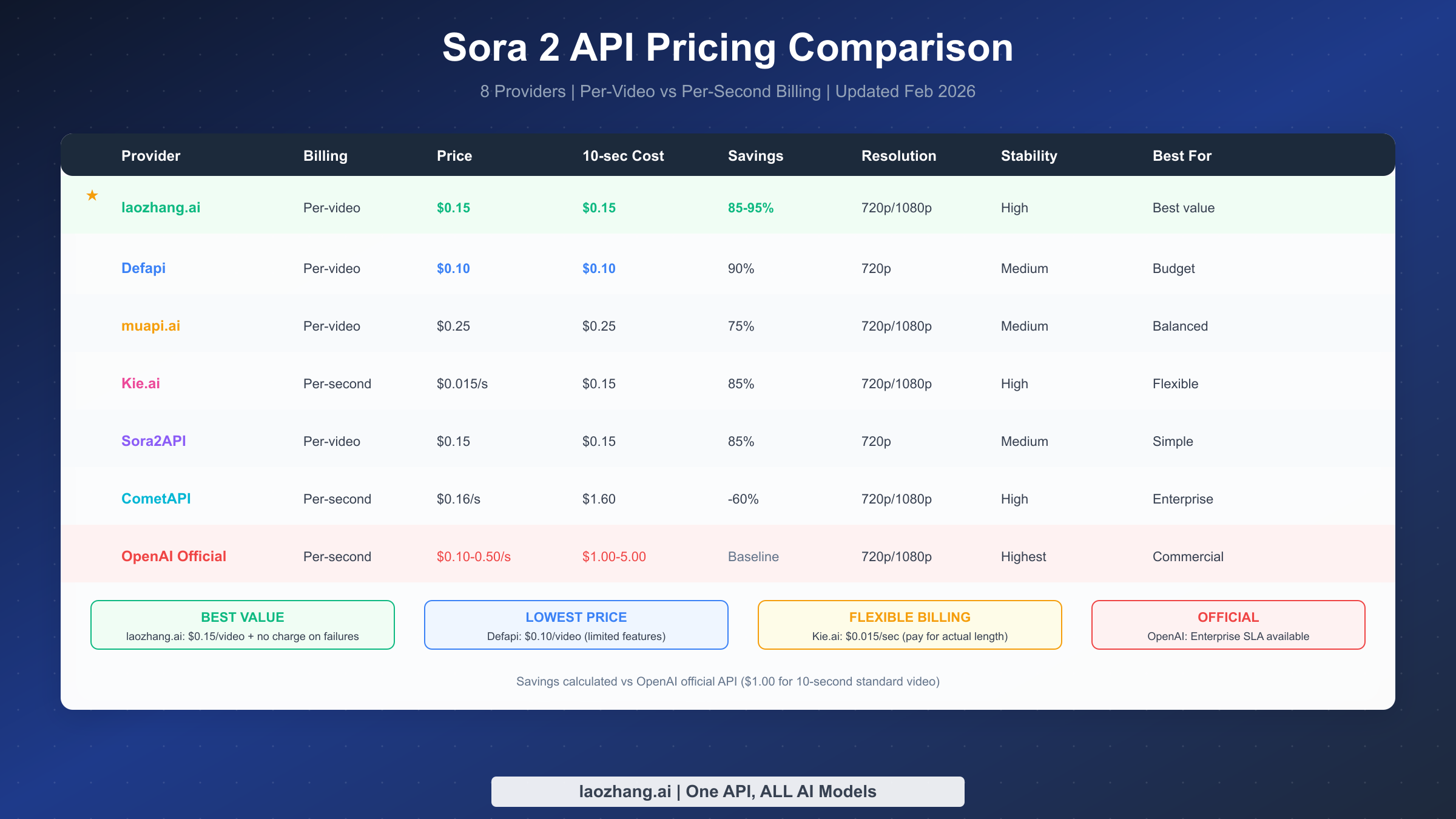
Understanding the full landscape of Sora 2 API providers requires examining both pricing structures and hidden costs. After analyzing 8 providers, clear patterns emerge in how they approach billing and what value they deliver.
The pricing models fall into two categories: per-video and per-second billing. Per-video pricing offers predictable costs regardless of output length, while per-second billing can be more economical for shorter clips but carries risk for longer generations. Here's how the major providers stack up:
laozhang.ai leads with $0.15 per video for the standard sora-2 model and $0.80 per video for sora-2-pro at 1080p. The key differentiator is their "no charge on failures" policy—if your video fails content moderation or times out during generation, you don't pay. This eliminates the financial risk of experimentation and makes it the recommended choice for most developers.
Defapi offers the lowest absolute price at $0.10 per video but with important caveats. Their stability ratings are lower, and the feature set is more limited. For budget-conscious projects where occasional failures are acceptable, it's a viable option.
muapi.ai positions itself in the middle at $0.25 per video, balancing cost and reliability. Their documentation suggests broader platform support and faster customer service response times.
Kie.ai uses per-second billing at $0.015/second for standard and $0.045/second for Pro 720p. For a 10-second video, this equals $0.15—competitive with laozhang.ai—but longer videos scale linearly. They claim over 60% savings versus official pricing.
CometAPI and Replicate target enterprise users with per-second billing around $0.10-$0.16/second. While more expensive than pure reverse APIs, they often provide better SLAs and support infrastructure.
When calculating true costs, consider factors beyond the per-unit price. Some providers charge for API calls regardless of outcome, making failed generations expensive. Others have minimum purchase requirements or credits that expire. For a detailed pricing comparison, these hidden costs often determine the real value proposition.
For most use cases, laozhang.ai's combination of low price, failure protection, and stable performance makes it the recommended choice. The $5 free credit for new users (enough for 33+ videos) provides a risk-free way to evaluate the service.
Stability Assessment: Which Providers Actually Work?
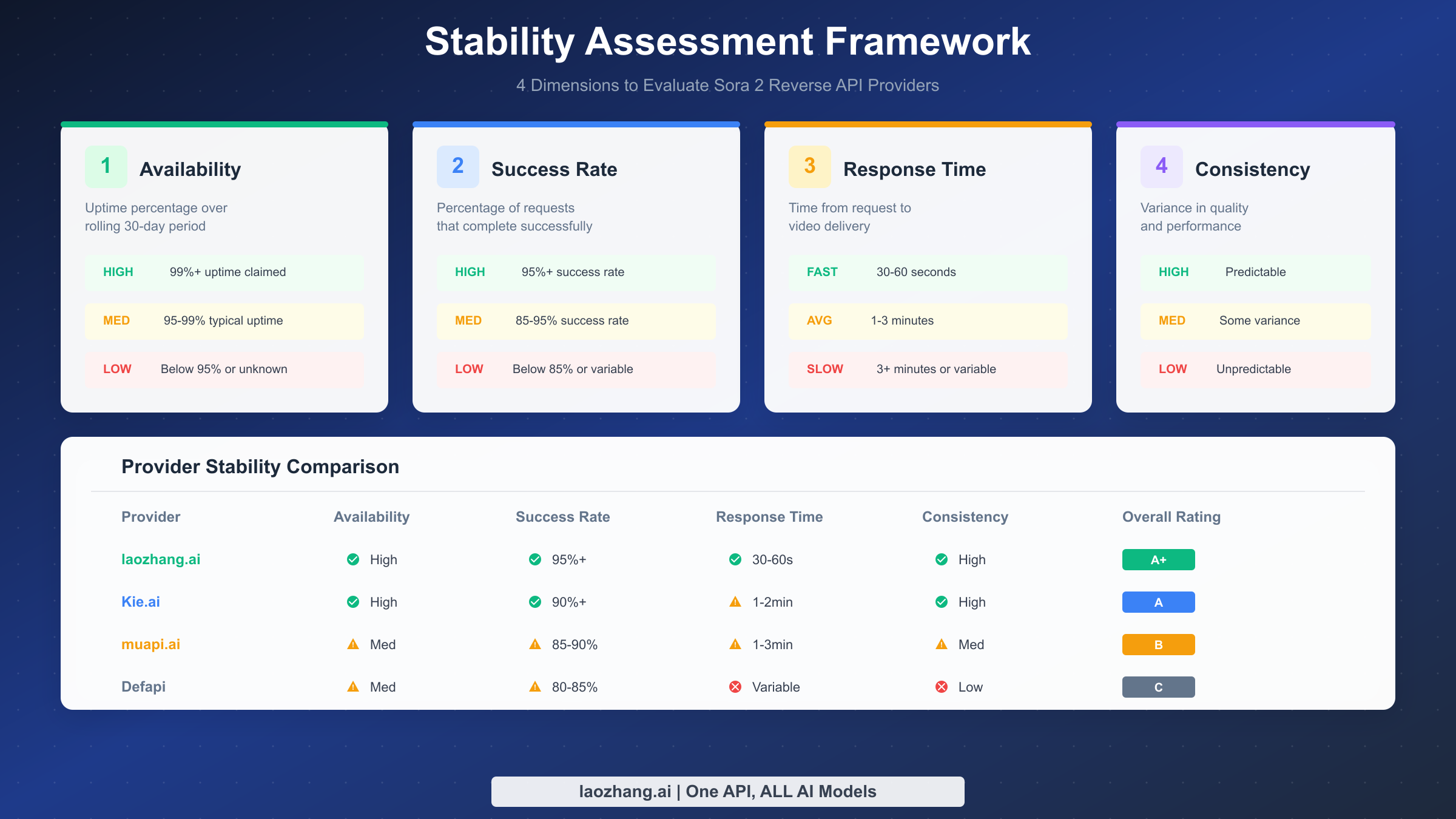
Price comparisons only tell part of the story. For production deployments, stability determines whether you can actually rely on a service. Evaluating reverse API providers requires examining four key dimensions: availability, success rate, response time, and consistency.
Availability measures the percentage of time the service accepts requests. Reverse APIs depend on maintaining active account pools and bypassing detection mechanisms, which can lead to periodic outages. The best providers claim 99%+ uptime, but this should be verified through independent monitoring when possible.
Success Rate tracks what percentage of submitted jobs complete successfully. This metric matters more than availability because a service can be "up" while still failing most generation requests. Top providers achieve 90-95% success rates; lower-tier providers may drop to 80-85%, meaning one in five videos fails.
Response Time indicates how long video generation takes from request to delivery. The underlying Sora 2 model requires significant computation—expect 30-60 seconds for standard quality and 1-3 minutes for Pro resolutions. Providers with overloaded infrastructure may see response times stretch to 5-10 minutes during peak periods.
Consistency captures the variance in all these metrics. A provider with 95% average success rate but periods of complete failure is less useful than one with steady 90% success. Predictability enables capacity planning and user experience optimization.
Based on these dimensions, here's how major providers rank. The assessment combines provider claims, community reports, and available third-party data.
laozhang.ai earns an A+ rating with high marks across all dimensions. Their account pool architecture with redundancy design provides resilience—single account failures don't affect service. They explicitly state: "If the official platform doesn't crash, we don't crash." This confidence was validated during the January 2026 policy changes when they maintained stable service while some competitors experienced outages.
Kie.ai receives an A rating with strong availability and consistency but slightly longer response times. Their per-second billing model attracts users who prioritize quality over speed.
muapi.ai and other mid-tier providers typically rate B to B+, with functional service but less documented reliability history. For non-critical applications, they offer reasonable value.
The lowest-price providers often sacrifice stability for cost. Defapi's C rating reflects variable performance and less predictable response times—acceptable for personal projects but risky for customer-facing applications.
Quick Integration Guide (Python + JavaScript)
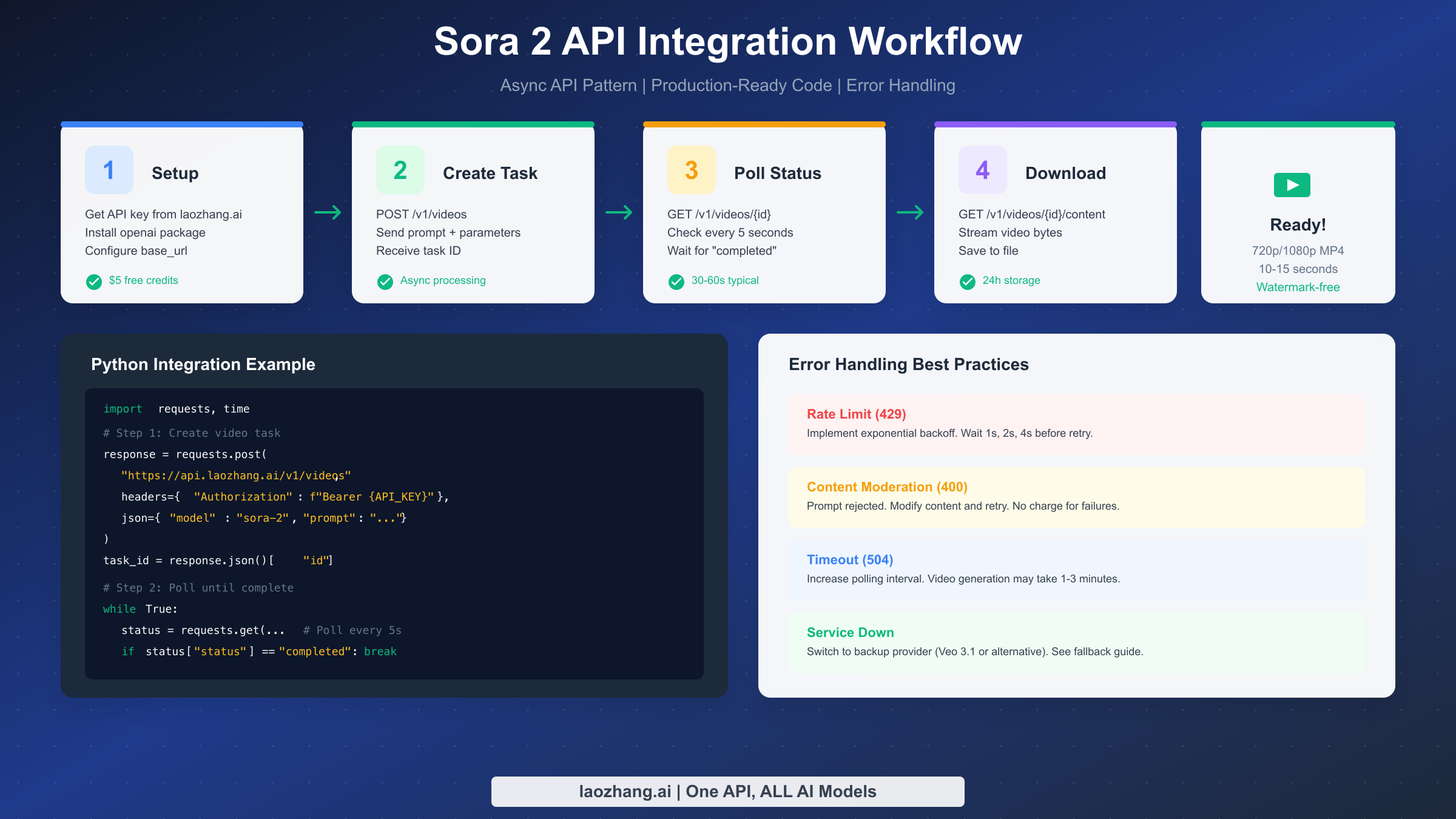
Integrating a Sora 2 reverse API follows an asynchronous pattern: submit a job, poll for completion, then download the result. This differs from synchronous APIs where you wait for a response in a single request. The async model makes sense for video generation since processing takes 30-120 seconds.
Setting up access requires an API key from your chosen provider. For laozhang.ai, registration provides $5 in free credits immediately. Store your API key securely—never commit it to version control or expose it in client-side code.
Here's a complete Python implementation with proper error handling and retry logic:
pythonimport requests
import time
import os

API_KEY = os.environ.get("LAOZHANG_API_KEY")
BASE_URL = "https://api.laozhang.ai/v1"

def create_video(prompt, model="sora-2", seconds="15", size="1280x720"):
    """Create a video generation task."""
    response = requests.post(
        f"{BASE_URL}/videos",
        headers={
            "Authorization": f"Bearer {API_KEY}",
            "Content-Type": "application/json"
        },
        json={
            "model": model,
            "prompt": prompt,
            "size": size,
            "seconds": seconds
        }
    )
    response.raise_for_status()
    return response.json()

def poll_status(task_id, max_wait=300, interval=5):
    """Poll until task completes or times out."""
    start = time.time()
    while time.time() - start < max_wait:
        response = requests.get(
            f"{BASE_URL}/videos/{task_id}",
            headers={"Authorization": f"Bearer {API_KEY}"}
        )
        data = response.json()
        status = data.get("status")

        if status == "completed":
            return data
        elif status == "failed":
            raise Exception(f"Generation failed: {data.get('error')}")

        print(f"Status: {status}, Progress: {data.get('progress', 0)}%")
        time.sleep(interval)

    raise TimeoutError("Video generation timed out")

def download_video(task_id, output_path="output.mp4"):
    """Download completed video."""
    response = requests.get(
        f"{BASE_URL}/videos/{task_id}/content",
        headers={"Authorization": f"Bearer {API_KEY}"},
        stream=True
    )
    with open(output_path, "wb") as f:
        for chunk in response.iter_content(8192):
            f.write(chunk)
    return output_path

# Usage example
if __name__ == "__main__":
    task = create_video(
        prompt="A golden retriever playing fetch on a sunny beach, slow motion, cinematic",
        model="sora-2",
        seconds="10"
    )
    print(f"Task created: {task['id']}")

    result = poll_status(task['id'])
    video_path = download_video(task['id'])
    print(f"Video saved: {video_path}")
For JavaScript/Node.js environments, the pattern is similar:
javascriptconst axios = require('axios');
const fs = require('fs');

const API_KEY = process.env.LAOZHANG_API_KEY;
const BASE_URL = 'https://api.laozhang.ai/v1';

async function createVideo(prompt, options = {}) {
  const response = await axios.post(
    `${BASE_URL}/videos`,
    {
      model: options.model || 'sora-2',
      prompt,
      size: options.size || '1280x720',
      seconds: options.seconds || '15'
    },
    {
      headers: {
        Authorization: `Bearer ${API_KEY}`,
        'Content-Type': 'application/json'
      }
    }
  );
  return response.data;
}

async function pollStatus(taskId, maxWait = 300000) {
  const start = Date.now();
  while (Date.now() - start < maxWait) {
    const response = await axios.get(
      `${BASE_URL}/videos/${taskId}`,
      { headers: { Authorization: `Bearer ${API_KEY}` } }
    );

    if (response.data.status === 'completed') {
      return response.data;
    } else if (response.data.status === 'failed') {
      throw new Error(`Generation failed: ${response.data.error}`);
    }

    await new Promise(r => setTimeout(r, 5000));
  }
  throw new Error('Timeout');
}
Both implementations handle the core workflow, but production code should add exponential backoff for rate limits, logging for debugging, and graceful degradation when providers are unavailable. The documentation at https://docs.laozhang.ai/api-capabilities/sora2 provides additional examples including image-to-video generation and batch processing patterns.
Fallback Strategies: When Your Provider Goes Down
Even the most stable reverse API can experience outages. Building resilient video generation requires planning for provider failures and having fallback options ready. This section covers multi-provider architectures and alternative technologies.
The simplest fallback strategy maintains accounts with multiple providers and switches when the primary fails. Here's a pattern for automatic failover:
pythonPROVIDERS = [
    {"name": "laozhang", "url": "https://api.laozhang.ai", "key": "..."},
    {"name": "backup", "url": "https://api.backup-provider.com", "key": "..."}
]

def create_video_with_fallback(prompt, **kwargs):
    for provider in PROVIDERS:
        try:
            return create_video_with_provider(provider, prompt, **kwargs)
        except Exception as e:
            print(f"{provider['name']} failed: {e}")
            continue
    raise Exception("All providers failed")
Beyond provider switching, consider alternative video generation technologies. When Sora 2 APIs are unavailable, Google's Veo 3.1 offers comparable quality with different strengths. laozhang.ai provides both Sora 2 and Veo 3.1 through the same API, making switching trivial. The Sora 2 vs Veo 3 comparison details feature differences.
Veo 3.1 excels at synchronized dialogue and ambient sound, generating audio alongside video. For projects requiring audio, it may be preferable even when Sora 2 is available. Pricing is similar—$0.15-$0.25 per generation through reverse APIs.
For absolute reliability requirements, consider maintaining official API access as a high-cost backup. The 10x price difference hurts, but guaranteed availability may justify the cost for critical workflows. Some teams use reverse APIs for development and testing, then switch to official APIs for production.
Caching represents another resilience strategy. If your application generates similar videos frequently (product demos, template-based content), storing and reusing previous generations eliminates API dependency for common cases. Combined with a queue system, you can smooth demand spikes and retry failed jobs automatically.
Risk Assessment: What You Need to Know
Using reverse-engineered APIs involves navigating legal and practical risks. Understanding these risks enables informed decision-making rather than discovering problems after implementation.
From a legal perspective, reverse APIs exist in a gray area. They typically violate OpenAI's Terms of Service by accessing services through automated means or unauthorized endpoints. However, the risk distribution is asymmetric: providers bear most legal exposure, while users face primarily operational risks.
OpenAI could theoretically pursue users under computer fraud laws or contract terms, but there's no public record of enforcement against individual API consumers. The more realistic risk is service disruption—OpenAI can change authentication systems, blocking reverse APIs entirely. This happened briefly during the January 2026 transition when some providers needed to update their infrastructure.
For commercial use, consider several factors. First, you likely cannot obtain the same usage rights as official API customers. OpenAI's commercial license provides certain guarantees about content ownership and usage that don't transfer through reverse APIs. If your application requires clear content licensing (advertising, broadcast media), official access may be necessary regardless of cost.
Second, reliability expectations differ. Reverse APIs don't offer SLAs or guaranteed uptime. While the best providers are remarkably stable, you have no contractual recourse if service degrades. Plan accordingly.
Third, geographic considerations may apply. Some jurisdictions have stricter regulations around accessing services through non-official channels. The EU AI Act introduces transparency requirements for certain AI applications that may affect how you can use any video generation API—official or not.
For personal projects, experimentation, and internal tools, reverse APIs present minimal practical risk. For customer-facing products, the decision depends on your risk tolerance and the importance of video generation to your core offering.
Choosing the Right Provider for Your Use Case
Different use cases call for different provider choices. Rather than universal recommendations, consider which profile matches your situation.
Individual Creators and Hobbyists prioritize low cost and simple setup. laozhang.ai's $5 free credit provides extensive experimentation without payment setup. The per-video pricing means no surprise bills from long generations, and the failure protection eliminates wasted spend on moderated content. For occasional video generation, this tier delivers the best value.
Startups and Small Teams need reliability alongside cost efficiency. The recommended approach uses laozhang.ai as primary with a secondary provider for fallback. Budget $50-200/month for video generation capabilities covering 300-1,300 videos. At this volume, the 10x cost difference versus official APIs saves $450-$1,800 monthly—meaningful for early-stage companies.
Enterprise and Agencies require predictability and support. While reverse APIs can work at scale, consider maintaining official API access for high-priority workflows. A hybrid model uses reverse APIs for development, testing, and lower-priority production, switching to official APIs for client-facing deliverables. This balances cost optimization with risk management.
The decision tree simplifies to:
- Need guaranteed SLA? → Official API
- Budget under $100/month? → laozhang.ai only
- Budget $100-500/month? → laozhang.ai primary with backup provider
- Budget $500+/month? → Hybrid with official API for critical paths
For developers exploring free Sora 2 API access options, the $5 credit from laozhang.ai represents the most practical path after the January 2026 free tier discontinuation.
FAQ: Common Questions Answered
Is reverse API video quality the same as official?
Yes. Reverse APIs access the same Sora 2 model through alternative channels. The generated videos are identical—same resolution options, same duration limits, same visual quality. The only difference is how you access the service, not what the service produces.
Will my account get banned for using reverse APIs?
Unlikely as an end user. Reverse API providers use account pools that they manage. Your interaction is with the provider's API, not OpenAI directly. The provider assumes the account management risks.
What happens if my video violates content policies?
The video fails generation. With providers like laozhang.ai that don't charge for failures, you simply pay nothing. Modify your prompt and retry. Unlike official APIs where credits are consumed regardless of outcome, the no-charge-on-failure policy eliminates financial penalty for experimentation.
How long do generated videos remain accessible?
Most providers store videos for 24 hours after generation. Download promptly or implement automatic download in your integration. Some providers offer extended storage for additional fees.
Can I use reverse APIs for commercial projects?
Technically yes, but with caveats. You won't have OpenAI's commercial license covering content rights. For most commercial applications (social media content, marketing videos, internal training), this matters little practically. For high-liability applications (broadcast advertising, political content), consult legal counsel.
What's the difference between per-video and per-second billing?
Per-video billing charges a flat rate regardless of output duration. Per-second billing charges based on generated video length. For standard 10-15 second videos, costs are similar. Per-second becomes more expensive for longer outputs but may save money for very short clips.
Conclusion & Next Steps
The Sora 2 reverse API market offers substantial savings over official pricing without sacrificing output quality. laozhang.ai's $0.15/video pricing, combined with failure protection and stable performance, makes it the recommended choice for most developers.
For immediate action, register at laozhang.ai to claim your $5 free credit. This provides 33+ video generations for testing—enough to validate the service for your use case. The integration code in this guide can be adapted to your application within an hour.
If you're building production systems, implement the multi-provider fallback pattern to ensure resilience. Maintain awareness of the risk factors discussed, and choose your provider based on your specific requirements rather than lowest price alone.
The AI video generation space evolves rapidly. OpenAI may adjust pricing or access policies, new providers will emerge, and alternative models like Veo 3 continue improving. Building flexible integrations that can switch providers enables adapting to changes without rewriting code.
For developers needing stable, affordable Sora 2 access today, the reverse API ecosystem delivers. At 10-20% of official costs with equivalent quality, it's a practical choice for projects where video generation enhances value without becoming a budget-breaking cost center.