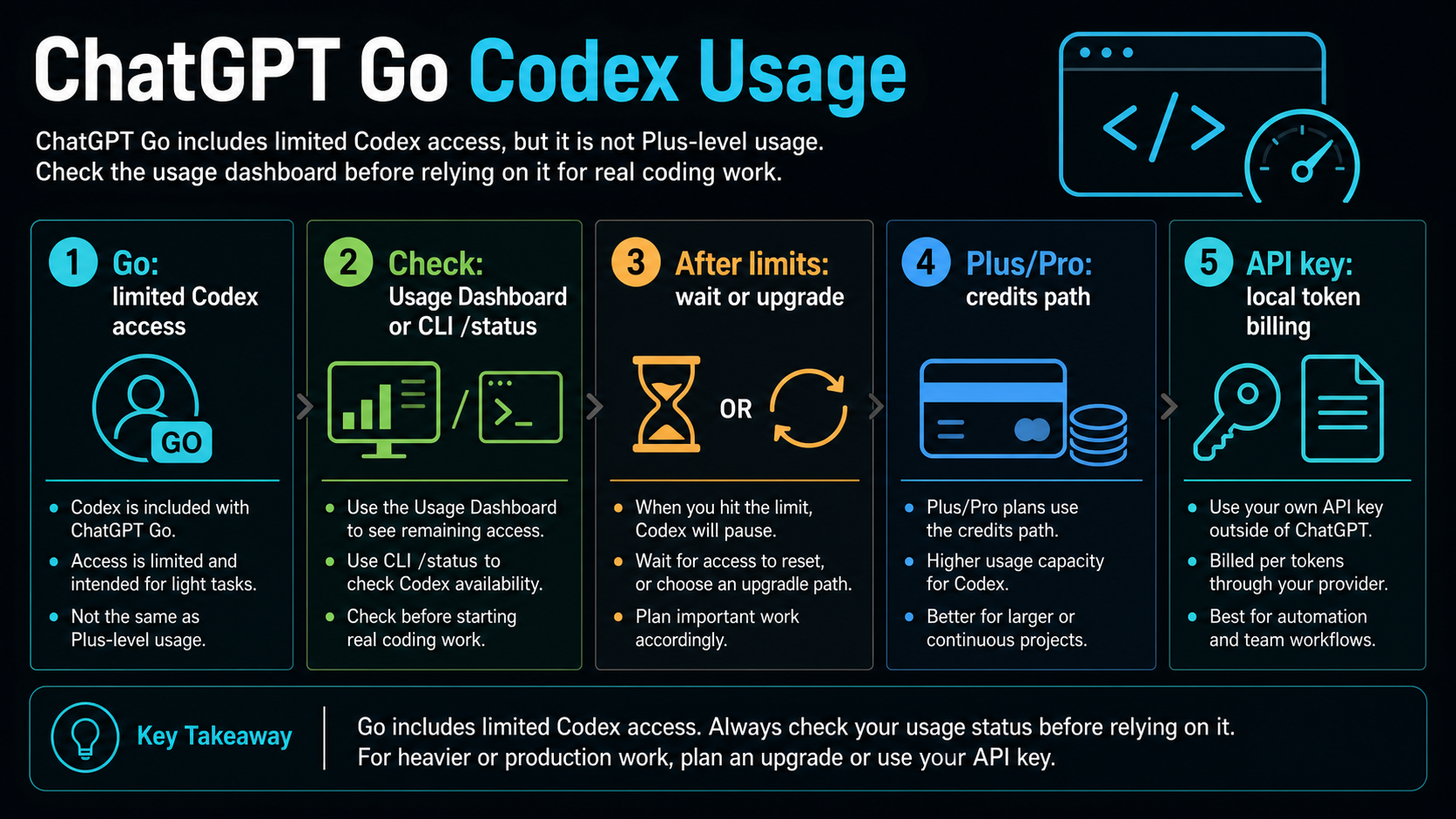
ChatGPT Go includes Codex access, but limited is the important word. Checked against OpenAI's docs and Help Center on May 25, 2026, Go is a lightweight Codex route, not the same usage contract as Plus.
Before starting real repo work, check the meter tied to your account: open the Codex Usage Dashboard in ChatGPT, or run /status during an active Codex CLI session. OpenAI did not publish a durable public Go-specific numeric Codex table in the checked docs, so the dashboard is safer than old quota tables.
Use this route board before you plan a coding session.
| If you are trying to... | Start with... | Why |
|---|---|---|
| Try Codex, make brief checks, or learn the workflow | ChatGPT Go | Go is the lightweight route; interruption risk is acceptable. |
| Use Codex regularly on repositories, longer sessions, or cloud tasks | Plus or Pro | More headroom and the current Plus/Pro credits path matter when work cannot pause midstream. |
| Run local CLI or IDE tasks under your own token billing | API key | API-key usage is separate billing and does not include cloud Codex features. |
Stop before critical work if you have not checked current usage. A plan that is fine for a quick fix can still be the wrong route for a long-running branch, multi-file migration, or task where losing the session costs real time.
Quick Answer: Does ChatGPT Go Include Codex?
Yes. OpenAI's Codex pricing page, checked on May 25, 2026, lists Codex across ChatGPT Free, Go, Plus, Pro, Business, Edu, and Enterprise routes, and positions Go for lightweight coding tasks. The same current evidence does not make Go equivalent to Plus. The ChatGPT pricing page describes Free and Go Codex access as limited, while Plus moves into expanded usage and Pro moves into higher capacity.
That difference changes the buying decision. "Included" means you can start using Codex from the Go plan. It does not mean you should plan a long delegated coding session, cloud task, repository migration, or multi-hour review as if you were on Plus or Pro. If your Codex use is exploratory, occasional, or easy to pause, Go can be enough. If Codex becomes part of daily development work, the limit surface matters more than the subscription price.
The most important missing piece is also the easiest place to make a bad claim: OpenAI did not expose a stable public Go-specific message-count table in the official docs checked on May 25, 2026. Some users may see account-specific banners, rollout changes, or plan-specific options. Treat those as account evidence, not a universal quota.
What Go Gives You And What OpenAI Does Not Publish
OpenAI's current public materials support a conservative wording: Go has Codex access, and that access is limited. The Codex quickstart says every ChatGPT plan includes Codex and describes setup across app, IDE extension, CLI, and cloud. The Codex FAQ in the Help Center, checked on May 25, separately says Free and Go inclusion is for a limited time, while Plus, Pro, Business, Enterprise, and Edu are included plan routes.
That is why a fixed "Go gets X Codex messages" claim would be weaker than a dashboard check. Codex usage depends on plan, model, task size, complexity, and execution surface. A tiny local request and a larger cloud task do not cost the same usage budget. A normal ChatGPT conversation, an image request, a file upload, and a Codex task also do not all belong to one simple meter.
There is one price detail worth dating carefully: OpenAI's Codex pricing page showed Go at $8/month when checked on May 25, 2026. Older pages in the market, including some broad plan comparisons, may still talk about earlier Go pricing or regional launches. Use the current OpenAI page for buying facts, and keep local availability or currency details out of the Codex usage decision unless you verify them for your country.
Where To Check Your Current Codex Usage
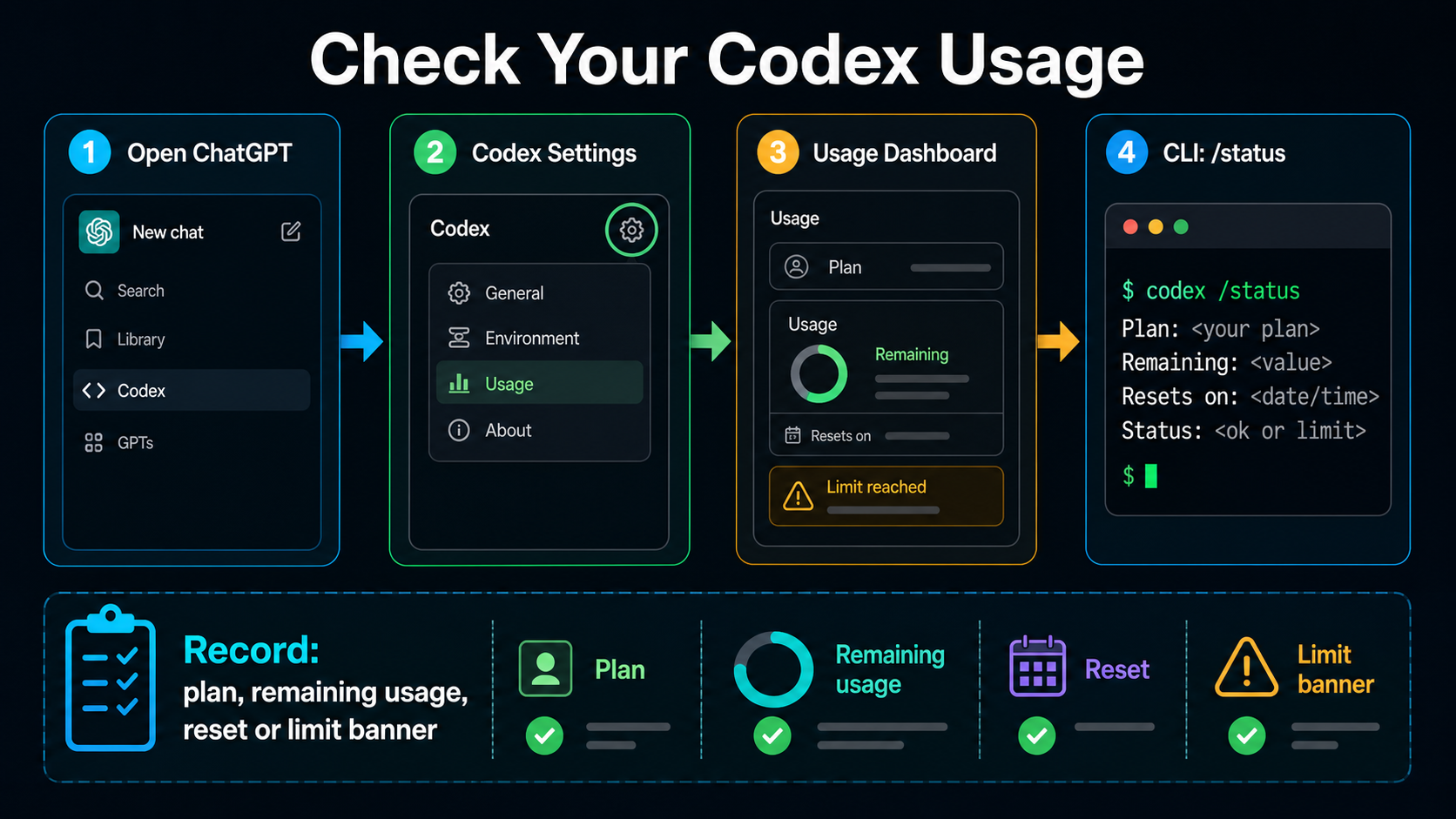
The practical answer lives in your account. OpenAI's Codex pricing page points users to the Codex usage dashboard for current limits, and the Help Center credits article describes the path as Codex Settings > Usage Dashboard. If you are working in the CLI, /status can show remaining limits during an active session.
When you check, record more than a single remaining number. Record the plan, the surface you are using, the model when visible, the remaining usage signal, any reset or limit banner, and whether the task is local or cloud-based. That small habit prevents three common mistakes: assuming old public numbers still apply, assuming a Plus user's credit behavior applies to Go, and assuming API-key local usage has the same feature set as ChatGPT-plan Codex.
Use the dashboard before a large task, not only after the first limit. A short bug triage can tolerate a pause. A repo-wide migration, long pull request review, or scheduled automation should not begin on Go unless the meter and the task size both make that risk acceptable.
What Happens When You Hit A Codex Limit
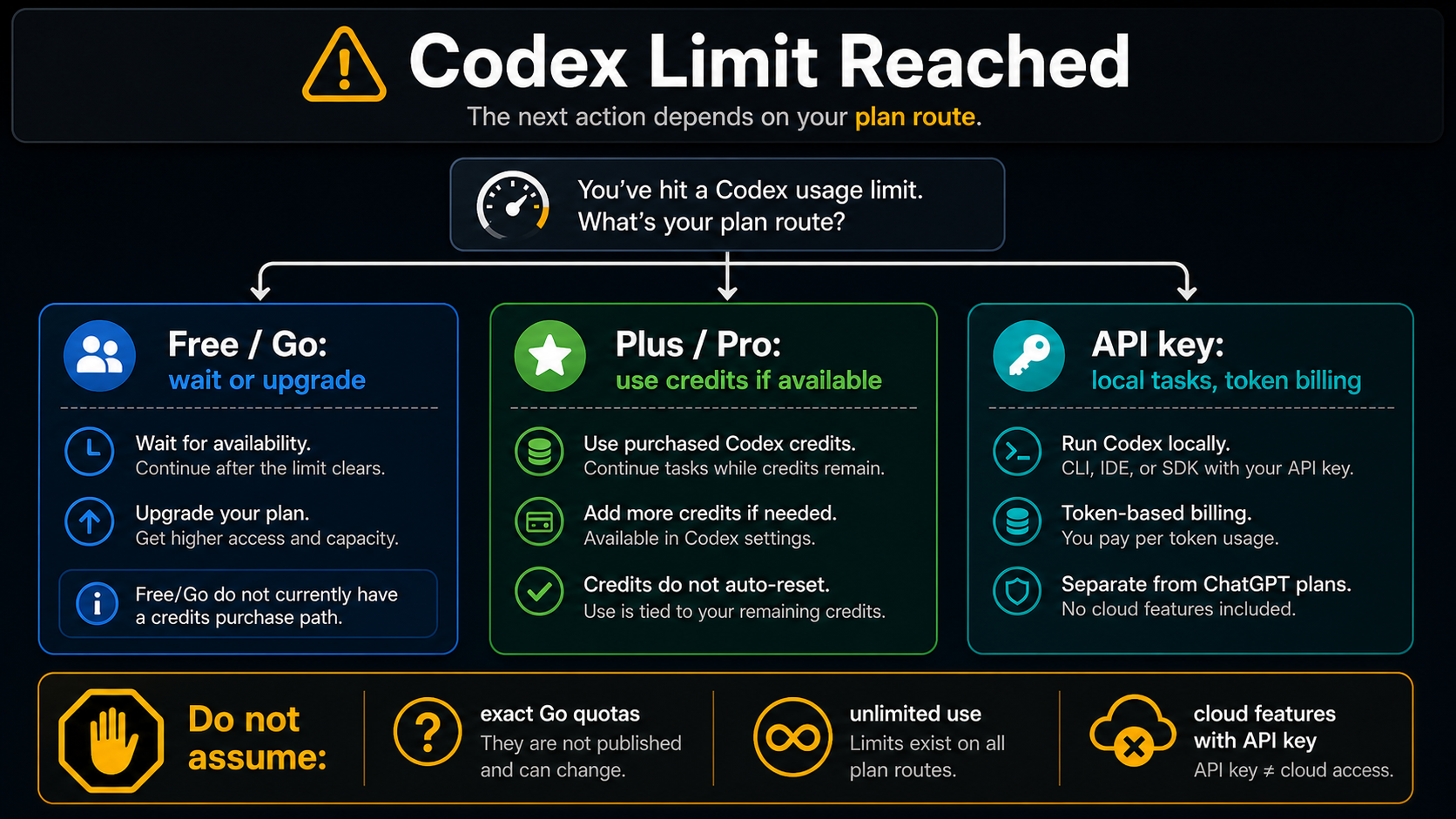
The post-limit branch is where Go and Plus diverge most clearly. OpenAI's credits Help article, checked on May 25, says credits are a pay-as-you-go add-on for Codex and ChatGPT for Excel after included usage is exhausted. For Codex, the same Help article says credits currently can only be used by Plus and Pro users. Free and Go users are prompted to upgrade to Plus instead of adding Codex credits.
That does not make Go useless. It means Go is a lighter subscription route. After a Go limit, the sane options are to wait for availability to return, reduce the task size, or upgrade if Codex has become part of regular work. If you are already on Plus or Pro, additional credits may be available from the current account surface. If you want to keep running local tasks outside the ChatGPT plan meter, API-key Codex is another path, but it is not the same product route.
Do not blur those options. Credits are not a universal refill button. API-key billing is not a hidden way to turn Go into cloud Codex. Waiting is not a plan for urgent production work. The right branch depends on how expensive a pause would be for the task you are about to hand to Codex.
Go, Plus, Pro, API Key, And Business Routes Are Different Contracts
The routes are easiest to compare by what they are good for, not by pretending they buy one identical Codex bucket.
| Route | Best fit | Important boundary |
|---|---|---|
| Free | Trying Codex briefly while access is available | Limited access and no Plus-style credit extension. |
| Go | Lightweight coding tasks, learning, small fixes, and occasional checks | Limited route; do not plan Plus-level usage or exact public quotas. |
| Plus | Regular individual Codex use with broader ChatGPT features | More headroom, current credit extension path, and expanded usage compared with Go. |
| Pro | Heavy individual Codex work where capacity matters | Higher price and capacity; promo or tier details must be rechecked before buying. |
| API key | Local CLI, SDK, or IDE-extension usage under token billing | No cloud Codex features such as GitHub code review or Slack integration in the checked pricing docs. |
| Business / Enterprise | Team governance, enterprise controls, and broader organizational needs | Exact policy, data, and admin behavior should be checked against the plan your organization uses. |
The API-key row deserves special care. OpenAI's Codex pricing page says API-key use covers Codex in the CLI, SDK, or IDE extension and is billed by API token usage. It also says this route does not include cloud-based features such as GitHub code review or Slack integration. That makes API key useful for local automation and controlled developer workflows, not a replacement for every ChatGPT-plan Codex feature.
For broader plan buying, the older ChatGPT Go vs Plus comparison may still be useful as a subscription overview, but do not inherit its old Go pricing or general feature structure into a Codex usage decision. Codex has its own route, meter, and cloud/local boundaries.
When Go Is Enough And When It Becomes Too Small
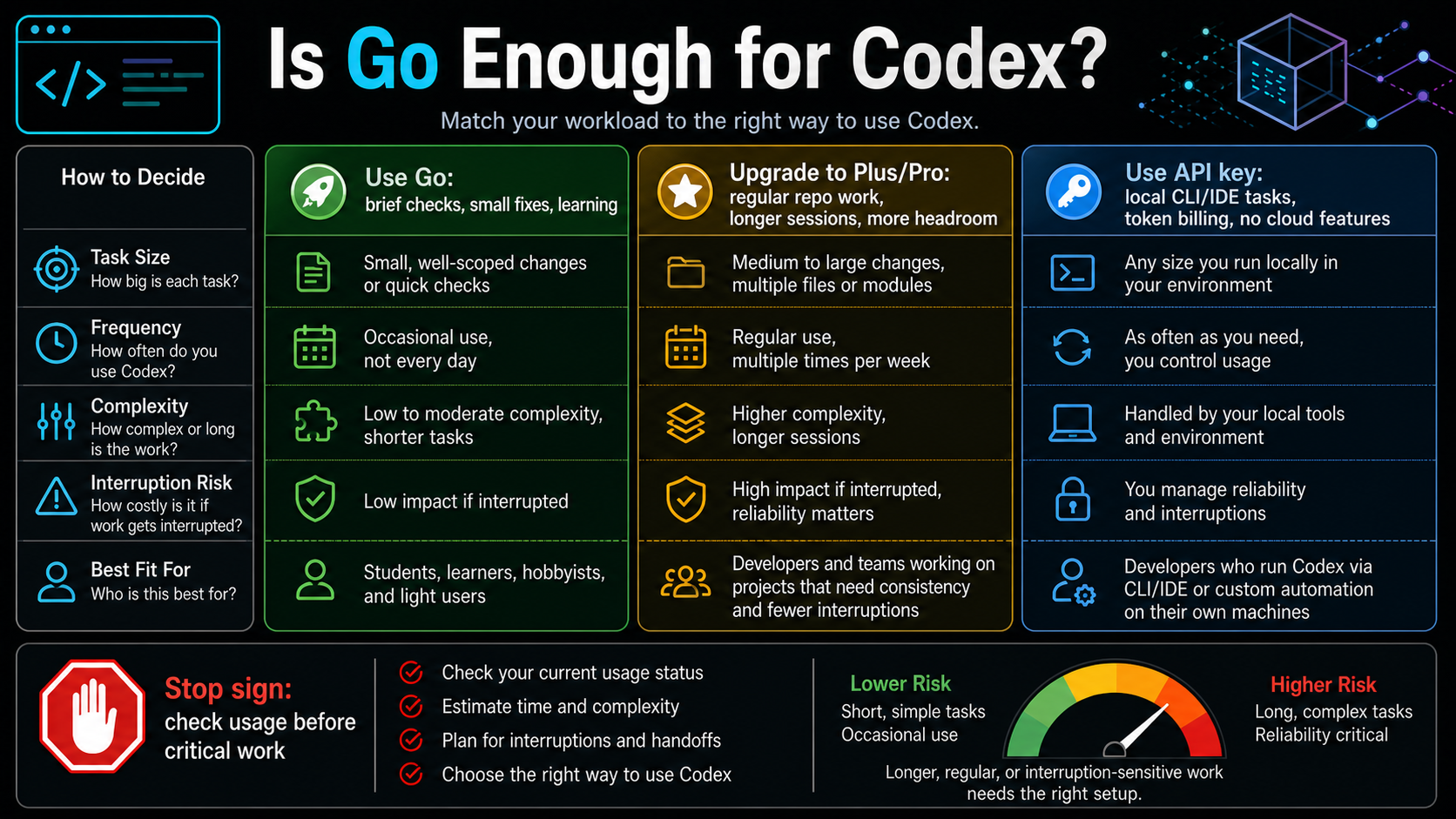
Go is enough when Codex is a light assist. Good examples include asking Codex to inspect a small file, suggest a quick bug fix, explain a diff, try a simple refactor, or help you learn the workflow. In those cases, a pause is annoying but not destructive. You can wait, split the task, or come back later.
Plus or Pro becomes the safer route when Codex is doing work you expect to keep moving. Longer repository tasks, repeated pull request review, cloud tasks, multi-file migrations, regular daily coding sessions, and anything tied to a deadline all need more headroom. The trigger is not only task size; it is interruption cost. If losing the session forces you to rebuild context or delays a real deliverable, the cheaper plan may become the more expensive workflow.
API-key local usage belongs to a different group of readers. It fits developers who want CLI, SDK, or IDE-extension work under token billing and who understand that they are giving up cloud Codex features. It can be a clean way to keep local automation moving, but it should be chosen as a deliberate billing and capability route, not as a workaround for an unclear Go quota.
Mobile Codex does not change that usage logic. OpenAI's May 14, 2026 announcement, Work with Codex from anywhere, says mobile Codex is rolling out in preview across all plans, including Free and Go, in supported regions. That improves where you can follow up, approve, and inspect work. It does not prove Go has the same included usage or credit behavior as Plus.
How To Avoid The Most Common Go Codex Mistakes
The first mistake is treating normal ChatGPT usage and Codex usage as one meter. The Codex FAQ says usage from Codex, ChatGPT for Excel, and Workspace Agents counts toward agentic usage, while ChatGPT file upload, image generation, and voice caps have separate usage limits and do not apply to Codex. That distinction matters when a user says, "I still have ChatGPT messages, so why did Codex stop?" The meters are not interchangeable.
The second mistake is using old plan tables as current Codex evidence. ChatGPT Go pricing, availability, and feature wording have changed across time and region. Codex itself has also expanded across app, CLI, IDE, cloud, mobile, and integration surfaces. Current OpenAI pages should outrank screenshots, forum counts, and older plan-comparison posts.
The third mistake is turning API-key usage into a magic continuation path. API-key Codex can be useful, but it shifts you to token billing and local CLI/IDE/SDK style work. If the job needs cloud tasks, GitHub review, Slack integration, or a ChatGPT-plan feature, the API-key route may solve the wrong problem.
The final mistake is starting serious work without a stop rule. If the task is important, check usage first, reduce the job to a bounded task, save context outside Codex, and decide whether a pause is acceptable. If a pause would hurt, choose the plan or route with enough headroom before Codex owns the work.
FAQ
Does ChatGPT Go include Codex?
Yes. OpenAI's current Codex docs checked on May 25, 2026 include Go in the Codex plan surface. The important qualifier is that Go is limited and framed for lightweight coding tasks, not Plus-level Codex use.
Is ChatGPT Go better than Free for Codex?
Go is a paid route with broader ChatGPT plan benefits than Free, and OpenAI's consumer pricing page separates Free and Go from Plus by describing both as limited for Codex. Because OpenAI did not publish a stable Go-specific Codex count in the checked docs, the practical answer still depends on your account dashboard and workload.
Can Go users buy Codex credits after hitting a limit?
Not in the same way as Plus and Pro in the checked Help Center article. OpenAI's credits page says Codex credits currently can only be used by Plus and Pro users, while Free and Go users are prompted to upgrade to Plus.
Does normal ChatGPT usage count against Codex?
Normal ChatGPT file upload, image generation, and voice caps are separate from Codex limits according to the checked Codex FAQ. Codex usage is part of agentic usage, along with surfaces such as ChatGPT for Excel and Workspace Agents.
Where do I check my Codex limits?
Use the Codex Usage Dashboard in ChatGPT. During an active Codex CLI session, use /status to inspect remaining limits. Account-specific meters are more reliable than old public quota tables.
Does API-key Codex bypass Go limits?
API-key Codex is a separate paid local route, not a Go refill. It can run CLI, SDK, or IDE-extension tasks under token billing, but the checked OpenAI pricing page says API-key usage does not include cloud-based features such as GitHub code review or Slack integration.
Did mobile Codex make Go equal to Plus?
No. Mobile Codex preview expands where users can follow and steer Codex work across supported plans, including Free and Go, but it does not prove Go has Plus-level usage, Plus/Pro credits, or the same cloud-feature contract.
Should a developer stay on Go or upgrade to Plus?
Stay on Go for brief checks, learning, small fixes, and occasional low-risk tasks. Upgrade when Codex becomes regular repo work, longer sessions, cloud tasks, or anything where a usage pause would cost more than the plan difference. For local automation under token billing, evaluate the API-key route separately.
For workflow choice beyond subscription limits, compare Codex with adjacent tools in Claude Code vs Codex; for broad subscription buying, use ChatGPT Go vs Plus after rechecking current plan facts.