Getting access to Nano Banana Pro without breaking the bank has become one of the most searched topics among AI developers and creators in early 2026. Google's latest image generation model delivers unprecedented text rendering accuracy—scoring 94-96% on benchmark tests compared to 71-78% for competitors—but the pricing structure and quota limitations can be confusing for newcomers. This comprehensive guide walks you through every available method to obtain a Nano Banana Pro API key for free trial, explains the quota system in detail, and reveals cost optimization strategies that can save you up to 79% on your image generation costs.
Whether you're a developer building an application, a content creator exploring AI capabilities, or an enterprise evaluator testing before procurement, understanding the full landscape of free trial options and pricing tiers will help you make informed decisions. By the end of this guide, you'll know exactly how to get started without spending a penny, when it makes sense to upgrade, and how third-party providers can dramatically reduce your costs for production workloads.
What is Nano Banana Pro and Why Developers Want Free API Access
Nano Banana Pro represents Google's most advanced image generation model, built on the Gemini 3.0 Pro architecture and released in late 2025. Unlike standard text-to-image models, Nano Banana Pro excels at rendering text within images—a capability that has historically been the Achilles heel of AI image generation. According to benchmark testing by Spectrum AI Labs, the model achieves 94-96% accuracy in text rendering, dramatically outperforming Midjourney v6.1 (78%), DALL-E 4 (74%), and Flux Pro (71%).
The technical capabilities that set Nano Banana Pro apart are substantial. The model supports native 4K resolution output (up to 4096×4096 pixels), generates images in approximately 3 seconds, and offers robust multi-language text support including Latin scripts, CJK characters, and Arabic text. For developers building applications that require text overlays, watermarks, or integrated typography, these capabilities eliminate the need for post-processing workflows that previously added complexity and cost.
Why API access specifically matters relates to integration flexibility. While the consumer-facing Gemini app provides access to Nano Banana Pro, it imposes strict limitations that make it unsuitable for any serious development or production use. The API, by contrast, allows programmatic access with higher quotas, batch processing capabilities, and the ability to integrate image generation directly into applications. For developers building SaaS products, content automation tools, or creative applications, API access is non-negotiable.
The demand for free trial access reflects the experimental nature of AI development. Before committing to paid plans or integrating a new API into production systems, developers need to test edge cases, evaluate output quality for their specific use cases, and benchmark performance. Google recognizes this need, which is why multiple free access pathways exist—though navigating them requires understanding the distinctions between consumer tiers, API tiers, and third-party alternatives.
Free Trial Options Complete Breakdown
Obtaining free access to Nano Banana Pro involves understanding the distinct pathways available and their respective trade-offs. The options fall into two broad categories: official Google channels and third-party platforms that provide access through their own infrastructure.
Official Google Channels
The Gemini consumer app offers the most accessible entry point. Available at gemini.google.com, the free tier provides 2 images per day at approximately 1 megapixel resolution (1024×1024 pixels). While this resolution falls short of the 4K capability that distinguishes Nano Banana Pro at higher tiers, it provides sufficient quality for concept testing, social media content, and personal projects. The visible Gemini sparkle watermark appears on all free-tier outputs, along with an invisible SynthID digital signature for content provenance tracking.
Google AI Studio provides a more developer-focused free option. Accessible at aistudio.google.com, this platform offers up to 1,500 daily API requests for development and prototyping. Developers can generate API keys without attaching payment methods, though production deployment eventually requires billing activation. The key advantage here is the significantly higher request limit compared to the 2-image consumer quota—a 750x improvement that makes serious testing possible.
Google Cloud Platform's free credits represent the most generous official offering. New Google Cloud users receive $300 in free credits applicable to all Google Cloud services, including Gemini API usage for Nano Banana Pro. At the standard API pricing of $0.134 per 1K-2K image, this credit enables approximately 2,240 image generations—enough for extensive testing and initial development. The credits require adding a valid payment method for identity verification, though no charges occur until credits are exhausted. Important caveat: credits expire after 90 days, so plan your testing accordingly.
Third-Party Platforms
Several third-party platforms have emerged offering Nano Banana Pro access with different value propositions. These platforms proxy requests to Google's API using their own billed projects, often absorbing costs to attract users or offering substantially lower per-image pricing than Google's official rates.
Platforms like nanobananaapi.ai provide instant free credits upon signup, allowing you to test both standard Nano Banana (Gemini 2.5 Flash) and Nano Banana Pro (Gemini 3 Pro) without upfront payment. The unified API key system simplifies integration by granting access to multiple model tiers through a single credential.
For developers seeking the most cost-effective option for ongoing usage, third-party API providers offer prices as low as $0.05 per image—representing a 63-79% savings compared to Google's official pricing. Services like laozhang.ai have built infrastructure specifically for high-volume image generation, passing the savings from bulk API access onto customers.
| Free Trial Method | Daily Limit | Resolution | Watermark | Best For |
|---|---|---|---|---|
| Gemini App Free | 2 images | 1MP | Yes | Quick testing |
| Google AI Studio | 1,500 requests | 2K | No | Development |
| Google Cloud Credits | ~2,240 total | 4K | No | Extended testing |
| Third-party free credits | Varies | 4K | No | Evaluation |
Understanding Quota Limits and Restrictions
The quota system for Nano Banana Pro operates on multiple dimensions: daily image limits, resolution caps, API rate limits, and reset timing. Understanding these mechanics helps you maximize your free access and plan for when paid tiers become necessary.
The consumer tier quota underwent a significant reduction in November 2025. Google decreased the free tier from 3 images per day to 2 images per day, citing high demand as the primary factor. This reduction sparked considerable discussion in developer communities, as it effectively halved the testing capacity available to free users. The 2-image limit applies account-wide, not per device—accessing Gemini from your phone, tablet, and computer all share the same daily allocation.
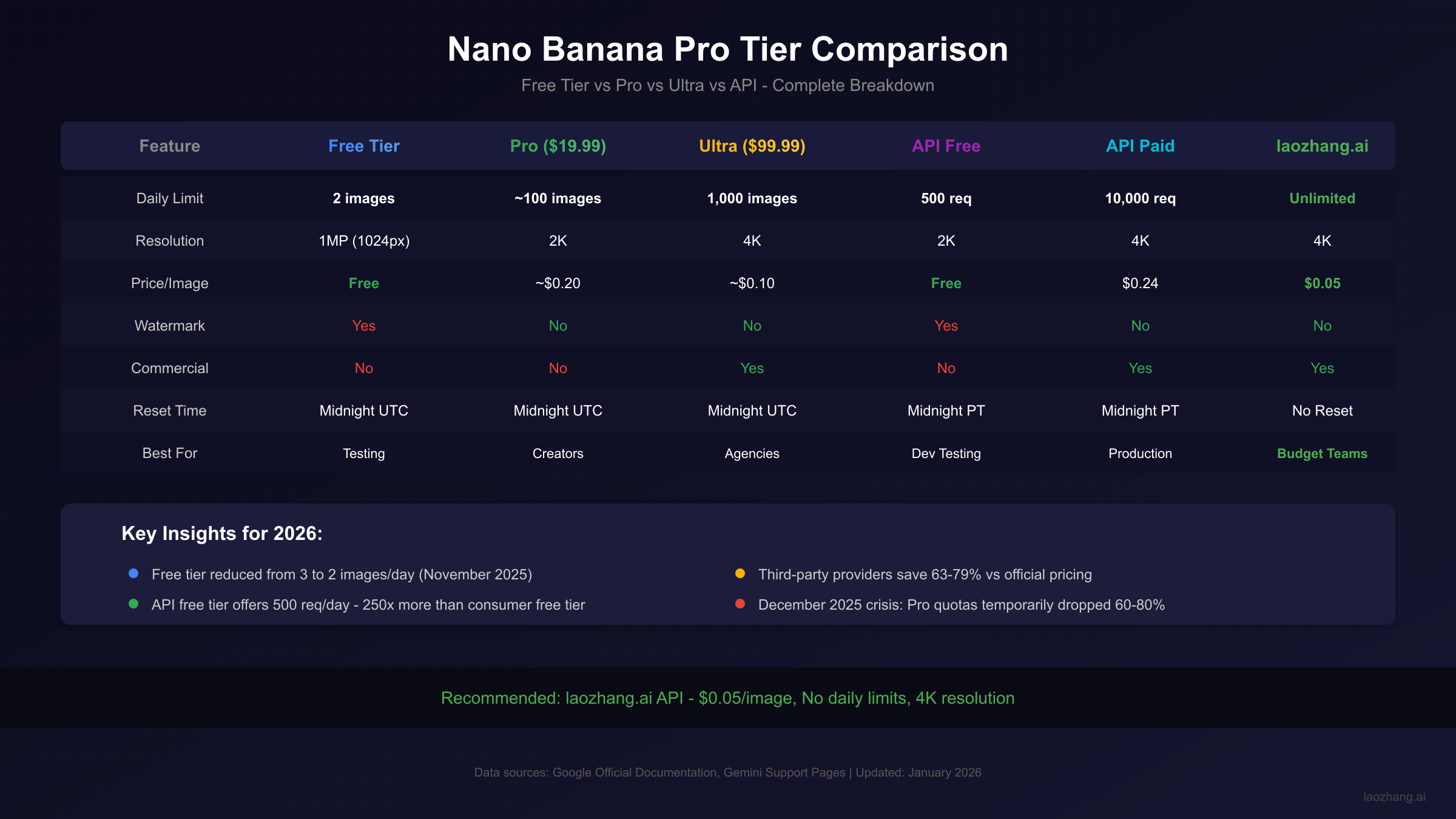
Resolution restrictions add another layer to the quota system. Free tier outputs are capped at approximately 1 megapixel (roughly 1024×1024 pixels), preventing access to the 2K and 4K capabilities that distinguish Pro and Ultra tiers. When the free quota depletes, users are automatically downgraded to the older Nano Banana model (non-Pro variant), which lacks the advanced text rendering and resolution capabilities.
The API tier structure differs significantly from consumer tiers. The API free tier offers 500 requests per day with 5-10 requests per minute rate limiting—250x more generous than the consumer 2-image limit. This discrepancy reflects Google's strategy of encouraging developer adoption while limiting casual consumer usage. Paid API access increases limits to 10,000 requests per day with 100 requests per minute, suitable for production deployments.
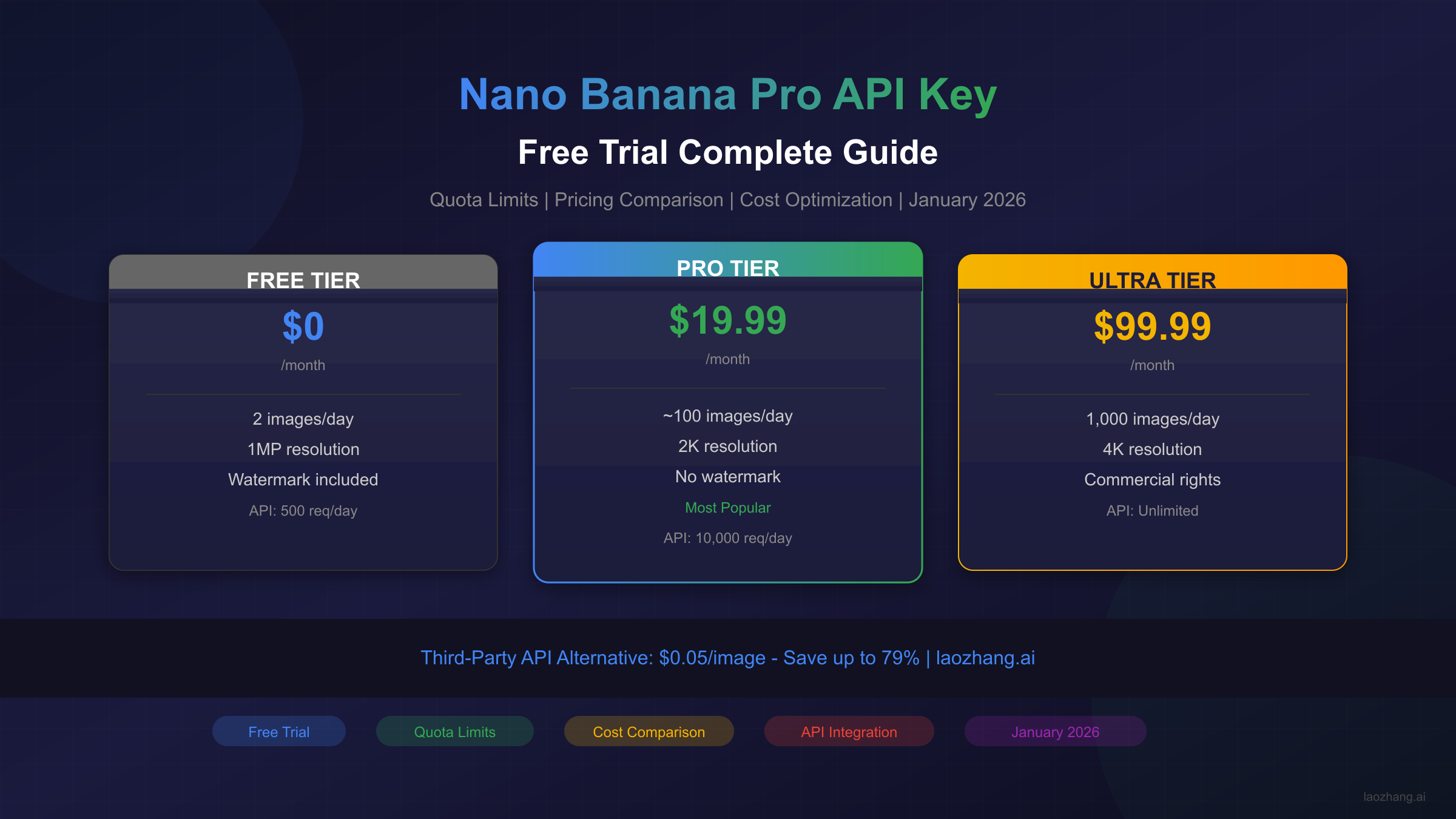
| Tier | Monthly Cost | Daily Limit | Resolution | Rate Limit | Commercial Rights |
|---|---|---|---|---|---|
| Free (Consumer) | $0 | 2 images | 1MP | N/A | No |
| Pro | $19.99 | ~100 images | 2K | N/A | No |
| Ultra | $99.99 | 1,000 images | 4K | N/A | Yes |
| API Free | $0 | 500 requests | 2K | 5-10 RPM | No |
| API Paid | Pay-per-use | 10,000 requests | 4K | 100 RPM | Yes |
Reset timing varies between consumer and API access. Consumer accounts reset at midnight UTC (Coordinated Universal Time), which translates to 4 PM PST / 7 PM EST for US users, 8 AM China Standard Time, and 9 AM JST for Japan. API quotas reset at midnight Pacific Time—8 hours later than consumer resets. There's no rollover mechanism; if you generate 0 images today, you still only have 2 available tomorrow, not 4.
Failed attempts and edits consume quota. Any generation attempt—successful, failed due to safety filters, or errored due to technical issues—counts against your daily limit. Image editing operations using Nano Banana Pro's editing capabilities also count as generations. This makes prompt engineering particularly important for free-tier users who want to maximize their limited allocations.
API Key Acquisition Step-by-Step Guide
Obtaining an API key for Nano Banana Pro involves different workflows depending on whether you're using Google's official channels or third-party providers. Each approach has distinct advantages and trade-offs.
Google AI Studio Method
Step 1: Navigate to Google AI Studio. Open aistudio.google.com in your browser and sign in with your Google account. If you don't have a Google account, you'll need to create one first—this is free and takes approximately 2 minutes.
Step 2: Access the API keys section. Once logged in, look for the "Get API key" option in the left sidebar or main dashboard. Click this to enter the API key management interface.
Step 3: Create a new API key. Click "Create API key" and select whether to create the key in a new project or an existing Google Cloud project. For testing purposes, creating in a new project is simpler. The key generation is immediate—you'll receive an alphanumeric string that looks like "AIzaSy..." which is your API credential.
Step 4: Test your key. Before integrating into your application, verify the key works using a simple curl command or the Google AI SDK. The free tier provides 500 requests per day, sufficient for development testing.
Important consideration: While Google AI Studio allows key creation without payment methods, you'll eventually need to add billing for production usage. The $300 free Google Cloud credits (for new users) can extend your free testing period significantly.
Third-Party Provider Method
Third-party providers simplify the acquisition process while often providing better pricing. The workflow typically involves:
Step 1: Register on the provider's platform. Create an account with your email address. Most platforms verify your email before granting access.
Step 2: Obtain your API key. After email verification, navigate to the API keys or credentials section. Many providers grant instant free credits upon registration—enough for evaluation testing.
Step 3: Configure your integration. Third-party APIs typically mirror Google's API structure, requiring minimal code changes if you're migrating from direct Google access. The endpoint URL changes, but request/response formats remain similar.
For developers requiring cost-effective API access for production workloads, third-party providers like laozhang.ai offer significant advantages: $0.05 per image (versus $0.24 official), no daily limits, and simplified billing without Google Cloud overhead.
Pricing Comparison and Cost Optimization
Understanding the full pricing landscape is essential for making informed decisions about Nano Banana Pro usage. The cost difference between official and third-party options can be substantial, particularly for high-volume use cases.
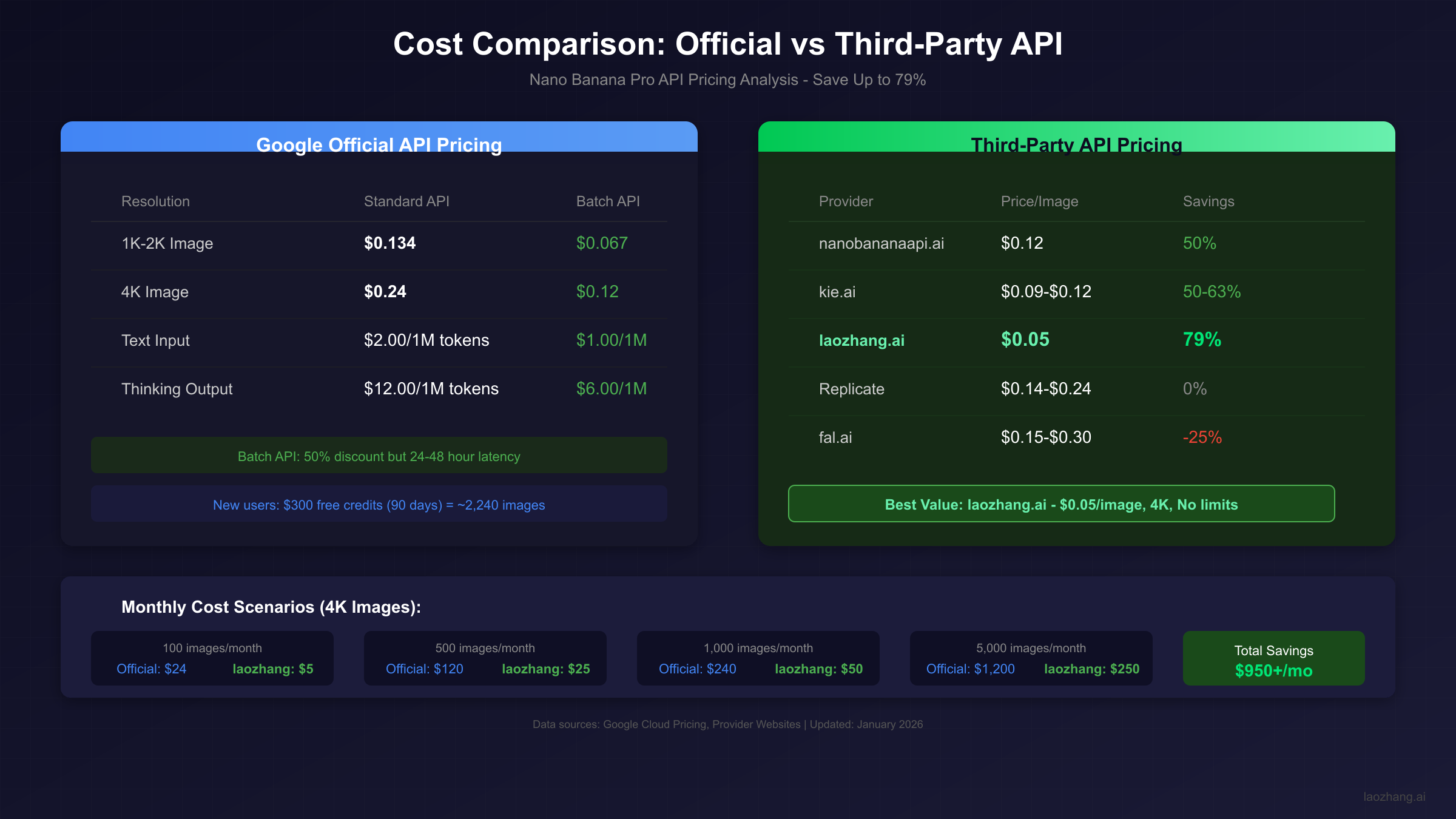
Official Google API pricing follows a tiered structure based on resolution. Standard API requests cost $0.134 per 1K-2K image and $0.24 per 4K image. Text prompts incur separate charges: $2.00 per million input tokens for prompts and $12.00 per million tokens for the model's "thinking" output. For most use cases, the image generation cost dominates, but verbose prompts can add meaningful costs at scale.
The Batch API offers 50% savings for non-time-sensitive workloads. Batch processing costs drop to $0.067 per 1K-2K image and $0.12 per 4K image. The trade-off is latency: batch jobs complete within 24-48 hours rather than the ~3 seconds of synchronous requests. For background processing, asset pre-generation, or bulk content creation, this represents a significant cost optimization.
| Provider | 1K-2K Image | 4K Image | Savings vs Official |
|---|---|---|---|
| Google Official | $0.134 | $0.24 | Baseline |
| Google Batch API | $0.067 | $0.12 | 50% |
| nanobananaapi.ai | $0.12 | $0.12 | 50% |
| kie.ai | $0.09 | $0.12 | 50-63% |
| laozhang.ai | $0.05 | $0.05 | 63-79% |
Third-party providers achieve lower pricing through bulk access and infrastructure optimization. By aggregating demand from multiple customers and negotiating volume pricing with Google, these providers pass savings to end users. The most competitive offerings reach $0.05 per image regardless of resolution—a 79% reduction from Google's 4K pricing.
Monthly cost scenarios illustrate the practical impact of provider choice. Consider these examples for 4K image generation:
| Monthly Volume | Google Official | laozhang.ai | Monthly Savings |
|---|---|---|---|
| 100 images | $24 | $5 | $19 |
| 500 images | $120 | $25 | $95 |
| 1,000 images | $240 | $50 | $190 |
| 5,000 images | $1,200 | $250 | $950 |
For teams generating thousands of images monthly, the annual savings can exceed $10,000—budget that can be redirected to other development priorities.
Best Practices and Use Case Recommendations
Maximizing value from Nano Banana Pro requires matching your usage patterns to the appropriate access tier and implementing efficiency practices that reduce wasted generations.
Prompt engineering becomes critical when operating under quota constraints. The free tier's 2-image daily limit leaves no room for iterative refinement through trial and error. Before generating, invest time in crafting detailed prompts that specify: subject matter, artistic style, lighting conditions, technical specifications (aspect ratio, dominant colors), and any text elements. The extra upfront effort reduces failed generations and maximizes the value of each allocated image.
Resolution planning affects both cost and quality. Not every use case requires 4K output. Social media images, thumbnails, and concept exploration work well at 1K-2K resolution, costing approximately half of 4K generation. Reserve 4K for final production assets where quality directly impacts outcomes—hero images, print materials, and commercial deliverables.
| Use Case | Recommended Tier | Resolution | Estimated Monthly Cost |
|---|---|---|---|
| Personal projects | Free Tier | 1MP | $0 |
| Content testing | API Free | 2K | $0 |
| Blog/social media | API or Third-party | 2K | $10-50 |
| E-commerce product images | Third-party API | 4K | $50-200 |
| Agency/production | Third-party API | 4K | $200-500 |
| Enterprise integration | API Paid or Third-party | 4K | Custom |
Timing your generations can improve reliability. During peak hours (typically 9 AM - 6 PM in major markets), Google occasionally implements dynamic throttling that can affect even paid subscribers. Generating during off-peak hours—early morning or late evening UTC—typically provides more consistent performance.
For developers building applications that require image generation, consider implementing caching and pre-generation strategies. If your application generates similar images repeatedly (e.g., product mockups with different text), caching results can dramatically reduce API costs. Pre-generating common variations during low-traffic periods and serving from cache provides instant response times while minimizing per-request costs.
Related resources for image generation optimization: AI Image-to-Image Generation Guide covers techniques for editing and modifying existing images, while Gemini 2.5 Flash API access provides options for standard (non-Pro) image generation at even lower costs.
Frequently Asked Questions and Summary
How do I verify I'm using Nano Banana Pro and not standard Nano Banana? Check the output resolution and text rendering quality. Nano Banana Pro supports up to 4K output and renders text with 94-96% accuracy. Standard Nano Banana maxes out at 2K with lower text fidelity. In the API, specifying "gemini-3-pro-image" or "nano-banana-pro" ensures Pro model usage.
Why was my free tier reduced from 3 to 2 images? Google reduced consumer free tier limits in November 2025, citing high demand. The change affects all free users globally. The API free tier (500 requests/day) remains unchanged, making developer-focused access more attractive.
Can I use free tier outputs commercially? No. Free tier outputs include visible watermarks and are restricted to personal, non-commercial use. Commercial rights require Ultra subscription ($99.99/month) or paid API access.
What happens when I exceed my quota? Consumer users cannot generate additional images until the next reset. API users receive rate limit errors that can be caught programmatically. Planning your generation timing around reset schedules helps maximize availability.
How do third-party providers offer lower prices? Third-party providers purchase API access in bulk, benefiting from volume discounts that individual users cannot access. They also optimize infrastructure for image generation specifically, reducing operational costs that get passed to customers as savings.
Is using third-party API providers safe? Reputable providers like laozhang.ai, kie.ai, and nanobananaapi.ai have established track records with developer communities. Key considerations: verify the provider has clear terms of service, responsive support, and positive community feedback. Avoid providers that seem too good to be true or lack verifiable business presence.
The path forward depends on your specific needs. For casual exploration and testing, the free consumer tier provides sufficient access to evaluate Nano Banana Pro's capabilities. Developers building applications should leverage the API free tier's 500 daily requests through Google AI Studio, supplemented by Google Cloud's $300 free credits for new users.
For production workloads where cost efficiency matters, third-party providers offer compelling value. At $0.05 per image through services like laozhang.ai, you can generate 20 images for the price of 1 at Google's official rates. Combined with no daily limits and 4K resolution support, these alternatives make high-volume image generation economically viable for projects of any scale.
The key insight is that free access is abundantly available for testing and development, while production usage requires thoughtful cost analysis. By understanding the full landscape of options—from Google's official tiers to third-party alternatives—you can build image generation capabilities into your projects without budget constraints limiting your vision.