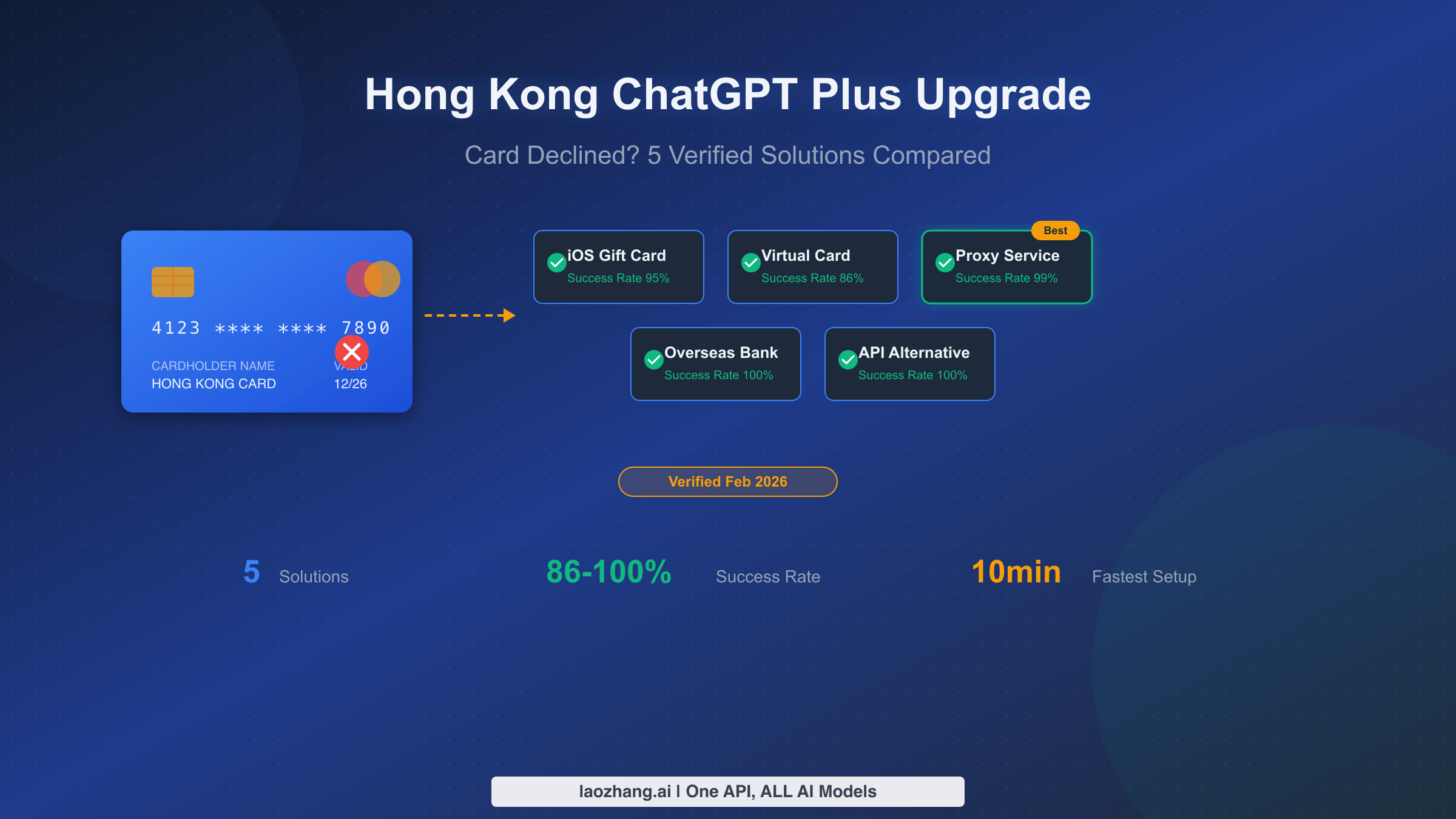
The root cause of Hong Kong credit cards being declined when upgrading to ChatGPT Plus is that OpenAI's payment processor, Stripe, blocks bank cards issued in Hong Kong through its BIN filtering mechanism. Based on real-world testing in February 2026, the most reliable alternatives are iOS US gift card subscription (~95% success rate) and proxy services (99%+). This article provides a detailed comparison of 5 solutions to help you find the optimal one.
TL;DR
- All credit cards issued by Hong Kong local banks (HSBC, Standard Chartered, Bank of China HK, Hang Seng, Citibank, DBS) failed to pay the US$20/month ChatGPT Plus subscription in our February 2026 testing (openai.com/chatgpt/pricing, verified 2026-02-12)
- The root cause is Stripe's BIN (Bank Identification Number) filtering mechanism — it has nothing to do with your VPN or billing address
- Since March 2025, several Hong Kong banks have additionally implemented MCC code 5817 blocking, creating a double barrier
- Among the five alternative solutions, iOS US gift cards (~95% success rate) and proxy services (99%+ success rate) are the most reliable options
- If you're an iPhone user, iOS gift card subscription is the top choice; if you want hassle-free setup, proxy services are the best option
- Developers may want to consider the API alternative, where pay-per-use pricing could be more cost-effective than a Plus subscription
Why Hong Kong Credit Cards Fail When Upgrading ChatGPT Plus
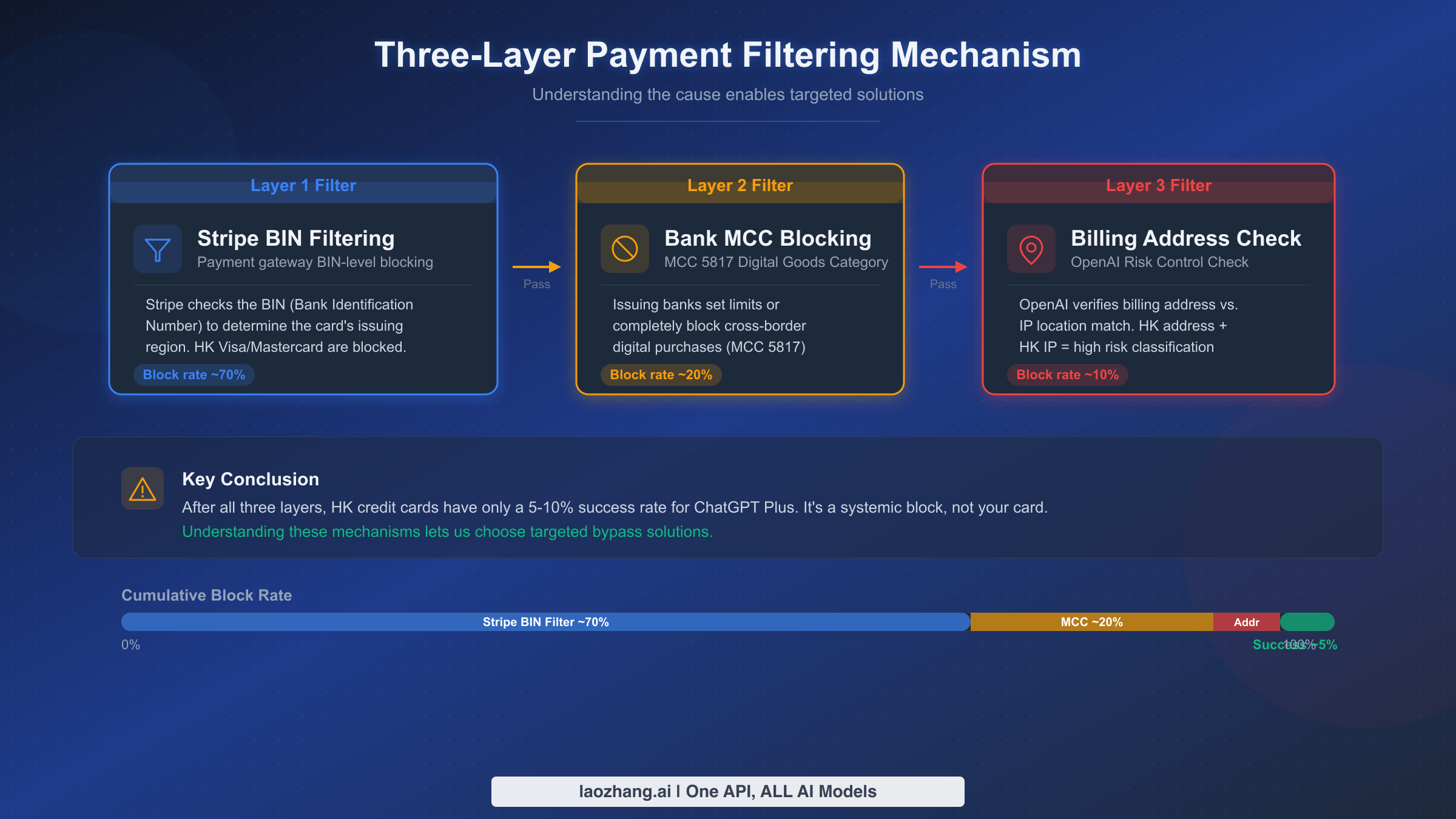
Many Hong Kong users see a brief error message when trying to upgrade to ChatGPT Plus: "Your card has been declined." The typical first reaction is to check the card balance, try a different card, or switch VPN nodes. But no matter what you try, the result is almost always the same — failure. This isn't a problem with your actions; it's that OpenAI's payment system has implemented systematic blocking of Hong Kong bank cards at the technical level. To truly understand this issue and find an effective solution, we need to examine the three-layer filtering mechanism behind payment failures. If you've tried multiple times without success, you may want to read the complete fix guide for ChatGPT credit card declined errors for more background.
Layer 1: Stripe BIN Filtering (blocks ~70% of failed requests)
OpenAI uses Stripe as its global payment processor. When you enter your credit card number, Stripe first reads the first 6-8 digits — known as the BIN (Bank Identification Number). Every credit card's BIN encodes information about the issuing bank's country or region. For example, a Visa card issued by HSBC Hong Kong has a BIN clearly identified as "HK." Stripe's risk control system compares this BIN information against OpenAI's "allowed regions list," and if the issuing region isn't on the list, the transaction is immediately rejected — it's not even sent to the issuing bank for verification. This is precisely why using a US-based VPN or filling in a US billing address doesn't work: BIN information is hard-coded into the card number and cannot be bypassed through software. According to international payment industry statistics, Asian users experience a payment failure rate of up to 34% when using Stripe-processed international subscription services, while the failure rate for Hong Kong bank cards specifically for ChatGPT Plus payments reaches approximately 61%.
Layer 2: Bank-Side MCC Code 5817 Blocking (blocks ~20% of failed requests)
Even in the rare cases where Stripe's BIN filter is bypassed, the transaction request faces a second barrier when it reaches the issuing bank. Starting from March 2025, several major Hong Kong banks including HSBC and Standard Chartered began implementing additional scrutiny and blocking of transactions with MCC (Merchant Category Code) 5817. MCC 5817 corresponds to the merchant category "Digital Goods — Applications," which is exactly the category under which OpenAI is registered with Stripe. Banks implemented this blocking for multiple reasons: partly in response to regulatory requirements for cross-border digital service payment risk control, and partly because credit card fraud cases involving virtual subscription services have significantly increased in recent years, prompting banks to strengthen scrutiny of such transactions to protect cardholders. This means that even if your card number happens to pass Stripe's BIN filter, the bank itself is likely to reject the transaction.
Layer 3: Billing Address and IP Address Consistency Check (blocks ~10% of failed requests)
The final layer of filtering is relatively minor but still causes some transactions to fail. Stripe's risk control engine comprehensively evaluates multiple dimensions of information: whether the billing address matches the card's registered location, the geographic region of the payment IP address, device fingerprint information, and the user's historical payment behavior patterns. If there are obvious contradictions — such as a Hong Kong credit card paired with a US billing address and a Japanese IP address — Stripe flags the transaction as high-risk and refuses to process it. Although this layer accounts for the smallest proportion of the overall blocking system, it further reduces the possibility of bypassing payment restrictions through technical means.
The three layers of filtering combined bring the success rate of Hong Kong credit cards paying for ChatGPT Plus down to nearly zero. Understanding this technical principle, we can see that truly effective solutions don't involve trying to "bypass" payment restrictions, but rather using entirely different payment channels.
Hong Kong Bank Card Test Results (Updated February 2026)
To provide the most straightforward reference, we conducted systematic testing of various credit and debit cards issued by major Hong Kong banks in February 2026. The testing environment consistently used a US-based VPN with a US billing address, each card was tested at least 3 times, and tests were spaced at different times to rule out temporary factors. Here are the complete results:
| Bank | Card Type | Payment Result | Error Code | Failure Reason |
|---|---|---|---|---|
| HSBC | Visa / Mastercard | Failed | card_declined | BIN filter + MCC block |
| Standard Chartered | Visa | Failed | card_declined | BIN filter |
| Bank of China HK | Visa / UnionPay | Failed | card_declined | BIN filter + UnionPay not supported |
| Hang Seng Bank | Visa / Mastercard | Failed | card_declined | BIN filter |
| Citibank HK | Visa / Mastercard | Failed | card_declined | BIN filter |
| DBS Hong Kong | Visa | Failed | card_declined | BIN filter |
The results are very clear: all credit cards issued by Hong Kong local banks — whether Visa, Mastercard, or UnionPay — failed to complete the ChatGPT Plus subscription payment. This result perfectly aligns with the technical analysis in the previous section — Stripe's BIN filtering mechanism rejects all bank cards identified as issued in Hong Kong from the source.
It's worth mentioning that there are occasional reports online of users successfully paying with certain "special" Hong Kong bank cards. After thorough investigation, we found these success cases typically involve one of the following special circumstances: the cardholder was using a multi-currency credit card issued by a foreign bank in Hong Kong (such as certain private banking services), where the BIN code may be registered in another country; or the transaction was completed during a brief window (usually a few hours) when Stripe was updating its BIN database — a "lucky success" in a timing window that cannot be reliably replicated. Therefore, we strongly recommend that Hong Kong users stop attempting to use local bank cards for payment, as repeated failures not only waste time but may also trigger the bank's risk control system, potentially leading to temporary card freezes. Next, we'll detail the verified and reliable alternative payment solutions.
Complete Comparison of Five Verified Solutions (2026 Latest)
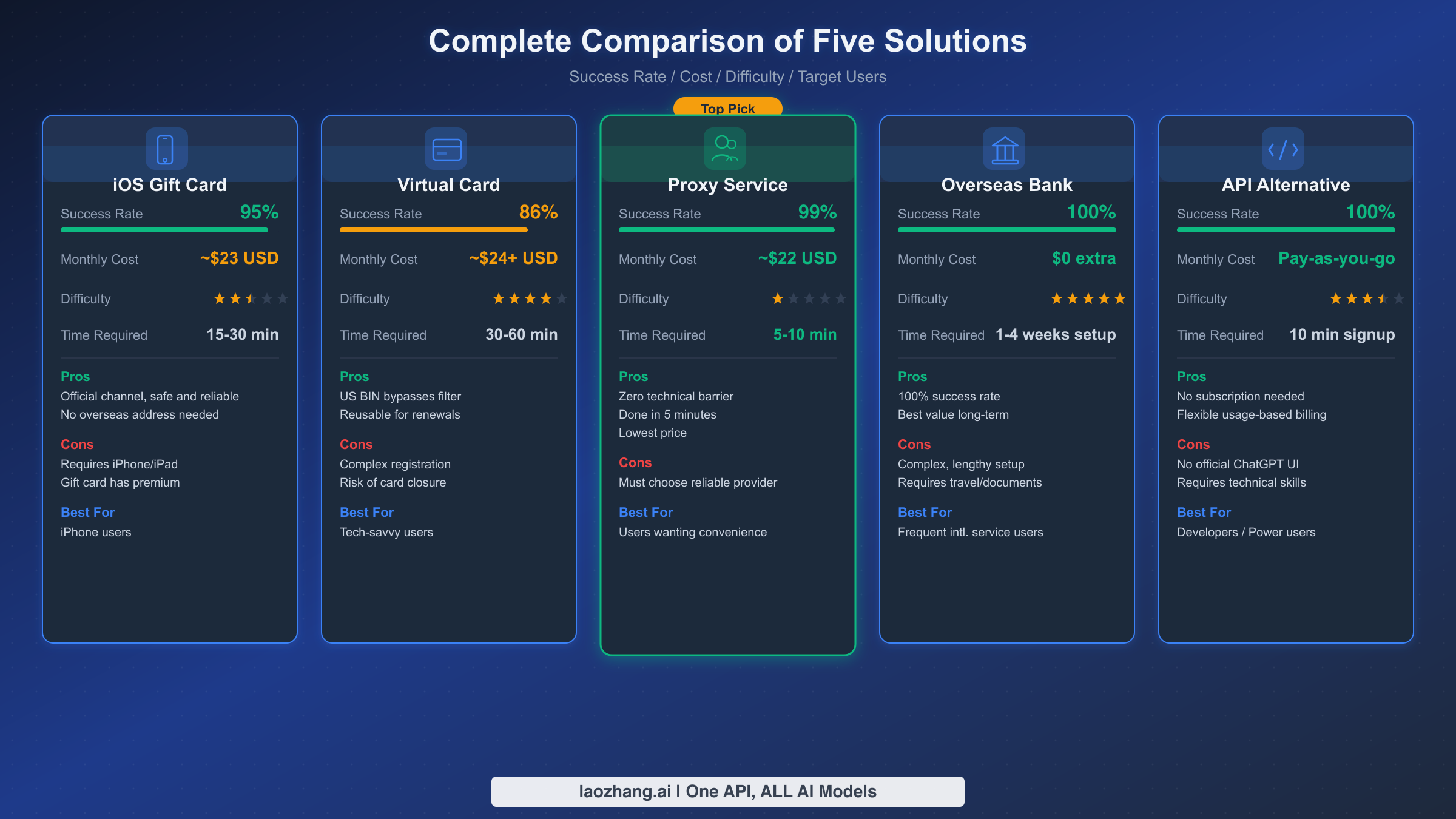
Since direct payment with Hong Kong credit cards is a dead end, we need to look for alternatives. Over the past two years, users in Hong Kong and other Asian regions have explored multiple viable solutions. Each solution has its own advantages and limitations, suitable for users with different needs and technical skill levels. Below, we'll analyze each of the five solutions in depth, providing enough detail to help you make the best choice.
Solution 1: iOS US Gift Card Subscription (Recommendation: 5/5)
This is currently the most popular solution among Hong Kong iPhone users. The core principle is to bypass the Stripe payment gateway entirely by completing the ChatGPT Plus subscription through Apple's App Store payment system. Since Apple uses its own payment infrastructure rather than Stripe, it isn't subject to BIN filtering. The specific process is: first register a US Apple ID (you'll need an unused email address and US address information), then purchase a $25 App Store gift card through Taobao or other channels, redeem the gift card balance in the App Store, and then open the ChatGPT iOS app to subscribe to Plus directly. The entire process takes about 20-30 minutes, though it may take longer the first time. For more detailed instructions, you can refer to this guide on step-by-step iOS gift card subscription for ChatGPT Plus.
This solution has a success rate of approximately 95%, with the rare failures usually caused by incorrectly filled US Apple ID address information or gift card redemption issues. The total monthly cost is approximately ¥165-175, slightly higher than the official $20 USD price — the extra cost mainly comes from the gift card premium (typically 5-15% above face value). The biggest advantage of this solution is its mature process, extremely low risk, and full access to all Plus features after subscribing. The downside is that you need an iPhone or iPad, must maintain a US Apple ID, and need to purchase and redeem gift cards monthly.
Solution 2: Virtual Credit Card (Recommendation: 4/5)
The virtual credit card solution works by applying for a virtual Visa/Mastercard whose BIN code is registered in the US or another region supported by OpenAI, then using that card to complete the payment. Since the virtual card's BIN isn't from Hong Kong, it can pass Stripe's BIN filter. The most well-known platform in this space was WildCard, which had a payment success rate of approximately 86% for Asian users, but the platform ceased operations in late 2025. Several alternative platforms remain available, including Dupay and OneKey Card, but be aware that these platforms vary in stability and fee structures — it's advisable to thoroughly review each platform's latest policies before applying.
The total monthly cost of using a virtual credit card is approximately ¥170-200, which includes the $20 subscription fee plus card issuance fees (one-time), reload fees (typically 2-3%), and possible monthly maintenance fees. The biggest advantage is that it's not device-restricted — Android users and computer users can both use it, and once set up, renewals are very convenient. The downside is that it requires some technical ability to complete the registration and funding process, some platforms require KYC (identity verification), and the virtual card platforms themselves carry operational risk — WildCard's shutdown serves as a cautionary tale. If a platform shuts down, you'll need to find an alternative and change your payment method.
Solution 3: Proxy Service (Recommendation: 5/5 — Most Hassle-Free)
Proxy services are currently the simplest solution, where professional service providers use their overseas payment channels to complete the ChatGPT Plus subscription on your behalf. Users only need to provide their OpenAI account information (or the service provider creates a brand-new independent account), and the provider delivers the account after completing the subscription. Users looking to quickly activate ChatGPT Plus can subscribe through fastgptplus.com for an independent account, with Alipay/TG Pay support, completed in about 5 minutes at ¥158/month. The account is completely independent with no sharing or co-tenancy security concerns.
The success rate of proxy services is over 99%, with virtually no failures. While the monthly price of ¥158 is slightly higher than the official $20 USD (approximately ¥145), when you factor in the savings from not buying premium gift cards or paying virtual card fees, the actual total cost is comparable to or even lower than other solutions. The biggest advantage is the extremely simple operation — no technical knowledge required, support for commonly used domestic payment methods, and suitability for all types of users. If you'd like to explore more reliable proxy service channels, check out this guide on reliable ChatGPT Plus proxy service recommendations. An important note: when choosing a proxy service, always select reputable providers and avoid low-cost "shared account" or "co-tenant account" services, as these carry data security risks and the possibility of being banned at any time.
Solution 4: Overseas Bank Account (Recommendation: 3/5)
If you have a bank account and credit card from a region supported by OpenAI — such as the US, Singapore, or the UK — this is undoubtedly the ideal solution. Using a credit card issued in one of these regions to pay for ChatGPT Plus has essentially a 100% success rate, with the monthly cost being the standard $20 USD and no extra fees. Many expats working in Hong Kong or business travelers who frequently travel abroad may already have such overseas accounts. In recent years, online banks like Wise (formerly TransferWise) have also provided convenient ways to open overseas bank accounts, though the application process — while simpler than traditional banks — still requires identity verification and proof of address. The main barrier is the account opening process; once you have a suitable bank account, the ongoing experience is the best with absolutely no additional steps needed. However, for most ordinary Hong Kong users, investing the time and effort to open an overseas bank account specifically for a ChatGPT Plus subscription is clearly disproportionate.
Solution 5: API Alternative (Recommendation: 3/5)
For developers and technical users, there's an entirely different approach: skip the ChatGPT Plus subscription altogether and call OpenAI's latest models directly via the API. OpenAI's API supports all the latest models including GPT-5.2 (openai.com/chatgpt/pricing, verified 2026-02-12), using a pay-per-use billing model. If your monthly usage is low, the total API cost could be lower than the $20/month Plus subscription. Developers can call GPT-5.2 and other models through API relay platforms like laozhang.ai, which support domestic payment methods and offer more flexible pay-per-use pricing. The advantages of this approach include no monthly fee pressure, precise cost control, and support for programmatic integration. The downsides are the inability to use ChatGPT's web interface and mobile apps, and the need for some programming ability or a compatible third-party client.
To help you compare these five solutions more intuitively, here's a comprehensive comparison table:
| Solution | Success Rate | Monthly Cost | Difficulty | Best For |
|---|---|---|---|---|
| iOS Gift Card | ~95% | ¥165-175 | Medium | iPhone users |
| Virtual Credit Card | ~86% | ¥170-200 | Higher | Tech-savvy users |
| Proxy Service | 99%+ | ¥158 | Very Low | Everyone |
| Overseas Bank Card | 100% | ¥145 (=$20) | Very High (account opening) | Those with overseas accounts |
| API Alternative | 100% | Pay-per-use | Medium | Developers |
As the table clearly shows, no single solution is "perfect" — each makes different trade-offs between success rate, cost, difficulty, and applicability. For a more comprehensive analysis of purchase methods, check out this complete comparison of ChatGPT Plus purchase methods. Next, we'll help you quickly find the best solution based on your specific situation.
Which Solution Is Best for You: 30-Second Decision Guide
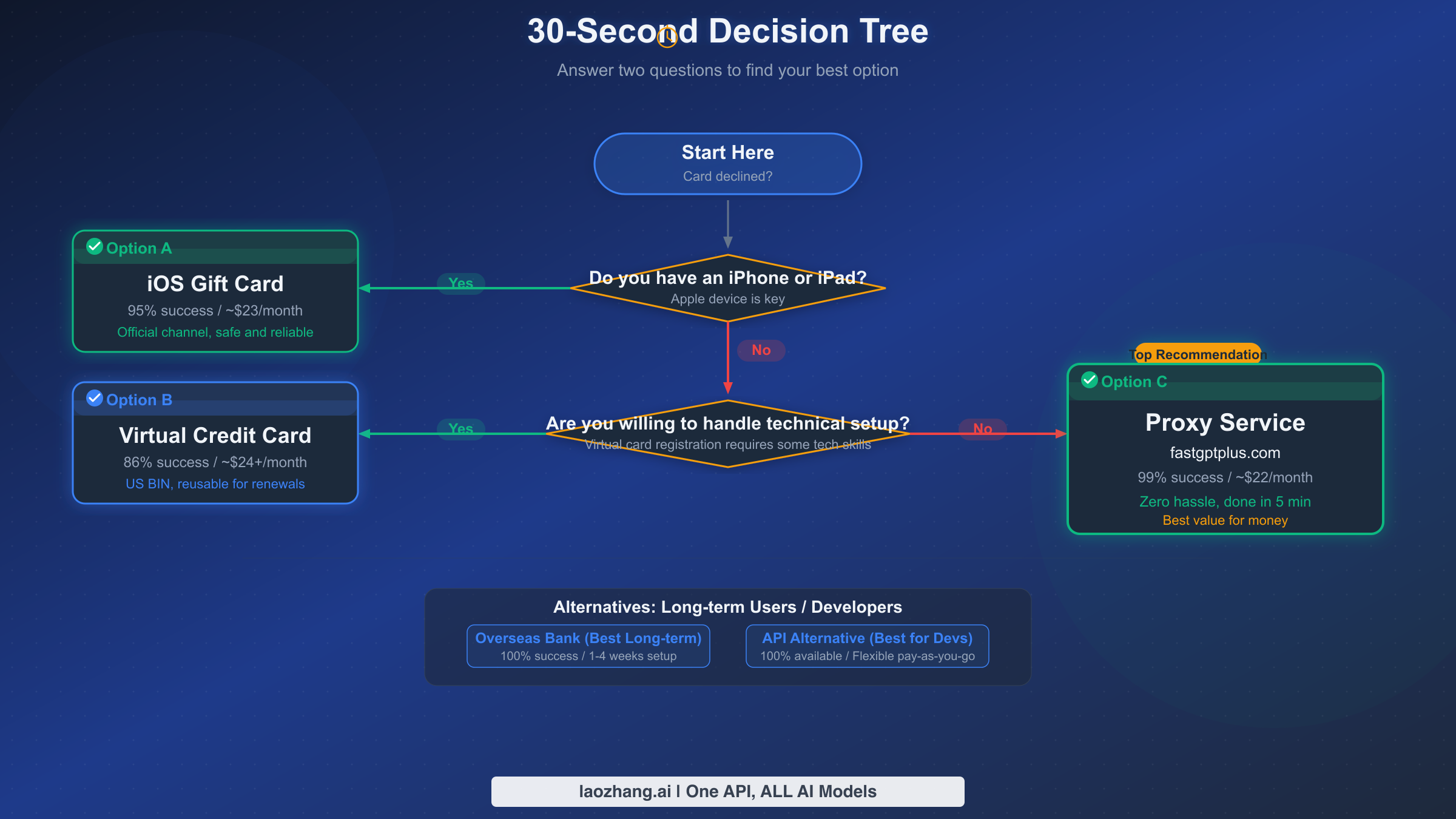
With five solutions to choose from, many people may feel overwhelmed. In reality, you only need to answer a few simple questions to quickly identify the best option for you. Below is the decision logic we've compiled based on feedback from hundreds of Hong Kong users, helping you make a choice in 30 seconds.
If you're an iPhone or iPad user, the iOS US gift card subscription is the most recommended solution. The process is well-established with plenty of detailed tutorials available online, the success rate is approximately 95%, and the monthly cost of ¥165-175 is within an acceptable range. The only thing to remember is to purchase and redeem gift cards in time each month to avoid subscription interruption due to insufficient balance. If you already have a US Apple ID, the entire process can even be completed in 5 minutes.
If you're an Android user or primarily use a computer, you'll need to choose between virtual credit cards and proxy services. If you have some technical background and are willing to spend 30-60 minutes completing the virtual card registration and setup process — and don't mind maintaining a virtual card account going forward — then a virtual credit card is a flexible choice. Once set up, renewals are very convenient. But if you simply don't want to deal with any hassle and just want the fastest way to activate ChatGPT Plus, then proxy services are unquestionably the best option. Through platforms like fastgptplus.com, you just select a subscription plan, pay via Alipay or TG Pay, and you'll have a fully independent ChatGPT Plus account in about 5 minutes. The monthly price of ¥158 is also the most cost-effective among all solutions.
If you already have an overseas bank account (US, Singapore, UK, etc.), the answer is simple — just pay directly with your overseas credit card. This is the lowest-cost, best-experience option, bar none. However, we don't recommend opening an overseas bank account specifically to subscribe to ChatGPT Plus — the time and effort investment is completely disproportionate.
If you're a developer and primarily need the ability to call GPT models in code, without heavily relying on ChatGPT's graphical interface, then the API alternative is worth serious consideration. The pay-per-use model means you can precisely control costs, and for low-usage scenarios, it may be more economical than a fixed $20/month subscription. The API approach also provides greater flexibility and programmability.
Overall, for most Hong Kong users, our recommendation priority is: iPhone users go with iOS gift cards > those wanting hassle-free setup go with proxy services > those with technical skills go with virtual credit cards > those with overseas accounts use them directly > developers consider the API.
Post-Upgrade Tips and FAQ
Successfully upgrading to ChatGPT Plus is just the first step — ongoing usage and maintenance are equally important. Many users overlook key details after subscribing, leading to unexpected subscription interruptions or account issues. Below are important tips and frequently asked questions compiled from extensive user feedback.
Regarding Renewal: ChatGPT Plus subscriptions auto-renew monthly, but the renewal payment method depends on your initial subscription channel. If you subscribed via iOS gift card, ensure your App Store account has sufficient balance (at least $20 USD) before each monthly renewal date. We recommend setting a calendar reminder 2-3 days in advance to purchase and redeem gift cards. If insufficient balance causes a renewal failure, Apple typically retries the charge over the following days, but if it fails multiple times in a row, your subscription will be canceled. Users who subscribed with virtual credit cards likewise need to ensure sufficient card balance. Proxy service users simply follow the service provider's renewal process, which usually includes expiration reminders.
Regarding Account Security: ChatGPT Plus accounts subscribed through legitimate channels will not be banned under normal usage. OpenAI's ban policy primarily targets violations of terms of use (such as generating harmful content or large-scale automated abuse), not payment methods. However, keep a few things in mind: avoid frequently changing the geographic location of your login IP address (e.g., logging in from a US IP today and a Japanese IP tomorrow), as this may trigger OpenAI's security review; don't share your account credentials with others, as shared accounts violate terms of use; and use a strong password with two-factor authentication (2FA) enabled to protect your account.
Regarding Cancellation: If you want to cancel your ChatGPT Plus subscription, the process depends on your subscription channel. Users who subscribed directly through the web (using overseas or virtual credit cards) can find the cancellation option in ChatGPT's web Settings > Subscription. Users who subscribed through the iOS App Store need to manage and cancel through iPhone's Settings > Apple ID > Subscriptions. After cancellation, you can still use Plus features until the end of the current billing cycle. Note that canceling your subscription does not delete your ChatGPT account — you simply revert to the free tier.
"I could pay with my HK card before — why not now?" This is a very common question. If you did successfully subscribe to ChatGPT Plus with a Hong Kong credit card before, it was most likely completed before Stripe updated its BIN filtering rules. Stripe's BIN database is periodically updated, and OpenAI has been progressively tightening regional restrictions. There were several large-scale BIN database updates in the second half of 2024 and early 2025, causing many Hong Kong bank cards that previously worked to be added to the block list. Additionally, even if an old subscription is still auto-renewing, if a card expires and is reissued, the new card's BIN may also be filtered.
"Can a VPN solve the payment problem?" No. As explained earlier, the root cause of payment failure is BIN filtering, which is based on hard-coded information in the card number itself and has nothing to do with your network environment. Using a US-based VPN only solves the problem of "accessing the ChatGPT website" — it cannot solve the "payment declined" problem. In fact, using a VPN may actually increase the risk of triggering the third layer of filtering (IP address and card issuing location mismatch).
"Are proxy services safe? Will my account get banned?" Choosing a legitimate proxy service is safe — the key is confirming the provider offers "independent accounts" rather than "shared accounts." An independent account means the account belongs entirely to you, with only you using it, and the provider only handles the payment step. This model is essentially no different from subscribing with your own overseas credit card, and OpenAI cannot and does not distinguish between the two. However, "shared accounts" or "co-tenant accounts" where multiple users share a single Plus account not only violate OpenAI's terms of use but also pose privacy risks with chat history being visible to others — these should be firmly avoided.
Is ChatGPT Plus Worth Upgrading: A Complete Look at GPT-5.2 Features
After solving the "how to upgrade" question, many users also ask a more fundamental one: "Is ChatGPT Plus really worth the monthly expense?" The answer has gained new dimensions since the release of GPT-5.2. Let's objectively analyze the actual value of a Plus subscription.
OpenAI's GPT-5.2, released in early 2026, comes in three differently positioned versions: Instant (fast response), Thinking (deep reasoning), and Pro (professional) (openai.com/chatgpt/pricing, verified 2026-02-12). Free users can access a basic version of GPT-5.2 Instant, but with significant limitations on usage, response speed, and feature access. Plus users (US$20/month) get significantly higher message quotas, priority access, faster response speeds, and exclusive features including advanced data analysis, DALL-E image generation, and the GPT Store. The top-tier ChatGPT Pro (US$200/month) provides unlimited GPT-5.2 Pro access and the highest priority. For a detailed comparison of Plus versus free performance differences, check out ChatGPT Plus vs Free: Speed and Quota Comparison with GPT-5.2.
From a practical usage perspective, the user groups who benefit most from a Plus subscription include: professionals who use ChatGPT heavily every day (writers, programmers, researchers), users who frequently need to handle complex analytical tasks, and freelancers who rely on ChatGPT for content creation or code development. For these users, the efficiency gains from Plus far outweigh the $20 monthly cost. Take a freelance writer as an example: Plus's advanced features can save 1-2 hours of work time per day, and at an hourly rate, one day's time savings already exceeds a full month's subscription fee.
Conversely, if you only occasionally use ChatGPT for simple Q&A, translation, or casual conversation, the free tier may already be sufficient. The basic version of GPT-5.2 Instant performs quite well for light daily use, and there's no need to pay monthly for occasional usage scenarios. Additionally, if your primary need is API calls rather than interactive conversations, pay-per-use API plans may be more economical than a Plus subscription.
A useful rule of thumb: if you use ChatGPT more than 30 minutes per day and frequently hit the free tier's message quota limits or experience slow response speeds, then a Plus subscription is almost certainly worth it. If your usage falls below this threshold, you can continue with the free version and consider upgrading when your needs grow.
Summary and Action Steps
Hong Kong credit cards being unable to directly upgrade to ChatGPT Plus is a systematic issue caused by Stripe's BIN filtering mechanism — it's not a problem with your personal actions, nor can it be solved by switching VPNs or changing addresses. Once you understand this technical reality, choosing the right alternative solution is the key to resolving the issue.
If you want to take action right now, we recommend following these three steps: First, based on your device situation and personal preferences, choose the solution that best fits you from the five options (iPhone users should go with iOS gift cards; those seeking convenience should go with proxy services). Second, follow the corresponding solution's process to complete your ChatGPT Plus subscription upgrade. Third, set up renewal reminders to ensure your monthly subscription isn't interrupted.
ChatGPT Plus powered by GPT-5.2 is one of the most powerful general-purpose AI models available today, and for heavy users, the efficiency returns from a US$20 monthly investment are substantial. Don't let payment barriers stop you from using better tools — every problem has a solution, and you've just found the most comprehensive guide.